
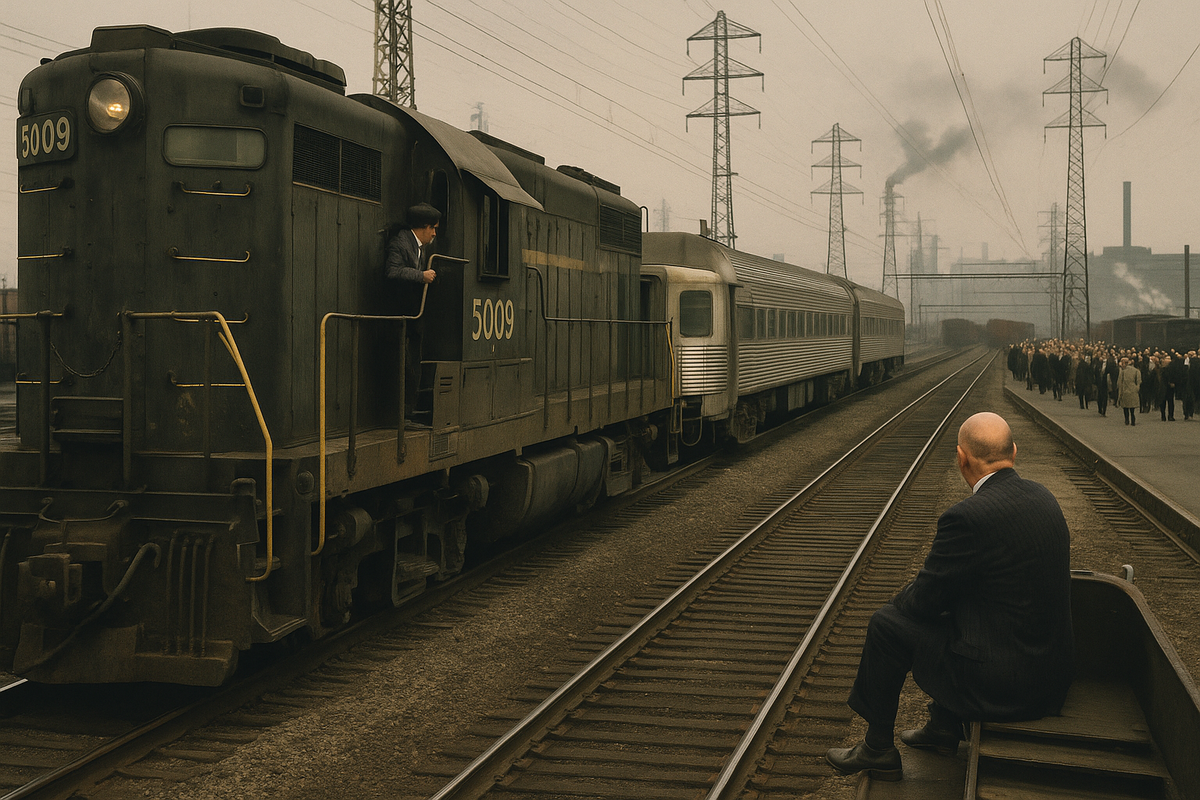
The $5 Billion Gamble: When America's Mightiest Railroads Merged—and Why It Mattered
How the January 26, 1968 issue of Time Magazine captured the Penn Central merger at its moment of triumph—twenty-nine months before the largest corporate collapse in American history
On January 26, 1968, Time Magazine chronicled what seemed like a triumph. Two titans of American industry—the Pennsylvania Railroad and the New York Central Railroad—had consummated the largest railroad merger in history. Penn Central Transportation Company now commanded 40,000 miles of track, moved 1.5 million passengers daily, and controlled assets exceeding $5 billion. It was the biggest corporation in the United States.
Twenty-nine months later, it collapsed.
The January 26, 1968 issue of Time didn't predict the catastrophe. It couldn't. But it captured something more valuable: the precise moment when American industry believed that scale alone could rescue legacy systems from obsolescence. For collectors and historians today, this issue stands as a time capsule of corporate hubris, technological anxiety, and the final chapter of America's railroad age.
Archive Intelligence
Publication: Time Magazine
Issue Date: January 26, 1968
Historical Subjects: Stuart Saunders (Pennsylvania Railroad), Alfred Perlman (New York Central Railroad)
Corporate Event: Penn Central Transportation Company merger (largest railroad in American history)
Subsequent Crisis: Bankruptcy filed June 1970 (largest corporate failure in U.S. history at the time)
The Context: An Industry in Twilight
By 1968, the romance of rail had died. Passenger numbers were hemorrhaging as Americans migrated to jets and interstate highways. Freight remained profitable, but trucks and cargo planes were devouring market share. The Pennsylvania Railroad—"the Pennsy," once the world's most powerful transportation company—and the New York Central Railroad faced a brutal calculus: merge or perish.
Their solution was consolidation on an unprecedented scale. Penn Central would operate more than 230,000 freight cars, serve the industrial corridor from Boston to St. Louis, and theoretically achieve the cost efficiencies that neither railroad could capture alone. Time's coverage reflected the prevailing optimism: bigness was the answer. Streamlined operations, economies of scale, modern management—these would reverse decades of decline.
The article didn't dwell on warning signs. It couldn't know that incompatible computer systems, clashing corporate cultures, and mounting debt would trigger the largest bankruptcy in American history by June 1970. But the seeds were there, visible only in retrospect.
Time's Editorial Architecture: Making Boardrooms Readable
Time Magazine in 1968 wielded a unique editorial power. It didn't just report business news—it framed how middle-class Americans understood the forces reshaping their lives. The Penn Central coverage demonstrated this mastery.
The magazine profiled executives like Stuart Saunders and Alfred Perlman not as faceless bureaucrats but as industrial generals waging a campaign against modernity itself. Maps illustrated the wave of railroad mergers that had redrawn the nation's transportation infrastructure since 1962. Photographs—a turbine-powered high-speed train tested on Pennsy tracks, commuters waiting at Connecticut stations—grounded abstract corporate strategy in tangible human experience.
Time's visual storytelling transformed a merger announcement into cultural narrative. Readers saw the sleek turbines as symbols of hope, proof that railroads could evolve to compete with airlines. They saw the Connecticut commuters as evidence that rail still mattered to American life. The message was clear: this merger wasn't just about two companies. It was about whether traditional industries could survive technological disruption.
That editorial synthesis—blending economic analysis, human-interest photography, and cultural commentary—made Time indispensable in the pre-digital era. No competitor matched its ability to make corporate boardroom decisions feel urgent to suburban families.
The Symbolism of Modernity vs. the Reality of Decline
The article celebrated innovation. It highlighted turbine-powered trains that promised to close the speed gap with airlines. It touted computer systems that would optimize freight routing. It presented Penn Central as evidence that American ingenuity could adapt even the most entrenched industries.
History reveals a different story. The turbine trains never achieved commercial viability. The computer systems from the two railroads proved incompatible, creating operational chaos. The merger didn't streamline operations—it paralyzed them. By 1970, Penn Central was losing $1 million per day.
But in January 1968, those failures lay hidden. Time captured the optimism of a moment when corporate America still believed that sheer scale and technological investment could overcome structural obsolescence. That faith—and its betrayal—gives this issue its historical weight.
Key Themes in Time's Coverage
Corporate Marriage of Giants
Time framed the merger as a union promising economies of scale, streamlined operations, and cost-cutting that would rescue American railroads from decline.
Symbols of the Future
The article showcased turbine-powered trains and modern technology as proof that railroads could adapt to compete with airlines and highways.
Economic Stakes
With combined assets exceeding $5 billion, Penn Central became the largest corporation in the United States—bigness itself positioned as a survival strategy.
Hidden Fractures
While Time captured optimism, incompatible systems and clashing cultures were already undermining the merger's foundation.
The Authenticity Factor: Why Original Matters
Collectors understand a fundamental truth: digital archives cannot replicate the experience of holding an original magazine. The paper stock, the print quality, the smell and texture—these carry authenticity that no PDF can match. More importantly, the original contains elements that digitization often loses: full-page advertisements, subscription cards, the specific layout and pacing that editors crafted.
This issue of Time isn't just a business article. It's a complete artifact of January 1968—the exact stories, images, and advertisements that Americans encountered that week. For anyone studying corporate history, transportation policy, or the cultural anxieties of the late 1960s, the original magazine offers immersive context that excerpts cannot provide.
Why This Issue Matters to Collectors
Historical Inflection Point
Penn Central's creation marked the climax of American railroad consolidation and the beginning of its spectacular collapse. Few corporate events of the 20th century carried such immediate and lasting consequences for American infrastructure, labor, and government policy. The bankruptcy would eventually lead to Conrail, Amtrak, and federal intervention in rail transportation—a chain of events that began with this merger.
Dramatic Irony
Reading Time's optimistic coverage with knowledge of the impending disaster creates a unique historical tension. The magazine captured ambition at its peak, unaware that the entire structure would crumble within two years. This makes the issue a case study in the limits of corporate journalism and the dangers of conventional wisdom.
Cultural Artifact
Beyond the Penn Central story, the issue preserves the texture of 1968 America. The advertisements—for automobiles, airlines, typewriters, consumer electronics—offer a parallel narrative of American prosperity and technological confidence. The typography, the black-and-white photography, the editorial tone all reflect a specific media moment that can't be replicated digitally.
Market Rarity
Business-themed Time covers that document major corporate failures attract sustained collector interest. The Penn Central merger and collapse remains one of the most studied business disasters in American history, ensuring ongoing demand for primary source material.
The January 26, 1968 issue of Time Magazine stands as more than historical documentation. It's evidence of a specific kind of faith—the belief that American industrial might could adapt to any challenge through consolidation and technological investment. Penn Central tested that faith and found it wanting.
For collectors, the issue represents a rare convergence: a major business story, captured by America's most influential newsweekly, at a moment of maximum dramatic irony. To own it is to preserve not just news, but narrative—the story of how American capitalism understood itself in 1968, and how spectacularly that understanding would fail.
The magazine remains a testament to ambition, miscalculation, and the forces that reshape nations. For those who recognize its significance, it's an essential piece of 20th-century American history.
Explore the Complete Archive
Discover thousands of original Time magazines spanning the 1920s through the 1970s. Whether you're building a research archive, honoring family history, or preserving cultural memory, these magazines are living documents—not souvenirs, but primary sources that capture history as it unfolded.
Browse Time Magazine Collection