
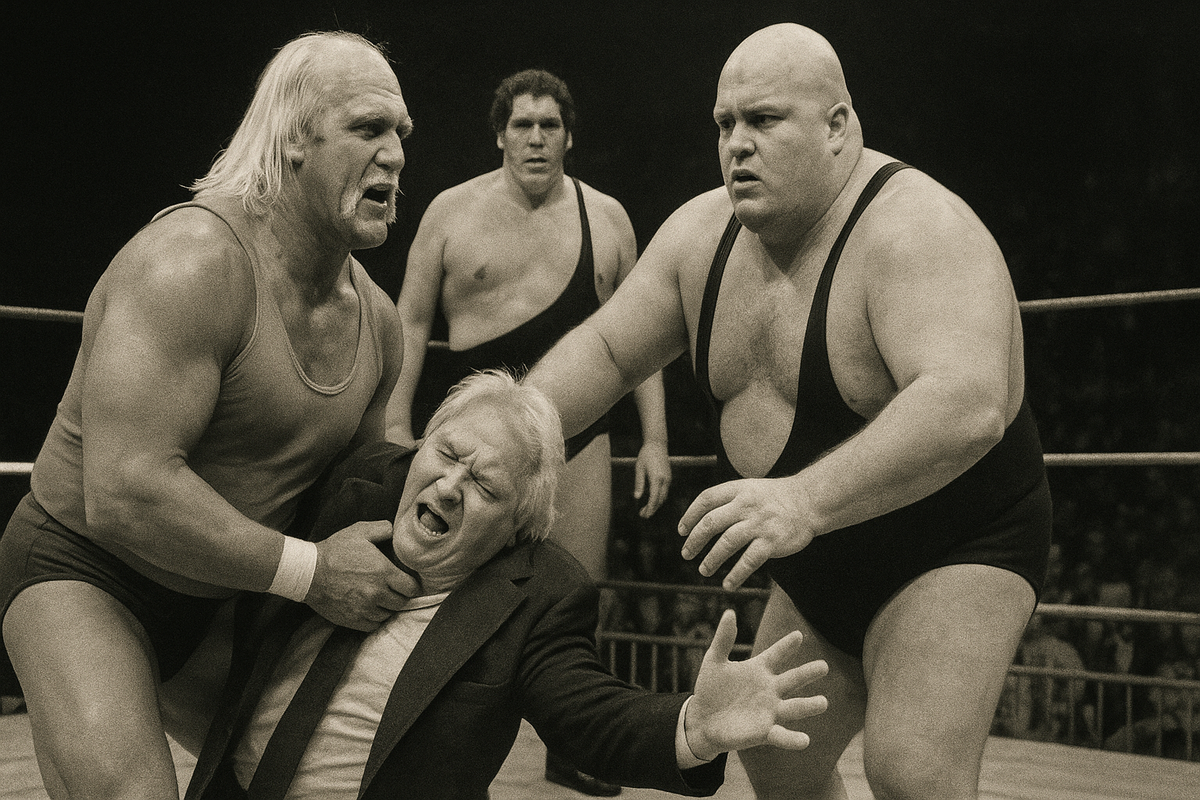
The Night Hulk Hogan Bodyslammed Bobby Heenan—And WWF Magazine Immortalized the Chaos
How the February 1988 issue captured wrestling's most brutal three-on-one ambush and turned Saturday night television into mythology
February 1988. NBC's Saturday Night's Main Event. Hulk Hogan defending his championship against the 460-pound King Kong Bundy while Andre the Giant lurked at ringside and Bobby "The Brain" Heenan schemed from the apron.
It wasn't a wrestling match. It was a three-on-one ambush—and WWF Magazine's February 1988 issue captured every brutal second.
When fans cracked open that issue, they found "Battle of the Titans: Bundy Beats Hogan with lots of help from Heenan"—a feature that read less like sports coverage and more like war correspondence. The magazine didn't just report what happened. It mythologized it. Every splash, every interference, every desperate comeback was frozen in full-color photography and breathless prose, turning a Saturday night television spectacle into wrestling scripture.
For anyone who lived through the golden age of 1980s WWF, this issue isn't nostalgia. It's evidence.
Archive Details
Featured Wrestlers: Hulk Hogan, King Kong Bundy, Andre the Giant, Bobby "The Brain" Heenan
Issue Date: February 1988
Event Coverage: Saturday Night's Main Event, NBC
Archive Source: WWF Magazine
Historical Context: Published between WrestleMania III and WrestleMania IV, peak Hulkamania era
The Winter Wrestling Turned Operatic
By late 1987, Hulk Hogan had carried the WWF Championship for years, transforming from wrestler to cultural phenomenon. His face sold lunchboxes. His catchphrases saturated playgrounds. Vince McMahon had successfully weaponized Hulkamania into mainstream American consciousness, and now he needed monsters big enough to make Hogan's dominance feel precarious.
Enter King Kong Bundy. Over 450 pounds of crushing weight. Fresh off his infamous steel cage war with Hogan at WrestleMania 2, Bundy returned to the main event spotlight as the immovable object designed to flatten wrestling's unstoppable force.
But the real threat wasn't just Bundy's size. It was Andre the Giant's betrayal. Months earlier, Hogan had body-slammed Andre in front of 93,000 fans at WrestleMania III—the most iconic moment in wrestling history. By winter, Andre had aligned with Bobby Heenan, ensuring that Hogan's title defenses would never be clean again.
This was the powder keg when WWF Magazine hit newsstands in February 1988: Hogan vulnerable, Bundy hungry, Andre vengeful, and Heenan orchestrating chaos from ringside.
Inside the Magazine's Battle Report
WWF Magazine didn't summarize the match. It dramatized it.
Hogan's Caution: From the opening bell, the champion circled Bundy warily, aware that one miscalculation could end his reign under 460 pounds of avalanche force.
Bundy's Dominance: The article cataloged every splash, every corner crush, every near-fall where Bundy's sheer mass nearly finished Hogan. The magazine's language emphasized the physics of the mismatch—this wasn't just a big man, this was gravitational force made flesh.
Andre's Shadow: At a critical moment, Andre reached through the ropes and yanked Hogan's ankle, dragging the champion down and nearly costing him everything. Even when officials banished Andre from ringside, his presence poisoned the match.
Heenan's Miscalculation: The sequence that defined the night came when Bobby Heenan—confident in his safety outside the ring—grabbed Hogan's leg once too often. Hogan's retaliation was swift and spectacular: he hauled the Brain into the ring and physically slammed him, sending Heenan to a neck brace and giving fans the cathartic payoff they craved.
Hulkamania's Roar: The magazine captured how the live crowd became Hogan's co-conspirator, their energy fueling every comeback, every elbow drop, every impossible rally against Bundy's overwhelming size.
This wasn't journalism. It was mythology in real time.
Photography as Historical Evidence
WWF Magazine's visual storytelling elevated the feature beyond text.
One spread freezes Bundy mid-splash—460 pounds of wrestler collapsing onto Hogan's chest, the champion's face twisted in agony.
Another captures Hogan's counterattack—sweat-soaked, muscle-straining, the crowd behind him rising as one organism.
The most striking image shows Hogan hoisting Bobby Heenan overhead, the Brain's legs kicking helplessly, Hogan's face locked in righteous fury. It's the money shot of the entire saga—the manager who thought himself untouchable learning otherwise.
These weren't candid snapshots. They were carefully composed tableaux designed to make Saturday night television feel Shakespearean. WWF Magazine functioned as the company's official historian, using kayfabe narration and dramatic photography to transform matches into legends. Unlike independent wrestling publications that questioned or analyzed, WWF Magazine believed—and that conviction made every page feel essential.
Why This Issue Endures
Historic Timing
Published as Hogan's feud with Andre intensified, just weeks before their WrestleMania IV tournament collision that would redefine both careers.
Final Chapter Energy
One of the last major installments in the Hogan-Bundy rivalry, a feud that had defined WWF's heavyweight division since WrestleMania 2.
Peak Hulkamania
Issued at the absolute zenith of wrestling's crossover into mainstream culture, when Saturday Night's Main Event commanded prime NBC real estate.
Archival Photography
Full-color action shots that remain among the most reproduced images of 1980s wrestling—particularly Hogan's revenge on Heenan.
This issue isn't just collectible. It's a primary source.
The Magazine as Time Machine
WWF magazines endure because they solve a problem digital media never will: permanence.
These weren't disposable updates. They were glossy, substantial artifacts fans could hold, re-read, and preserve. Each issue functioned as both chronicle and keepsake—evidence that these larger-than-life personalities and their feuds actually existed. In an era before instant replay, social media, or on-demand video, WWF Magazine was how fans relived their favorite moments and kept storylines alive between television broadcasts.
The February 1988 issue captures wrestling at its commercial and creative peak: when matches aired on network television, when characters felt mythic rather than ironic, when a bodyslam could become a cultural moment.
For fans who remember Hulkamania as a lived experience—or for collectors who study the 1980s as wrestling's artistic high-water mark—this issue remains indispensable.
Collector Significance
Historic Timing
Released just as Hogan's feud with Andre was intensifying—and before their epic WrestleMania IV clash.
Iconic Rivalry
Features one of the last major chapters in the Hogan vs. Bundy saga.
Classic Photography
Full-color action shots of Hogan, Bundy, and Heenan that remain among the most memorable magazine spreads of the 1980s.
Cultural Significance
A true artifact of the Hulkamania era, when wrestling crossed into Saturday night television and mainstream American culture.
Original WWF magazines trace the entire arc of professional wrestling's golden age. From the early Hulkamania years through the rise of The Undertaker, Shawn Michaels, and the Attitude Era, these issues document storylines, personalities, and cultural moments that defined multiple generations of fans.
Explore the Collection
Whether you're a lifelong fan, a cultural historian, or someone preserving wrestling's analog era, these magazines offer something no digital archive can replicate: the experience of holding history as it was first written.
Browse WWF Magazine CollectionFinal Bell
The February 1988 issue of WWF Magazine stands as one of the most significant artifacts from wrestling's mainstream explosion. Its coverage of Hulk Hogan vs. King Kong Bundy—complete with Andre the Giant's interference and Bobby Heenan's painful education—captured the drama, spectacle, and emotional stakes that made professional wrestling compulsory viewing.
To hold this issue is to hold proof that WWF matches weren't just athletic exhibitions. They were serialized mythology, performed live and preserved in print for fans who needed evidence that these impossible nights actually happened.
More than 35 years later, the magazine's storytelling and photography remain as vivid as the night Hogan bodyslammed the Brain and proved that even schemers pay a price for interfering with Hulkamania.
This isn't just a magazine. It's a monument.