
The Night Hulk Hogan Bled in Japan
Inside Wrestling's Lost Chronicle of Survival, August 1990
August 1990. Hulk Hogan had just lost the WWF World Title—the belt that had defined him, the symbol that made him invincible. Days later, he stepped off a plane in Japan to face Stan Hansen, the cowbell-swinging brawler who had once broken Bruno Sammartino's neck.
No script could save him here. No "Hulking up" for the cameras. This was survival.
When Eddie Ellner's Insider column hit newsstands in the August 1990 issue of Inside Wrestling, American fans were given a rare glimpse of their hero stripped of his armor—sweat-drenched, bloodied, clinging to the ropes in a match that existed outside the sanitized boundaries of Vince McMahon's empire. This wasn't WrestleMania. This was warfare.
And the magazine didn't just report it. It felt it.
Archive Details
Featured Wrestlers: Hulk Hogan, Stan Hansen
Publication: Inside Wrestling, August 1990
Writer: Eddie Ellner (Insider Column)
Historic Event: First co-promoted card between New Japan Pro Wrestling, All Japan Pro Wrestling, and WWF
Original Opponent: Terry Gordy (replaced by Stan Hansen)
When Empires Collided: The First Co-Promoted Card
The match itself was secondary to the event's sheer impossibility. For the first time in wrestling history, New Japan Pro Wrestling, All Japan Pro Wrestling, and the WWF joined forces for a single card. In 1990, this was geopolitical theater. Promotions hoarded their stars like Cold War superpowers guarded nuclear codes. Territory wars had defined wrestling for decades. Cooperation was heresy.
But there stood Hogan—freshly dethroned, globally famous, and suddenly available—as the glue holding this fragile alliance together.
The buildup was chaos. Terry Gordy was the original opponent, but when he withdrew, speculation ran wild. Would Shohei "Giant" Baba, the towering legend, step in? Could Genichiro Tenryu—widely regarded as the world's best wrestler—abandon his scheduled match to face Hogan? Would Randy Savage ambush the Hulkster in some worked-shoot fever dream?
The answer was somehow more terrifying: Stan Hansen.
The Man Who Broke Bruno's Neck
Hansen wasn't a wrestler. He was a natural disaster with a cowbell.
A former AWA World Champion, Hansen had built his legend in Japan by treating every match like a bar fight. Stiff strikes. No choreography. Pure, unfiltered violence. American fans knew him as the man who had shattered Bruno Sammartino's neck in a botched bodyslam—a reputation that followed him like a ghost. Inside Wrestling called him "arguably the wildest brawler to ever lace up a pair of boots," and no one in 1990 would have argued otherwise.
For Hogan, this was a different kind of test. In the WWF, he played Superman. In Japan, against Hansen, he would have to be human.
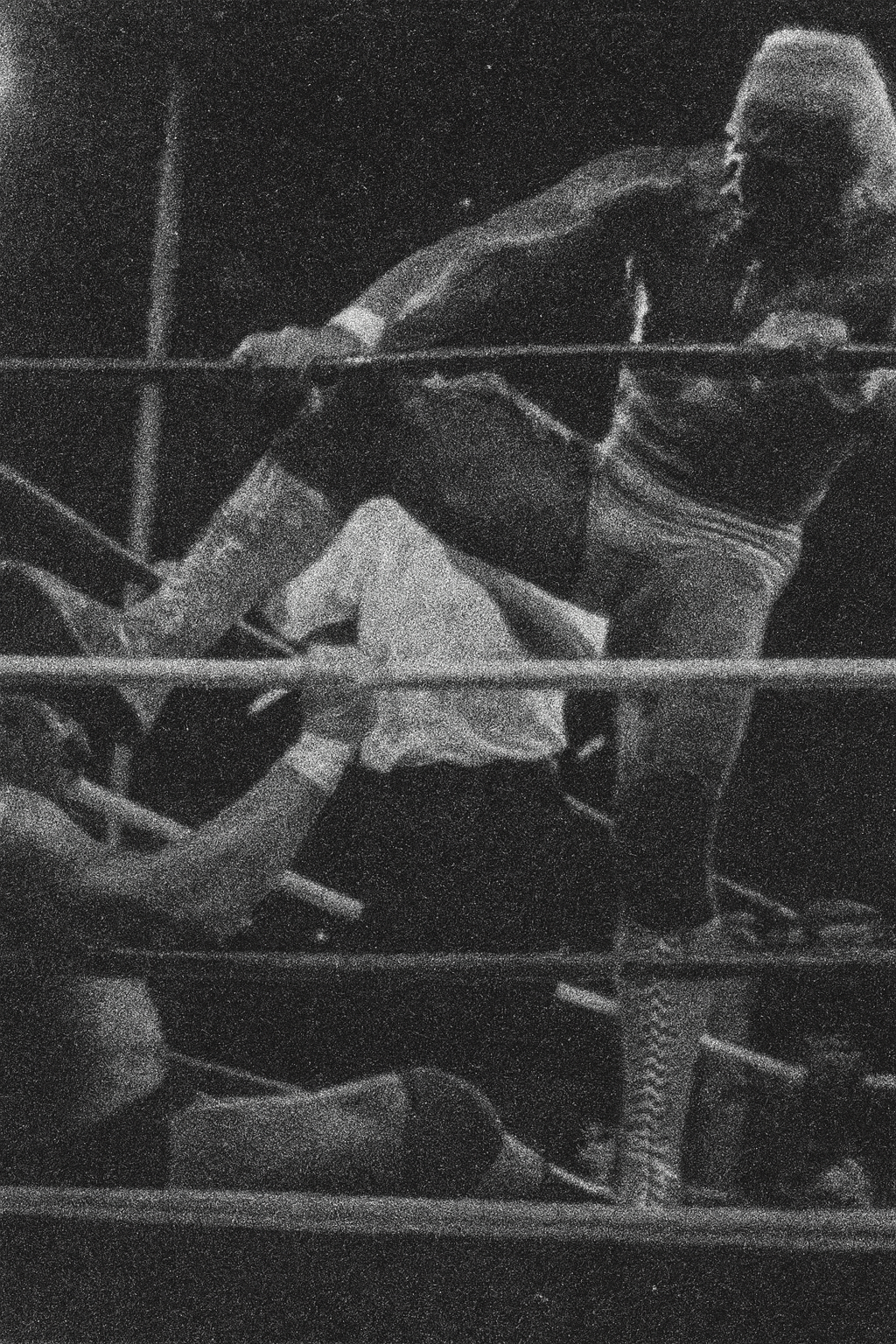
The magazine captured that vulnerability in a single photograph: Hogan, drenched in sweat, face contorted in exhaustion, gripping the ropes like a drowning man clutching driftwood. The caption drove the point home: "Days after losing the WWF World title, Hulk Hogan went to Japan and wrestled Stan Hansen, one of that country's most loved American wrestlers."
One of the most loved. Not by Americans—by the Japanese, who revered Hansen's brutality the way New Yorkers once revered Joe Louis.
Pulp Storytelling at Its Finest
Eddie Ellner didn't write wrestling journalism. He wrote combat literature.
His prose in the Insider column was pure Inside Wrestling—half sportswriting, half dime-store novel, unapologetically dramatic. Hansen "raised a cowbell" and crushed Hogan with it. Both men "bled profusely." Both were "crushed like tomatoes." And then, in a sentence that could only exist in 1990, Ellner compared Hansen's assault to his wife Emma crushing tomatoes for homemade chili.
It was absurd. It was vivid. It was perfect.
This is why wrestling magazines mattered. They didn't just document matches—they mythologized them. They turned a foreign bout into an epic that American fans could replay in their heads, even if they never saw a single frame of footage. The magazine became the match. The words became the memory.
And Ellner understood that Hogan, without his title, had something to prove. "Without the weight of his title belt," the column noted, "[he] had never wrestled better."
That detail—the idea that losing made Hogan better—was the story beneath the story. Not invincibility, but resilience. Not the superhero, but the fighter.
Deep Dive: Key Moments from the Column
First co-promoted card between New Japan, All Japan, and WWF—a moment of unprecedented cooperation in wrestling's territorial era.
Early rumors included Shohei Baba, Genichiro Tenryu, and even Randy Savage before Hansen was announced.
Hansen replaced Terry Gordy, delivering the dream brawl fans didn't know they needed.
Ex-AWA World Champion, breaker of Bruno Sammartino's neck, feared worldwide for his stiff, uncompromising style.
Coming off his WWF title loss, Hogan was described as wrestling "better than ever"—vulnerability as strength.
Hansen's cowbell attack, Hogan's bleeding, and nonstop punishment—a test of survival, not spectacle.
Ellner's comparison to Emma Hansen crushing tomatoes for chili—pulp storytelling at its most surreal.
Hogan pictured exhausted in the ropes, showing vulnerability rarely seen in WWF programming.
Caption notes Hansen as "one of that country's most loved American wrestlers"—a testament to his legendary status overseas.
Framed as a fight for survival outside his comfort zone—the invincible hero made mortal.
Why It Still Matters
This feature endures because it captured Hulk Hogan at his most human. In America, he was the red-and-yellow demigod who trained, said his prayers, and ate his vitamins. In Japan, against Stan Hansen, he was a man fighting for his reputation with nothing but his body and his will.
For historians and collectors, this isn't just about a match. It's about wrestling culture at the crossroads of East and West. It's about the moment when the biggest star in the world had to prove he belonged in the ring with the hardest hitter on the planet.
And it's about the magazine that made us feel every bruise.
Why Collectors Prize This Issue
Hogan Outside the Machine
This wasn't a WWF storyline. It was Hogan operating in a foreign system, under foreign rules, against a man who didn't care about protecting the brand. For collectors, that rarity—Hogan vulnerable, Hogan tested—makes this feature irreplaceable.
Stan Hansen's Japanese Legacy
Hansen's career in Japan dwarfed his American profile. This article bridges that gap, connecting U.S. fans to a legend they only half-understood. It's one of the few mainstream American publications to capture why Hansen was revered overseas.
The Historic Cross-Promotion
New Japan, All Japan, and the WWF working together? It never happened again, not like this. The August 1990 issue documents a moment of cooperation in an industry defined by tribalism.
Artifact as Experience
Owning this issue isn't about reading information you can find on Wikipedia. It's about holding the actual pages that fueled schoolyard debates, barbershop arguments, and living room reenactments. It's about touching the medium that was the message in 1990—before the internet, before YouTube, before WWE Network.
Condition matters. Copies without mailing labels, with sharp covers and intact spines, command premium prices. But even worn issues retain their power. They were read. They were lived in. That's part of their history.
Add This to Your Collection
If you collect wrestling history, the August 1990 issue of Inside Wrestling belongs on your shelf. It captures the night Hulk Hogan stepped outside the empire and survived one of the toughest fights of his career.
Browse Inside Wrestling Magazine CollectionFrom the 1970s through the 1990s, these magazines weren't just publications—they were the architecture of fandom. They built the myths we still argue about today. Owning one means preserving that architecture for the next generation.
Because some stories don't just live in the ring. They live in the pages that made us believe.