
When a French Refugee's Feast Landed in America's Living Rooms
How the June 1950 Ladies' Home Journal brought Isak Dinesen's "Babette's Feast" to millions—and changed what we expected from women's magazines
In June 1950, between advertisements for Jell-O molds and articles on how to bleach your husband's shirts whiter, American women discovered something unexpected: a story about grace, hunger, and the transformative power of art that would outlive nearly everything else published that year.
The story was "Babette's Feast" by Isak Dinesen—and it arrived not in a literary quarterly or a university press edition, but in the pages of Ladies' Home Journal, one of the most widely circulated magazines in America. What business did a Danish author's meditation on sacrifice and beauty have in a publication devoted to domestic life? As it turns out, everything.
Archive Details
Author: Isak Dinesen (Karen Blixen)
Publication: Ladies' Home Journal, June 1950
Illustrator: Harry Anderson
Story: "Babette's Feast"
Cultural Impact: Later adapted into Academy Award-winning film (1987)
The Unlikely Marriage of High Literature and Household Advice
When Karen Blixen (writing as Isak Dinesen) published "Babette's Feast" in the June 1950 Ladies' Home Journal, she wasn't slumming. The magazine had already established itself as more than a compendium of recipes and hemline advice. With a circulation in the millions, the Journal functioned as America's cultural ambassador to itself—a bridge between the practical demands of postwar domesticity and the intellectual life women were told they'd left behind at the altar.
The choice to publish Dinesen's work revealed the magazine's ambitions. This was the author of Out of Africa, a writer whose prose carried the weight of European literary tradition. Her appearance in the Journal signaled that American women deserved more than patronizing household tips. They deserved art.
Why 1950? Why This Story?
The timing wasn't accidental. Postwar America was experiencing a peculiar tension: unprecedented prosperity shadowed by spiritual unease. Suburban homes filled with new appliances, but the women inside them were asking harder questions about meaning, purpose, and what had been sacrificed for material comfort.
"Babette's Feast" spoke directly to this anxiety. Set in a remote Norwegian village, the story centers on Babette Hersant, a French refugee who has fled political upheaval in Paris. She arrives as a servant to two elderly sisters whose strict religious sect has renounced earthly pleasures in favor of austere devotion. For years, Babette lives quietly, her past as one of Paris's most celebrated chefs unknown to her hosts.
When she unexpectedly wins a lottery, Babette spends the entire sum preparing an elaborate French feast for the sisters and their congregation. The meal becomes a sacrament—exquisite wine, rare delicacies, artistry on every plate. The rigid sect, bound for years by resentment and joyless piety, experiences a moment of grace. Old grudges dissolve. Beauty transforms them.
The Journal captured this perfectly with its subheading: "Hers was a hunger that had lasted all her life… and was satisfied in a day." The hunger wasn't merely physical—it was spiritual, creative, existential.
For readers navigating their own balance between prosperity and purpose, the resonance was immediate.
Postwar Europe's Pull
Americans were fascinated by stories set in war-torn or politically turbulent regions. Dinesen's Norwegian setting carried the weight of Old World faith and tradition that felt both foreign and profoundly resonant.
Domestic Spirituality
The sisters' strict religious sect renounced earthly pleasures. In the early 1950s, readers navigating their own balance between material prosperity and spiritual life found this tension compelling.
Hidden Artistry
Babette's story is about a woman's concealed genius and self-sacrifice. For Journal readers, this theme reflected both the constraints and possibilities of mid-century womanhood.
Grace Through Beauty
The feast proves that beauty and generosity can transform even the strictest lives—that the sacred and the sensual need not be enemies, a message that resonated across generations.
The Visual Testament: Harry Anderson's Candlelit Tableaux
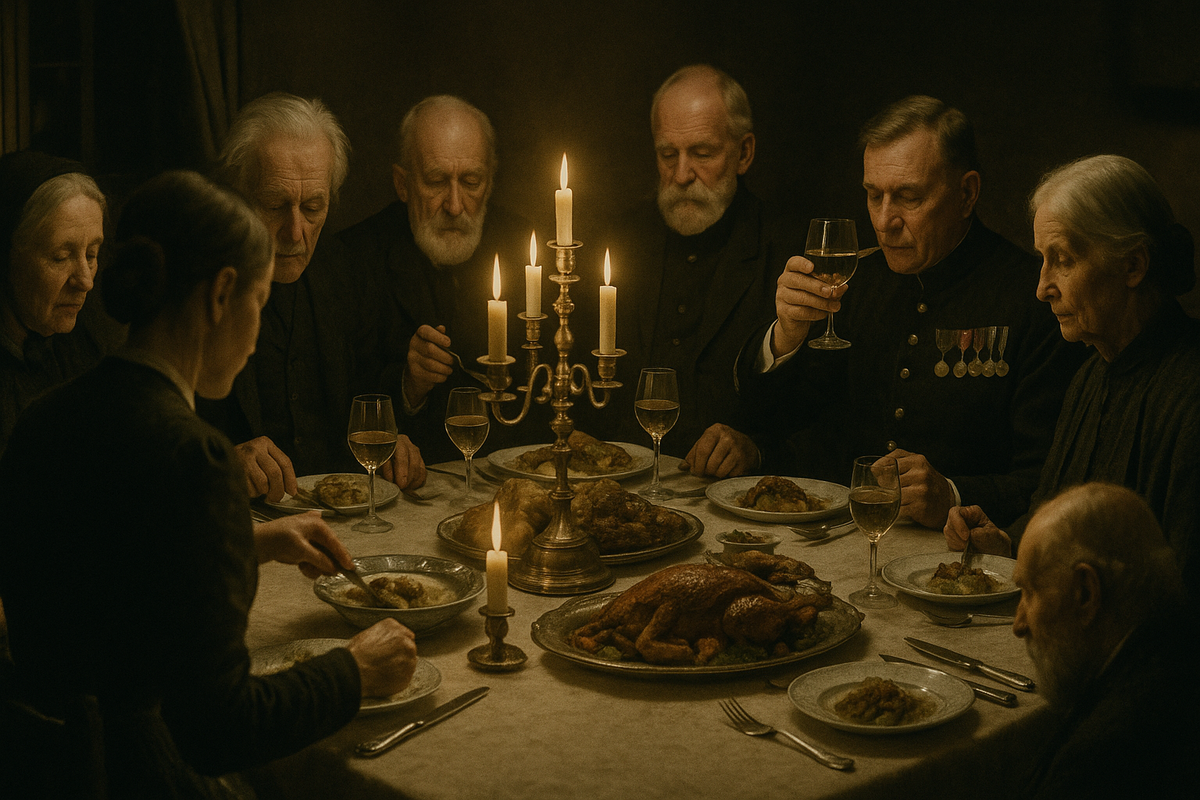
The story didn't stand alone. Harry Anderson's illustrations bathed the pages in amber, gold, and deep brown—colors of warmth and abundance. His images showed elderly faces illuminated by candlelight, wine glasses catching the glow, a general in uniform raising a toast to Babette's hidden genius.
These weren't decorative flourishes. In 1950s magazine culture, visual storytelling carried as much weight as text. Anderson's work amplified the central metaphor: the stark contrast between the sect's self-denial and the feast's opulence. Light against darkness. Grace interrupting austerity.
The illustrations made the story visceral. Readers could see what Babette had created—and understand what the sisters had been denying themselves.
The Radical Act of Placing Literature Beside Recipes
What makes the June 1950 issue so remarkable isn't just that it published Dinesen. It's how seamlessly the Journal placed "Babette's Feast" alongside columns on family budgets, features on summer fashion, and instructions for making casseroles. This wasn't compartmentalization—it was integration.
The magazine's editors understood something crucial: women didn't live segmented lives. They moved between kitchen and culture, between household management and intellectual hunger. The Journal honored both. It refused to patronize.
For many readers, "Babette's Feast" was their first encounter with Dinesen's work. The magazine became a gateway—proof that world literature belonged in American homes, not locked away in academic journals.
The Woman Behind the Pen Name
Isak Dinesen was the pseudonym of Karen Blixen, a Danish baroness whose life contained as much drama as her fiction. She had run a coffee plantation in Kenya, survived syphilis contracted from her unfaithful husband, lost her lover to a plane crash, and returned to Denmark to write. By 1950, she was an established literary figure in Europe, but American audiences knew her primarily through Out of Africa.
"Babette's Feast" revealed a different side of her talent—less concerned with African landscapes than with the interior geography of faith, sacrifice, and redemption. The story's themes of hidden artistry and delayed recognition may have reflected Blixen's own experience as a woman whose genius was often overshadowed by the men in her life.
The Ladies' Home Journal gave her an American platform at precisely the right moment.
What the Story Still Teaches Us
"Babette's Feast" endures because it asks a question every generation must answer: What is the relationship between beauty and goodness? Between art and faith? Between sacrifice and fulfillment?
The sisters' sect believed that renouncing beauty brought them closer to God. Babette's feast proved them wrong—not by rejecting their faith, but by showing them that grace can arrive through pleasure, that the sacred and the sensual need not be enemies.
For readers in 1950—and for readers today—that message carries weight. We are still negotiating the same tensions: between material comfort and spiritual depth, between duty and desire, between what we think we should want and what actually nourishes us.
Why June 1950 Matters to Collectors Today
Literary Significance
This issue introduced "Babette's Feast" to millions of American readers before the story achieved its later fame. When Gabriel Axel adapted it into a film in 1987—winning the Academy Award for Best Foreign Language Film—collectors and literary historians suddenly wanted the source. The June 1950 Journal became that source.
Cultural Documentation
The issue captures a specific moment in American women's history. Here is a publication that took its readers seriously, that believed they could hold both a spatula and an appreciation for European literature. It's a time capsule of aspiration.
Artistic Merit
Harry Anderson's illustrations give the issue visual value beyond the text. For collectors interested in mid-century illustration, this issue offers museum-quality work in a mass-market context.
Rarity and Condition
Most magazine issues from this era were discarded after being read. Those that survived often show heavy wear. Finding a clean copy of June 1950 is increasingly difficult—and correspondingly valuable.
Explore the Collection
If you're drawn to this intersection of literature, women's history, and mid-century culture, the June 1950 Ladies' Home Journal belongs in your collection. It represents a moment when a mass-market magazine trusted its readers with art—and when those readers rose to meet it.
Browse Ladies' Home Journal Magazine CollectionThe Feast That Keeps Giving
The June 1950 Ladies' Home Journal stands as one of the most culturally significant magazine issues of its decade. By publishing "Babette's Feast," the editors gave millions of readers access to a story that transcends its era.
It wasn't just about food. It was about what hunger means when you've been starving yourself. About what happens when grace interrupts duty. About the moment when someone finally recognizes your hidden gifts—and when you recognize that giving them away is the only true fulfillment.
Today, this issue remains what it was in 1950: a testament to the belief that women deserved art alongside their household advice, that beauty matters as much as efficiency, and that sometimes the most nourishing thing you can offer someone is a feast they never knew they needed.