
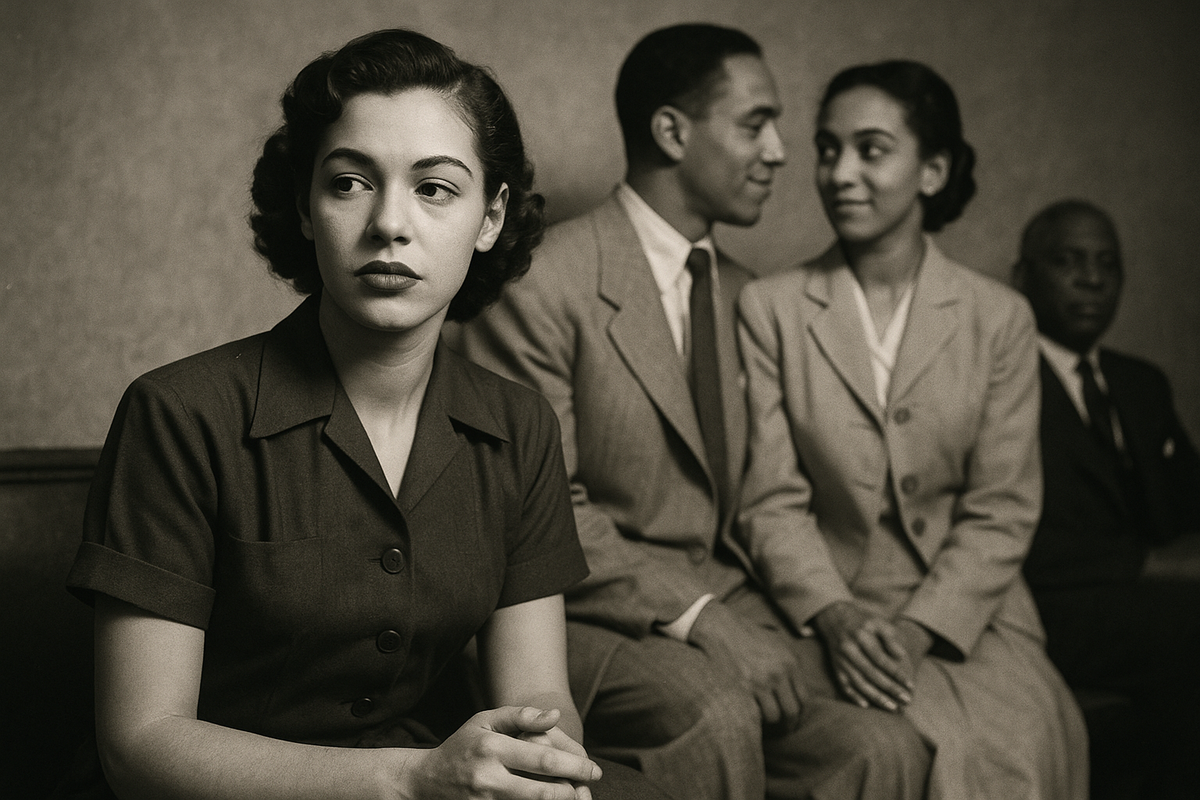
The Last Generation to Disappear
How Jet Magazine Captured Black America's Refusal to Pass
In July 1952, a pocket-sized magazine landed on newsstands with a story its readers had been living in silence for decades. The headline in Jet didn't whisper—it declared: "Why 'Passing' is Passing Out."
For generations, light-skinned African Americans had made an impossible calculus: blend into whiteness to survive, or claim their identity and face systemic exclusion. Some crossed the color line for a job. Others did it to escape violence. A few did it permanently, severing ties with family and community to access a world that would otherwise lock them out. But by the early 1950s, something fundamental had shifted. The survival tactic that once seemed inevitable was losing its grip—not because discrimination had vanished, but because a new generation refused to vanish with it.
Jet wasn't reporting sociology. It was documenting a rupture in Black American identity, a moment when pride began to outweigh pragmatism, and collective resistance replaced individual escape.
Archive Details
Publication: Jet Magazine
Issue Date: July 17, 1952
Featured Article: "Why 'Passing' is Passing Out"
Historical Context: Pre-Brown v. Board era, documenting cultural shift in African American identity politics
Notable Figures: Janice Kingslow, Herb Jeffries, Paul Williams, The Johnston Family
When Passing Was Survival
The context was unforgiving. Jim Crow still governed the South. Housing discrimination strangled the North. Unions barred Black workers. Universities turned away Black students. In this architecture of exclusion, passing wasn't cowardice—it was a rational response to an irrational system.
But rationality has a cost. To pass meant erasing yourself. It meant lying to employers, neighbors, sometimes even spouses. It meant living in fear of exposure, of the moment someone from your old life recognized you on the street. It meant raising children who didn't know their own heritage, building careers on a foundation of silence.
By 1952, fewer people were willing to pay that price.
The Forces That Changed the Equation
Jet identified what was driving the shift, and it wasn't wishful thinking. The ground was moving beneath segregation.
The NAACP and the National Urban League were winning battles. Federal courts were chipping away at restrictive housing covenants. State-level anti-discrimination laws, however weak, were appearing. Urban Black communities were gaining political muscle. And perhaps most critically, a sense of collective identity was hardening—one that rejected the premise that Blackness was something to hide.
The article profiled those who had chosen differently. Actress Janice Kingslow. Singer Herb Jeffries. Architect Paul Williams. All had the complexion to pass. None did. They were successful, visible, and unapologetically Black in a society built to punish that choice.
Then there was the Johnston family of Keene, New Hampshire—the real-life subjects of the film Lost Boundaries. After years of living as white, they publicly identified as Black. Jet reported that their community embraced them. It was a counternarrative to the assumption that passing was the only path to safety, and it landed at exactly the right moment.
What Jet Understood
The magazine's genius wasn't just in covering the story—it was in how it covered it.
Jet mixed personal portraits with family photographs, weaving individual experience into cultural analysis. It didn't treat passing as an abstract debate. It presented it as something its readers knew intimately: a choice their cousins had made, a rumor about the light-skinned family down the block, a tension at holiday dinners.
At a time when mainstream publications ignored or caricatured African American life, Jet documented it with precision and dignity. The July 17, 1952 issue exemplified the magazine's mission: serious journalism, bold design, and a refusal to sanitize the contradictions of Black life in mid-century America.
This was reporting that trusted its audience to handle complexity.
Key Themes in the Article
Generational Shift
Jet reported that younger African Americans were increasingly rejecting passing, choosing instead to embrace their identity despite discrimination.
Role Models Who Refused
Public figures like Herb Jeffries and Janice Kingslow were cited as examples of professionals who chose integrity over assimilation.
Structural Progress
Federal rulings against restrictive covenants, state-level anti-discrimination efforts, and broader civil rights activism were reducing the pressures to cross the color line.
Cultural Pride
The article emphasized a new sense of racial pride—a belief that African Americans had nothing to hide, and that the fight was to change the system, not escape it.
Why This Issue Matters Now
The July 17, 1952 Jet is more than a collectible—it's a historical marker. It captures the moment before the Civil Rights Movement exploded into national consciousness, before Brown v. Board of Education in 1954, before the Montgomery Bus Boycott in 1955. It shows the intellectual and cultural groundwork being laid, the debates happening in barbershops and living rooms, the pride that was building pressure beneath the surface.
These magazines survive because they are time capsules of what mainstream history forgot. They document not just oppression, but strategy. Not just struggle, but style. They show a community that was building culture, politics, and power even when the larger society refused to acknowledge it.
For historians, educators, and families preserving heritage, vintage Jet issues are original documents—unfiltered accounts of how African Americans saw themselves and their world at critical junctures.
They are archives you can hold in your hands.
Collector Significance
A Cultural Turning Point
The documented decline of passing as African Americans embraced identity over assimilation—a pivotal moment in Black American history.
Primary Source Material
Direct voices from actors, singers, and professionals who chose visibility in a hostile society, preserved in their original context.
Pre-Movement Context
Evidence of the ideological shift that made the coming decade of activism possible—the groundwork before the landmark victories.
Start Your Collection
If you value history that doesn't erase complexity, if you want to connect with the lived experience of past generations, vintage Jet magazines belong in your collection.
Browse Jet Magazine CollectionWhether you're a collector, a teacher, or someone honoring your family's story, these magazines are living artifacts—a way to preserve the past and understand how we arrived at the present.
Final Word
The July 17, 1952 Jet caught Black America in transition—moving from survival tactics to collective defiance, from hiding to demanding recognition. It chronicled a generation that refused to disappear, even when disappearing seemed safer.
That refusal changed everything.
And Jet was there to document it, one pocket-sized issue at a time.