
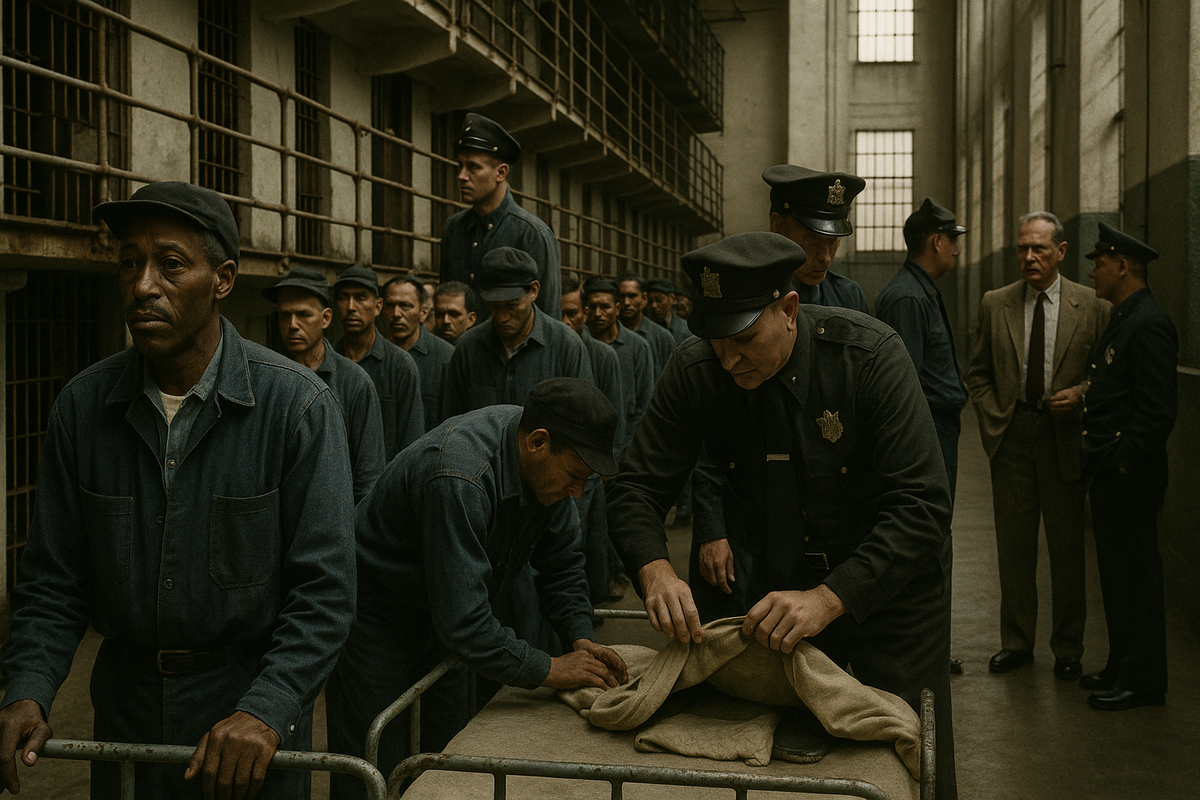
Inside San Quentin's "House of Living Death"
Crime, Counterfeiting, and Overcrowding in 1950 America
On April 1, 1950, millions of Americans opened their mailboxes to find the week's Saturday Evening Post—and on page after page, they discovered something far darker than Norman Rockwell's wholesome covers had prepared them for. Clinton T. Duffy, the warden of San Quentin State Prison, had done the unthinkable: he'd thrown open the gates to California's most feared penitentiary and invited the nation inside.
What readers found there was staggering. Counterfeiting rings operating in plain sight. Six thousand men crammed into a facility built for half that number. Informants marked for death. Escape attempts so brazen they read like pulp fiction—except they were real, documented, and happening behind stone walls just across the bay from San Francisco.
Duffy called his article "San Quentin Is My Home: House of Living Death." He wasn't exaggerating.
Archive Details
Historical Figure: Clinton T. Duffy, Warden of San Quentin State Prison
Issue Date: The Saturday Evening Post, April 1, 1950
Cover Artist: Thornton Utz
Archive Source: Original Magazine Collection
The Powder Keg: Postwar America Confronts Its Prisons
The year 1950 marked an inflection point in American life. World War II's victory parades had faded, suburbs were sprawling outward, and the economy was roaring. But beneath the surface, unease festered. The Cold War had begun. Organized crime dominated headlines. And as Duffy's exposé made brutally clear, the nation's prisons were buckling under the weight of a crime wave that showed no signs of stopping.
San Quentin became the symbol of this reckoning. With over 6,000 inmates—half of them sleeping in basement dormitories never meant for human habitation—the prison was a tinderbox. Duffy didn't mince words: one spark, he warned, and the whole place could explode.
The Saturday Evening Post had given its readers many things over the decades—short fiction by F. Scott Fitzgerald, essays on American values, covers that defined the national imagination. But this was different. This was an admission that postwar prosperity had cast a long, violent shadow.
The Faces Behind the Bars
Duffy structured his narrative around the men who populated San Quentin's tiers, and The Post backed him up with stark photography that left nothing to sentiment.
Albert M. Stewart, "The Squealer," stared out from his mugshot with the hollow eyes of a man who'd traded information for survival—and sent fellow inmates to California's gas chamber in the process. He was, Duffy noted, one of the most hated men in the prison.
Ethan McNabb had nearly pulled off the impossible: disguised in a stolen guard's uniform, he'd walked toward freedom before being captured just short of the gate. His story wasn't just about desperation—it was about the ingenuity born from years of watching, waiting, and planning.
Then there were the counterfeiters. Entire operations to print fake currency flourished inside the prison walls. The revelation wasn't just embarrassing for California's Department of Corrections—it was damning. How does a maximum-security facility lose control to the point where inmates are manufacturing money?
The answer, as Duffy made clear, was overcrowding. When you pack thousands of men into dormitories and cells designed for half that number, oversight becomes impossible. Privacy becomes a joke. Violence becomes inevitable.
The Warden's Impossible Balance
Duffy's article resonated because he refused to play hero. He was trapped in the same system he was tasked with managing—caught between the public's demand for punishment, the inmates' desperation, and his own belief that rehabilitation was still possible.
The photographs told this story as powerfully as the text. Tense staff meetings. Shakedowns that turned cells inside out in search of contraband. Rows of prisoners standing at attention during roll call, their faces blurred into anonymity by sheer numbers.
And always, looming in the background, the gas chamber. Death Row wasn't an abstraction at San Quentin—it was a physical place where men waited, sometimes for years, for the state to end their lives.
Duffy's honesty was radical for its time. He admitted the failures. He cataloged the violence. He documented how one killing triggered another in an endless cycle of retaliation. And he left readers with an uncomfortable question: Is this justice, or just warehousing?
The Cover: A Deliberate Counterpoint
Thornton Utz's cover illustration offered no hint of the darkness inside. It showed a woman driver struggling to maneuver her car while a trolley full of impatient male passengers looked on—a lighthearted jab at postwar debates over gender, automobiles, and modern life.
The contrast was intentional. The Saturday Evening Post understood that its readers wanted both: the comfort of everyday humor and the challenge of confronting uncomfortable truths. The magazine's genius lay in its refusal to choose between them.
That editorial confidence—the willingness to place a comedic cover on an issue featuring a prison exposé—reflected a publication at the height of its cultural power. The Post didn't pander. It trusted its audience to handle complexity.
Why This Issue Still Matters
For collectors and historians, the April 1, 1950 issue represents more than vintage journalism. It captures a specific moment when Americans were forced to reckon with the gap between their nation's ideals and its institutions.
The Cold War was beginning. Prosperity was real but uneven. Crime was rising. And prisons like San Quentin were failing in plain sight.
Duffy's "House of Living Death" endures because the questions it raised haven't been answered. Can prisons reform inmates, or do they simply warehouse them? What happens when the system is overwhelmed? How do we balance punishment with humanity?
These aren't quaint historical concerns—they're live debates in 2026.
Collector Significance
Historical Weight
Published at the dawn of Cold War anxiety about law, order, and social control, this issue captures America at a crucial turning point.
True Crime Gravitas
One of the most vivid firsthand prison narratives of the 20th century, told by the warden himself.
Artistic Value
Thornton Utz's cover captures the postwar cultural moment with humor and social commentary.
Cultural Complexity
The juxtaposition of humor and horror defines mid-century American media at its finest.
The Saturday Evening Post as Mirror
Great magazines don't just report on their era—they reflect it back to readers with clarity and conscience. The Saturday Evening Post did this week after week, year after year, through the Great Depression, World War II, postwar prosperity, and into the tumultuous 1960s.
The prison exposés. The fiction. The covers. The essays on American life. Together, they form a record of a nation arguing with itself about who it was and who it wanted to become.
The April 1, 1950 issue stands as proof that even in an age of suburban comfort and economic growth, Americans were willing to look hard at the institutions that failed them—as long as the storytelling was honest enough to demand their attention.
Explore the Full Archive
Whether you're a collector tracing the arc of American journalism, a historian studying mid-century crime and punishment, or someone honoring the memory of past generations, these magazines are more than artifacts. They are the conversations Americans were having with themselves—preserved in ink, paper, and unflinching photography.
Browse The Saturday Evening Post Magazine CollectionThe April 1, 1950 Saturday Evening Post remains a testament to what American journalism could achieve when it trusted its readers with difficult truths. Clinton Duffy's "House of Living Death" didn't offer easy answers about San Quentin's counterfeiters, overcrowding, or cycles of violence—it simply showed them as they were. And in doing so, it created a document that still demands attention seventy-six years later.