
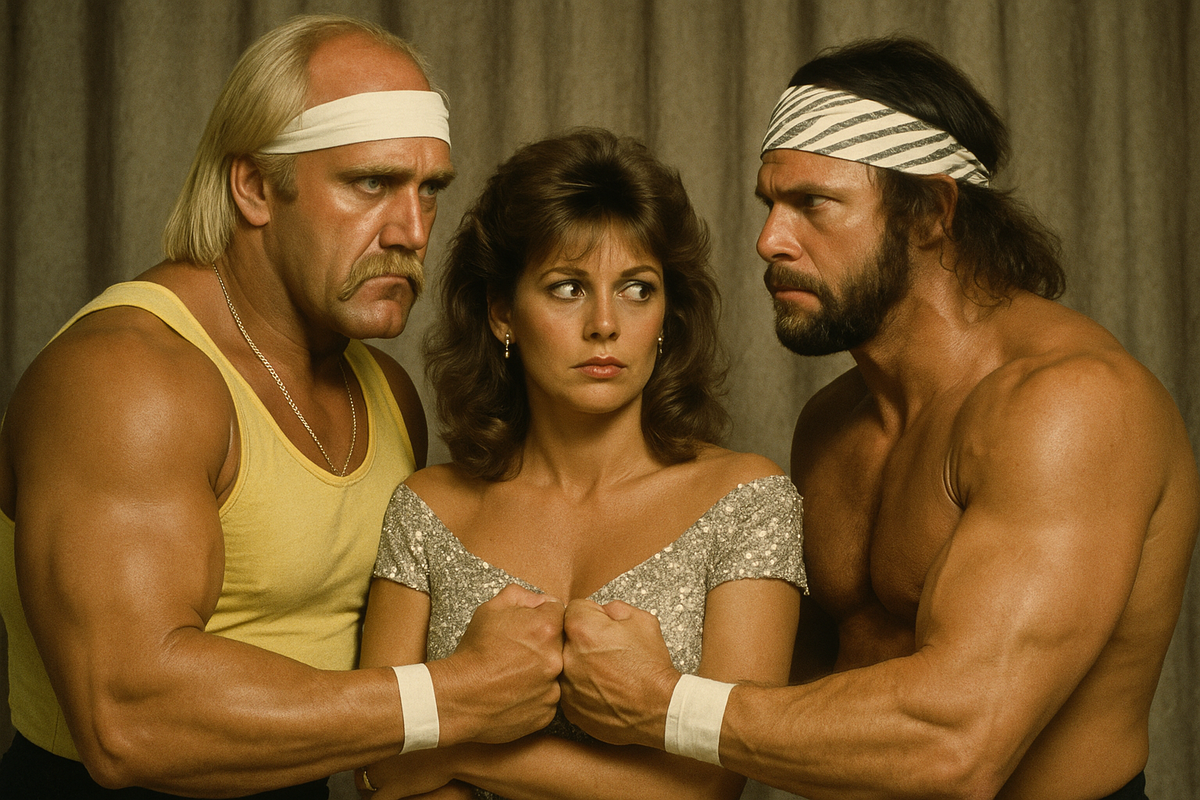
The Hogan-Savage-Elizabeth Triangle
How a Single Magazine Issue Captured Wrestling's Greatest Betrayal Before It Happened
In January 1989, months before WrestleMania V would shatter the most powerful alliance in professional wrestling, fans across America opened their mailboxes to find something prophetic. The latest issue of Pro Wrestling Illustrated didn't just report the news—it predicted an earthquake.
"Will the Megawoman Destroy the Megapowers?"
The headline screamed across the page in bold black type, framing a question that would define the WWF's next chapter. But this wasn't speculation dressed up as journalism. This was PWI doing what it did best: freezing a cultural moment before it exploded, giving fans the tools to understand what television could only hint at in fifteen-second glances and carefully scripted promos.
What made this issue extraordinary wasn't just its timing. It was the way PWI treated Miss Elizabeth—not as a prop in a male rivalry, but as the architect of wrestling's most inevitable collapse.
Archive Spotlight
Publication: Pro Wrestling Illustrated
Issue Date: January 1989
Featured Storyline: The Megapowers (Hulk Hogan & Randy Savage)
Central Figure: Miss Elizabeth
Historical Context: Published months before WrestleMania V
The Alliance That Couldn't Last
By 1988, Hulk Hogan and Randy "Macho Man" Savage stood at the center of Vince McMahon's expanding empire. Their 1987 handshake had created The Megapowers, an alliance that symbolized everything the WWF wanted to project: unity, star power, and dominance.
But alliances built on ego rarely survive proximity to power.
Hogan's interactions with Miss Elizabeth—Savage's manager and real-life wife—began cracking the foundation. At SummerSlam '88, Hogan's protective embrace of Elizabeth after a match sent Savage's eyes cold. The moment lasted seconds on television. In PWI's January 1989 issue, it stretched across a full-page photograph, Savage's unease frozen in time, his body language telling the story that announcers couldn't.
This was the magazine's genius. Where television moved at the speed of entertainment, PWI let fans study the evidence. A hug became a betrayal. A glance became jealousy. A gesture became proof.
PWI's Editorial Authority in the Kayfabe Era
By 1989, Pro Wrestling Illustrated had established itself as wrestling's paper of record. Its editors understood something fundamental: wrestling worked because it blurred reality and performance into something emotionally true. Fans didn't want to be told it was fake. They wanted their investment validated, deepened, made consequential.
The January 1989 issue delivered exactly that.
PWI didn't recap WWF programming—it expanded it. The feature on the Megapowers conflict posed genuine questions that treated Elizabeth as a figure with agency, Hogan as a man whose heroism might conceal ambition, and Savage as someone whose paranoia could be justified.
Could Elizabeth stay loyal to Savage while Hogan circled closer?
Was Hogan protecting Elizabeth, or was he methodically undermining his partner?
What if Elizabeth walked away from both men?
These weren't rhetorical exercises. For fans reading in early 1989, these were urgent questions with real stakes. PWI framed the storyline not as predetermined entertainment, but as an unfolding drama where decisions mattered.
The Power of the Photograph
The magazine's visual storytelling matched its editorial ambition.
The SummerSlam '88 hug appeared in stark clarity—Hogan's arms around Elizabeth, her expression uncertain, Savage watching from just outside the frame. The composition told the story better than any announcer could.
Another image showed Hogan and Savage working together against rivals, their unity already poisoned by suspicion. Their body language diverged. Their eyes looked in different directions.
And then there was Elizabeth, positioned literally and narratively in the middle—the woman whose choice would determine everything.
PWI understood what made wrestling compelling: not the moves, but the moments between the moves. The magazine gave fans time to analyze expressions, to read intentions into posture, to build theories from frozen instants that television couldn't afford to hold.
Three Futures, One Inevitable Collapse
The article laid out the possible outcomes with the seriousness of political analysis:
Elizabeth Chooses Hogan
A betrayal that would destroy Savage professionally and personally, handing Hogan both the woman and the moral high ground.
Elizabeth Chooses Savage
Loyalty reinforced, but at the cost of isolating Hogan and ensuring the alliance's collapse.
Elizabeth Walks Away
The nuclear option. No winners. Just the implosion of the WWF's most dominant team.
Elizabeth as Protagonist
PWI credited her with transforming Savage from an unfocused brawler into a world champion—making her the story's central force.
But PWI did something more sophisticated than just mapping outcomes. It credited Elizabeth with transforming Savage from an unfocused brawler into a world champion. It framed her not as a passive figure caught between two men, but as the central force whose presence had shaped both wrestlers' careers.
This was radical framing for 1989. Television wrestling often reduced women to scenery. PWI made Elizabeth the story's protagonist.
The magazine also dissected the moment that started everything—the SummerSlam hug—treating it as the spark that would ignite the feud. Months before WrestleMania V would make the breakup official, PWI had already written the epitaph for the Megapowers.
Why This Issue Endures
For collectors of vintage wrestling magazines, PWI's January 1989 issue holds a unique position.
Historical Timing – Released just months before WrestleMania V, it captures the exact moment when the Megapowers' unity began to fracture. Reading it now feels like examining documentary footage of an earthquake's first tremors.
Elizabeth's Prominence – Few issues positioned Miss Elizabeth as the central figure of analysis. This one treated her decisions as consequential, giving her a level of narrative respect that even WWF television sometimes denied her.
Iconic Storyline Documentation – The Hogan-Savage breakup remains one of wrestling's most remembered feuds. This issue documents it not in retrospect, but in real time, with all the uncertainty and anticipation intact.
Cultural Artifact – Like the best magazines of any era, this issue transcended its subject. It captured how fans processed wrestling in 1989—the theories they built, the loyalties they felt, the emotional investment they made in scripted conflict that felt devastatingly real.
Holding this issue means holding the emotional architecture of late-1980s wrestling fandom.
The Magazine as Time Machine
Wrestling magazines in the 1980s served a function that's nearly extinct: they slowed down the experience of fandom. Television gave you the moment. The magazine gave you the aftermath, the analysis, the space to think.
PWI's coverage of the Megapowers showed fans that alliances were fragile, that heroism could mask selfishness, and that even the strongest partnerships carried the seeds of their own destruction. It treated Elizabeth with seriousness. It gave Hogan and Savage's feud intellectual weight.
Decades later, revisiting this issue reveals something about wrestling's golden age: the stories worked because institutions like PWI made them matter. The magazine wasn't just covering wrestling—it was building the emotional infrastructure that made wrestling unforgettable.
Collector Significance
Historical Timing
Released just months before WrestleMania V, it captures the exact moment when the Megapowers' unity began to fracture.
Elizabeth's Prominence
Few PWI issues featured Miss Elizabeth so centrally, making this one unique in wrestling magazine history.
Iconic Storyline
The Hogan-Savage breakup remains one of wrestling's most remembered feuds, and this issue documents it in real time.
Cultural Artifact
A time capsule of how wrestling fans saw their heroes and villains in 1989—preserving the emotional heart of late-1980s wrestling.
A Collector's Essential
If you're tracking the evolution of professional wrestling through its primary sources, this issue isn't optional—it's foundational. It captures the Hogan-Savage-Elizabeth triangle at the exact moment when speculation became inevitability.
Browse Pro Wrestling Illustrated Magazine CollectionThe January 1989 issue of Pro Wrestling Illustrated didn't just report wrestling's most compelling storyline. It understood it, expanded it, and preserved it. For fans and collectors alike, this isn't memorabilia. It's evidence of the moment when wrestling storytelling reached its peak—and a magazine captured it perfectly.