
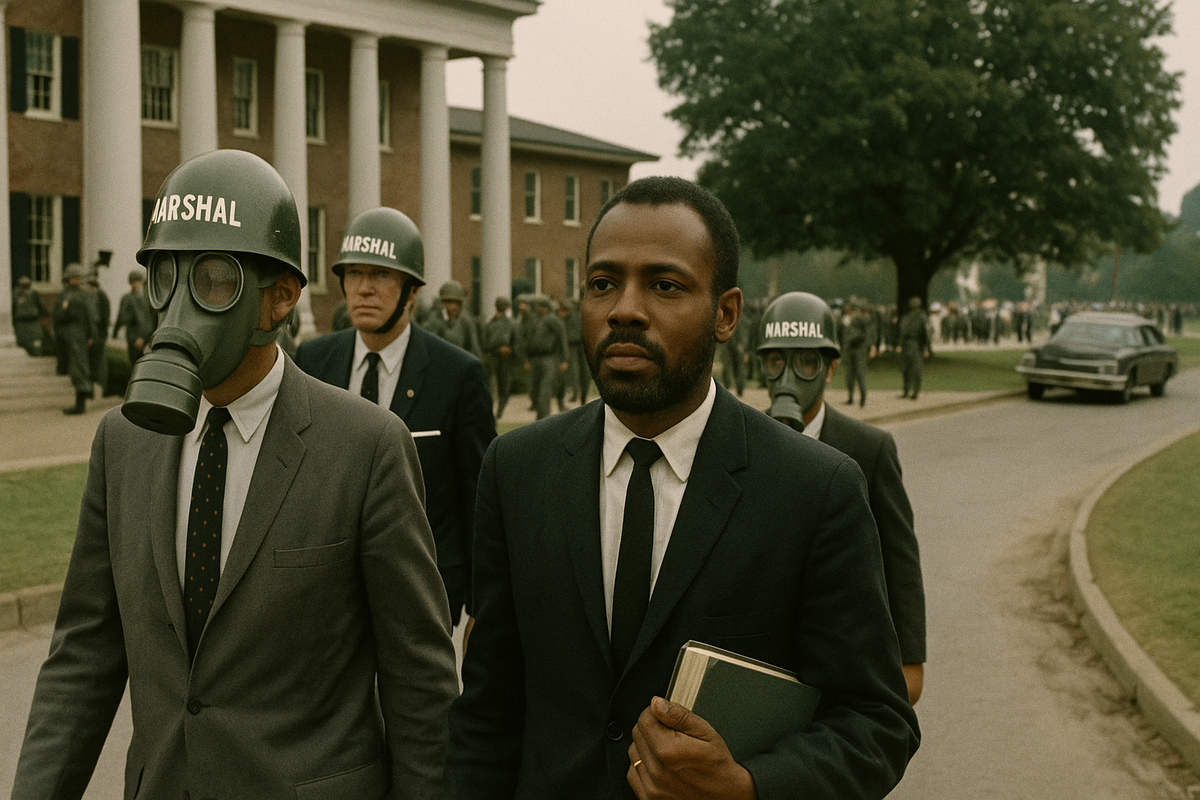
James Meredith, Ole Miss, and the Battle for Equal Education in 1962
When Ebony Magazine documented the most violent clash over school integration in American history
On September 30, 1962, the University of Mississippi became a battlefield. Federal marshals faced down white supremacist mobs hurling bricks, Molotov cocktails, and rifle fire. Two men died. One hundred seventy-five were injured. President Kennedy deployed more than 20,000 troops to enforce a single court order: that James Meredith, a 29-year-old Air Force veteran, had the right to register for classes.
When Ebony Magazine's December 1962 issue reached mailboxes weeks later, it carried something no other American publication could offer—the story of the man at the center of the storm, told to the people who understood what his fight truly meant.
Archive Details
Historical Figure: James Meredith
Issue Date: December 1962
Archive Source: Ebony Magazine
Feature Article: "Man Behind the Headlines" by Larry Still
Cover Subject: Cicely Tyson
The Price of a Transcript
By 1962, the legal framework for integration existed on paper. Brown v. Board of Education had declared segregated schools unconstitutional eight years earlier. But in Mississippi, law was fiction. Governor Ross Barnett personally blocked Meredith's registration. State legislators threatened secession. The Confederate flag flew over Oxford as if 1865 had never happened.
James Meredith's application to Ole Miss was not symbolic protest—it was calculated confrontation. Backed by the NAACP's legal machinery, Meredith forced the federal government to answer a question it had been avoiding: Would the United States enforce its own Constitution against a state willing to riot in defiance?
The answer came in the form of troops, tear gas, and what Ebony would call "the longest night" and "the darkest" in American history since the Civil War. Only after armed federal intervention could Meredith walk onto campus. His enrollment wasn't a milestone. It was a siege.
The Man No One Knew
Mainstream outlets covered the riots. Network cameras captured the smoke and chaos. But who was James Meredith?
Larry Still's feature, "Man Behind the Headlines," gave Ebony's readers what white America never bothered to see: the full measure of the man. Meredith was one of ten children raised on a family farm in Kosciusko, Mississippi. Seven of his siblings attended college. He served nine years in the Air Force, traveled internationally, saved money with military precision, and returned home with a mission. He wasn't a radical. He was disciplined, deliberate, and terrifyingly composed under threat.
His father told reporters that James "was born to die"—not melodrama, but acknowledgment. The Meredith family lived under constant intimidation. His wife and young children endured threats while he fought for a seat in a classroom. Ebony documented this human cost with a level of intimacy unavailable elsewhere: childhood photographs from family albums, images of Meredith working the farm, his Air Force portrait, and finally, the iconic shots of him walking under armed escort into Ole Miss, his expression unchanging—"cool and relaxed as ever without any trace of fear," as the magazine described him.
This was not hagiography. It was journalism that understood its audience had earned the right to see themselves in the heroes they were watching make history.
The Visual Testament
Ebony's December 1962 issue opened with Cicely Tyson on the cover—an emerging actress whose presence signaled the rise of new Black voices in American culture. Inside, the Meredith feature delivered something else: a photographic record of state-sanctioned violence meeting federal authority.
The images remain visceral. Marshals engulfed in clouds of tear gas. White students waving Confederate flags with open hatred. Meredith registering for classes amid barely contained chaos. And threaded throughout, family photographs that grounded him not as a symbol but as a son, a husband, a father—a man embedded in community and continuity.
No other publication in America could balance this duality: glamour and struggle, aspiration and survival, the future and the present colliding on the same pages. This was Ebony's singular achievement—it documented Black life as it was actually lived, in all its dimensions.
What the Article Contained
Federal Mobilization
Kennedy and Attorney General Robert Kennedy moved heaven and earth to enforce court orders while Governor Barnett openly defied them.
Military Discipline
Meredith's nine years in the Air Force explained his extraordinary composure under death threats and constant surveillance.
Generational Stakes
His family's history—parents who pushed all ten children toward education—revealed the deeper meaning of his stand.
Constitutional Test
Could the nation uphold its founding documents when faced with organized white resistance? Ebony simply showed what happened.
Community Witness
Neighbors who supported him, fellow veterans who understood his duty, and Black Americans who recognized his fight as their own.
Collective Movement
This wasn't one man's courage. It was the culmination of a movement demanding that America keep its promises.
Still's reporting captured details that made Meredith's ordeal unforgettable. The federal mobilization wasn't abstract—Kennedy and Attorney General Robert Kennedy moved heaven and earth to enforce court orders while Governor Barnett openly defied them. Meredith's military background wasn't incidental color; it explained his extraordinary composure under death threats. His family's history—parents who pushed all ten children toward education—revealed the generational stakes of his stand.
Ebony positioned Meredith's enrollment as a test of American credibility. Could the nation uphold its founding documents when faced with organized white resistance? The magazine didn't editorialize heavily. It simply showed readers what happened when one man insisted on his constitutional rights, and an entire state apparatus mobilized to stop him.
The article also captured community reactions—neighbors who supported him, fellow veterans who understood his sense of duty, and the Black Americans who recognized that Meredith's fight was their fight. This wasn't one man's courage. It was the culmination of a collective movement demanding that America keep its promises.
The Enduring Legacy
Ebony's Meredith coverage endures because it refused to abstract the civil rights struggle into competing ideologies or distant policy debates. It showed readers what courage looked like under specific threat. It documented what families risked when one member stood up. It recorded the exact machinery of state resistance and federal response.
For collectors and historians today, vintage Ebony magazines are not nostalgic artifacts. They are time capsules that preserve not just events, but the experience of living through America's most profound transformation. They show how Black Americans saw themselves and their battles when mainstream media was still deciding whether their humanity was newsworthy.
The December 1962 issue captured the moment when James Meredith forced the United States to choose between its laws and its racism. Ebony documented that choice with dignity, precision, and an understanding that its readers deserved to see history made by people who looked like them.
Why Collectors Pursue This Issue
Historic Timing
This issue documented the Ole Miss crisis as it unfolded, capturing the most violent confrontation over school integration in U.S. history while the tear gas still hung in the air. It's primary source material, not retrospective analysis.
Cultural Duality
Cicely Tyson's cover and Meredith's story together encapsulate Ebony's genius—celebrating Black achievement while documenting the brutal fight for basic rights. This wasn't compartmentalized coverage. It was the full spectrum of Black life in one issue.
Photographic Rarity
The images inside combine personal and political history in ways that cannot be replicated digitally. Seeing them on original newsprint, in the physical magazine that Black families held in 1962, carries weight that scans cannot reproduce.
Market Significance
Issues highlighting civil rights milestones—Meredith, King, Malcolm X, Rosa Parks—are among the most sought-after vintage Ebony magazines. The December 1962 issue stands with the most important documents of the era.
Explore This Historic Issue
Original copies of Ebony Magazine December 1962 and a wide range of vintage Ebony magazines are available for collectors and historians.
Browse Ebony Magazine CollectionEach issue tells a story—of progress, of struggle, of joy, and of resilience. To hold one is to hold history itself.