
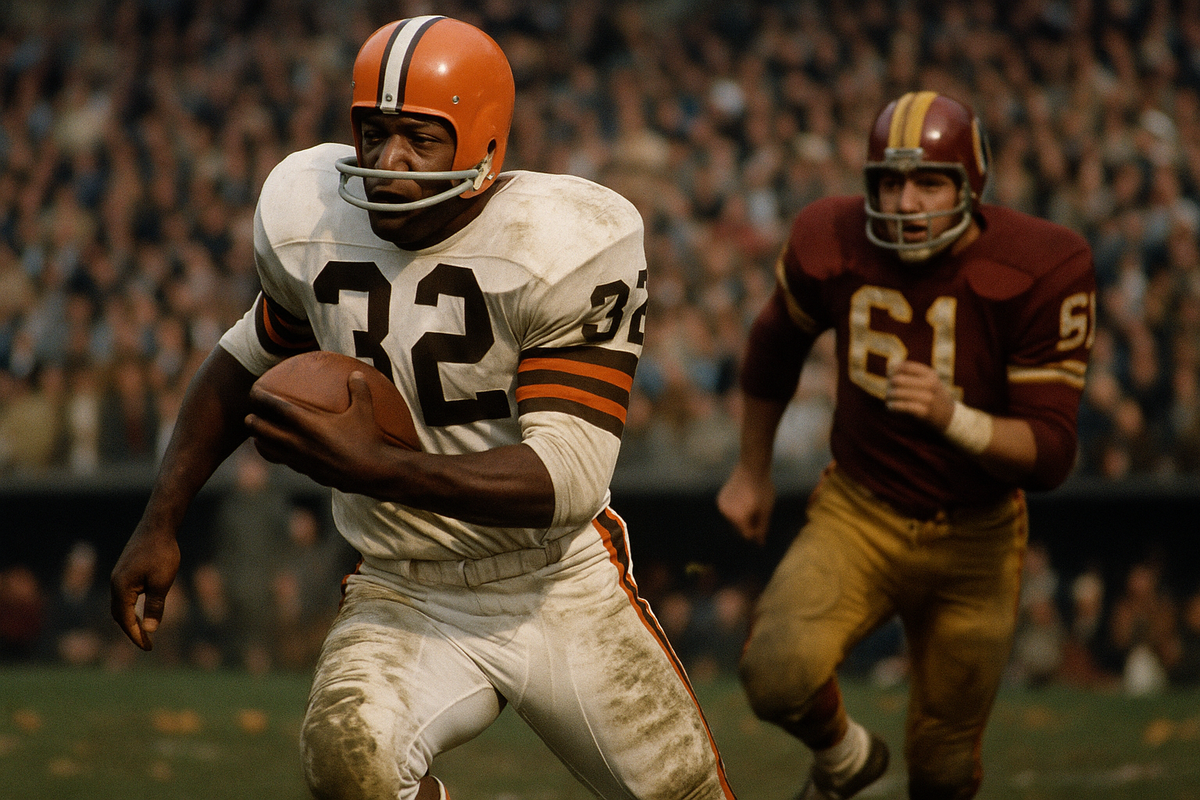
The Fullback Who Carried More Than a Football
Jim Brown, Ebony Magazine, and the Power of Representation in 1964 America
January 1964. Cleveland Browns fullback Jim Brown stood at the absolute summit of professional football—and at the crossroads of American history. When Ebony Magazine devoted its feature story to "Pro Football's Mightiest Player" that month, the editors understood something the mainstream sports press had missed: they weren't just profiling an athlete. They were documenting a revolution.
Six months after the March on Washington. Three months past Kennedy's assassination. Weeks before the Civil Rights Act would ignite the most consequential congressional battle of the decade. In this charged atmosphere, Brown's image—powerful, uncompromising, impossible to ignore—carried weight that transcended the gridiron.
This wasn't another puff piece about a star running back. It was a cultural manifesto in magazine form.
Archive Details
The Man the Record Books Couldn't Contain
By January 1964, Jim Brown had already reduced NFL defenses to rubble. He was threatening to become the first player in league history to rush for 2,000 yards in a single season—a benchmark so audacious that sportswriters openly questioned whether human physiology allowed it. Washington's defensive line couldn't stop him. Philadelphia's tacklers bounced off him like sparrows striking a locomotive.
But Ebony's readers—and writer Alex Poinsett—knew the statistics were only prologue.
The feature laid bare a more complex figure: college-educated from Syracuse, already negotiating business deals with Pepsi-Cola, studying investments with the same intensity he brought to reading defensive formations. Brown explained his philosophy with characteristic precision: great football demanded "a oneness of mind and body," not merely brute strength. The game required instant processing, split-second intelligence married to overwhelming force.
Here was an athlete who refused the narrow role white America had scripted for Black sports figures—the grateful, apolitical entertainer content to perform and disappear.
The Archive of Resistance
Ebony's photography told the story mainstream outlets couldn't. Action shots captured Brown demolishing defenders, yes—but the magazine devoted equal space to what happened when he left the field.
The Thinker
A pensive studio portrait: Brown alone with his thoughts, Syracuse diploma implicit in his gaze.
The Protector
A rare family photograph: Brown with his wife Sue and their children, a domestic sanctuary he fiercely guarded from media intrusion.
The Strategist
A hotel room before game day: Brown reading in solitude, concentrating, preparing his mind before unleashing his body.
The Businessman
Already working with Pepsi-Cola and studying investments, planning his exit from football on his own terms with financial independence secured.
These images constructed a counter-narrative to the sports page caricatures. They insisted on Brown's full humanity—thinker, husband, father, businessman-in-training. They documented a man planning his exit from football on his own terms, with financial independence already secured.
And they acknowledged the brutal arithmetic of American racism. Brown knew that no matter his achievements, some would always dismiss him as "just another Negro." Ebony didn't flinch from this reality. The magazine understood that representation meant showing both the triumph and the toll.
Why January 1964 Matters Now
The cover that month featured model Monique Cartwright in high-fashion styling—Ebony's signature blend of glamour and cultural commentary. But inside, the Brown profile operated as something more urgent than lifestyle journalism. It was documentation of Black excellence at the precise historical moment when that documentation had become a form of resistance.
Congress was debating whether African Americans deserved equal protection under federal law. Lunch counters remained segregated. Voting rights were violently suppressed. In this context, Ebony's portrait of Jim Brown—dominant, articulate, planning a business empire—became a political act disguised as a sports feature.
The magazine showed its readers what the Civil Rights Movement was fighting for: not merely the absence of discrimination, but the presence of dignity, autonomy, and power.
The Long Shadow
Brown would leave football in 1966, at age 29, still at the height of his powers. He walked away to pursue acting and activism, refusing to let the game define his entire existence. His insistence on self-determination—on the field and off—became blueprint for generations of Black athletes who followed.
The January 1964 Ebony profile captured him at the moment of maximum impact, when his dominance in football amplified his voice in the larger struggle for equality. Writer Alex Poinsett and the magazine's photographers understood they were documenting more than sports excellence. They were preserving evidence of what was possible when talent, intelligence, and resolve converged in a single figure who refused to be diminished.
That evidence, printed on glossy magazine stock, remains available for those who understand what they're holding.
What Collectors Hold in Their Hands
For those who acquire the January 1964 issue today, the value extends far beyond the paper stock and binding
Historical Convergence
Brown captured at his athletic peak, during the most consequential months of the Civil Rights era.
Editorial Distinction
Ebony presented athletes as complete human beings when mainstream publications still trafficked in stereotypes and half-truths.
Visual Archive
The photography remains some of the most striking sports portraiture the magazine ever published—intimate without being intrusive, heroic without mythology.
Cross-Disciplinary Significance
Prized equally by sports historians, collectors of African American cultural artifacts, and scholars of mid-century visual journalism.
Scarcity with Meaning
Original copies connect collectors to a specific, unrepeatable moment when an athlete, a magazine, and a movement aligned.
Primary Source Material
Not merely collectibles, but essential documents for understanding how African Americans documented their own story when the dominant culture looked away.
Access the Archive
For collectors searching for vintage Ebony magazines or civil rights era publications, this issue represents essential acquisition. From the 1940s through the 1980s, Ebony chronicled African American culture, politics, fashion, and progress as it unfolded.
Browse Ebony Magazine Collection