
The Trench Photograph That Changed War Reporting
Michael Herr's "Khe Sanh" in Esquire, September 1969
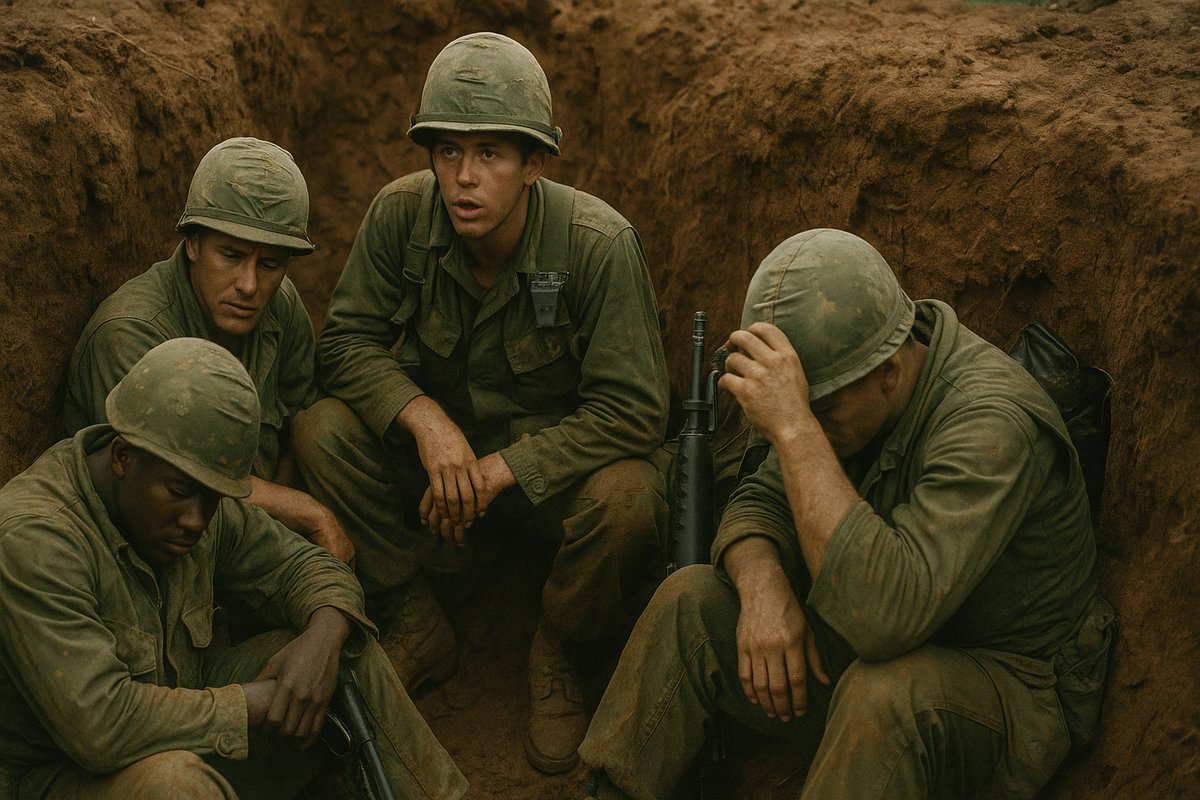
A Marine, barely old enough to vote, presses his body into red clay. His helmet is pulled low. His rifle rests against mud that has become both fortress and grave. Above him, the sky waits to deliver the next round of shelling. This is not a recruitment poster. This is not glory. This is the opening image of Michael Herr's "Khe Sanh" in the September 1969 issue of Esquire Magazine—and it detonated in American living rooms like incoming fire.
Readers expecting style tips and celebrity profiles were instead handed the raw, unfiltered truth of Vietnam. Herr's dispatch from the siege of Khe Sanh Combat Base didn't just report the war. It performed it—sensory, fragmented, and unflinching. Paired with photography that stripped heroism down to exhaustion and survival, this feature became one of the most important pieces of war journalism ever published in a mainstream American magazine.
For collectors, historians, and anyone seeking to understand how media shaped the Vietnam era, this issue is not merely a magazine. It is a historical detonation point.
Historical Context
Featured Writer: Michael Herr
Publication: Esquire Magazine, September 1969
Subject: The Siege of Khe Sanh Combat Base, 1968
Cultural Movement: New Journalism
Archive Significance: One of the defining Vietnam War dispatches of the era, precursor to Herr's masterwork Dispatches (1977)
The War America Was Losing—And Couldn't Look Away From
By September 1969, the Vietnam War had metastasized into a national wound. U.S. forces had been entrenched in Southeast Asia for years, and the conflict was increasingly regarded as unwinnable. The Tet Offensive of 1968 had shattered official optimism, revealing the tenacity of the North Vietnamese and exposing the gap between Pentagon briefings and battlefield reality. Protests consumed college campuses. Draft cards burned in public squares. Young men faced conscription into a war their country could no longer justify.
Into this atmosphere of rage and disillusionment, Esquire published Herr's "Khe Sanh"—a retrospective on the infamous 1968 siege where U.S. Marines endured months of relentless bombardment. The base had become a symbol of the war's contradictions: defended at staggering cost, then quietly abandoned. For many Americans, Khe Sanh embodied both the heroism and the futility of Vietnam—an isolated firebase held against impossible odds, only to be deemed expendable.
Herr's essay arrived when the public was starving for truth. Official military reports reduced combat to body counts and grid coordinates. Network news footage sanitized the violence into digestible segments. But Herr gave readers something else entirely: the voices of the Marines themselves—their slang, their exhaustion, their gallows humor. His prose didn't analyze strategy. It recreated the sensory overload of survival: the omnipresent mud, the shriek of incoming rounds, the absurdity of clinging to life in a trench while the world back home debated whether any of it mattered.
Esquire's Role: Where New Journalism Became Cultural Reckoning
In the 1960s, Esquire operated at the intersection of style and substance. Under editor Harold Hayes, the magazine became a laboratory for New Journalism—a movement that fused literary technique with reportage, turning facts into felt experience. Tom Wolfe dissected car culture and counterculture. Gay Talese profiled Frank Sinatra without ever interviewing him. Norman Mailer turned political conventions into existential theater. And Michael Herr brought the war home in sentences that crackled with adrenaline and dread.
The September 1969 issue gave Herr the space to construct an immersive experience. This wasn't the detached objectivity of The New York Times. It was frontline storytelling that placed readers inside the trenches, forcing them to feel the claustrophobia, the terror, the dark comedy of men fighting a war no one could explain.
Esquire's decision to publish this piece demonstrated its cultural courage. The magazine didn't just cover the war—it interrogated it, using the tools of literature to bypass propaganda and deliver something closer to truth. Alongside features on masculinity, fashion, and campus upheaval, Herr's work reflected the fractured consciousness of late-1960s America: a nation at war with itself, questioning everything it once believed.
The Writing: Mud, Music, and the Surreal Syntax of Survival
Herr's prose in "Khe Sanh" is visceral and fragmented, mirroring the psychological texture of combat. He doesn't describe the siege in linear narrative or military jargon. Instead, he builds scenes from sensory shards: the weight of the mud, the relentless percussion of shelling, the fatigue that sinks into bone. His language captures the Marines' own idiom—phrases like "Six shades of green, mother" distill their gallows humor into something both profane and poetic.
He also weaves in pop culture—references to The Beatles' Magical Mystery Tour—to underscore the surreal disconnect between America's youth culture and its battlefield. While college students tripped to psychedelic rock, young men their age crouched in trenches, waiting for the next barrage. This juxtaposition became one of the defining tensions of the 1960s: at home, utopian optimism; in Vietnam, blood and disillusionment.
Herr's descriptions of Route 9 being "completely controlled by the NVA" made the strategic futility undeniable. The siege wasn't just about holding ground—it was about clinging to meaning in a war that had lost coherence. His prose refused to offer easy conclusions or patriotic reassurance. It simply showed—and that honesty made it devastating.
The Photography: No Glory, Only Endurance
The images accompanying Herr's essay are as essential as the text. The opening color spread shows Marines compressed into trench walls, bodies half-buried in earth, bracing for incoming fire. Their faces are young—many barely out of high school—but their expressions carry the weight of something ancient: the exhaustion of men who have learned to live with death as a neighbor.
These photographs did not glorify combat. They humanized it, stripping away the abstractions of strategy and politics to reveal the raw physicality of survival. Other images capture helicopters banking over scarred hills, mud-caked gear, the desolate moonscape of Khe Sanh's perimeter. Together, they transform war from distant headline into immediate, uncomfortable intimacy.
For Esquire's readers—many of whom had never been near a battlefield—the photography made Herr's prose undeniable. The war was not a debate topic. It was real, and it was happening to young men who looked like their sons, their brothers, their classmates.
Why This Issue Mattered: A Cultural Turning Point
The September 1969 Esquire carrying Herr's "Khe Sanh" landed at a hinge moment in American history. The nation was already fracturing over Vietnam, with protests escalating and draft resistance spreading. By publishing unflinching frontline reporting, Esquire forced mainstream readers—not just activists or academics—to confront the human cost of the war.
The issue also captured broader cultural currents. 1969 was the year of Woodstock, the moon landing, and the Manson murders. It was a moment when traditional authority was collapsing, and magazines like Esquire helped shape the national conversation by refusing to look away. By combining war reportage with coverage of masculinity, style, and rebellion, Esquire became a mirror of its fractured, searching era.
Herr's piece didn't end the war. But it changed how Americans read about it—and how they understood the distance between official narrative and lived reality.
Why Vintage Esquire Magazines Endure
Unlike digital reporting that evaporates into feeds and archives, mid-century Esquire magazines persist as physical witnesses to history. They are documents of how Americans saw themselves—stylish, self-critical, engaged with the turbulence of their times. Herr's "Khe Sanh" exemplifies why Esquire mattered: it dared to publish what others sanitized, using literary craft and unflinching visuals to collapse the distance between soldier and civilian.
For history enthusiasts, collectors, and families honoring the experiences of past generations, vintage Esquire magazines are far more than reading material. They are original artifacts of the 20th century—tangible, imperfect, irreplaceable.
For Collectors: Why the September 1969 Esquire Is Essential
For collectors of vintage magazines, the September 1969 Esquire is a cornerstone issue. Michael Herr's "Khe Sanh" holds enduring literary and historical significance, standing as one of the defining Vietnam War dispatches of the era. To own this issue is to possess a tangible artifact of both journalistic innovation and cultural rupture.
Historical Timing
Published just over a year after the siege of Khe Sanh, while the war still raged and the nation still debated its meaning.
Author's Legacy
Michael Herr went on to write Dispatches (1977), widely regarded as one of the greatest works of war reportage ever published. This article is part of that lineage—raw material that would later be refined into a masterpiece.
Visual Power
The haunting trench photographs and supporting imagery make the issue visually arresting and historically vital. These images don't decorate the text; they amplify it.
Cultural Influence
Esquire in the 1960s is highly sought after for its role in shaping journalism, fashion, and social commentary. Issues from this era command attention not just as reading material, but as design objects and cultural documents.
Collectors prize this issue not only for its content but as an artifact that captures America's mid-century consciousness—its style, its anxieties, its willingness to confront uncomfortable truths.
Explore the Collection
If you're drawn to Michael Herr's work, Vietnam War history, or the evolution of American journalism, the September 1969 issue of Esquire is essential. It represents a moment when culture, politics, and reportage converged on the printed page—and the result was something few magazines have achieved before or since.
Browse Esquire Magazine CollectionWhether you're a seasoned collector, a student of history, or someone seeking the voices of the past, these magazines offer something rare: the chance to hold history in your hands.
The Magazine That Refused to Look Away
Michael Herr's "Khe Sanh" in the September 1969 issue of Esquire Magazine remains a landmark of American war reporting. Its fusion of raw, fragmented prose and unsparing photography captured the Vietnam War in a way no official statement or network broadcast ever could. At a moment when America was interrogating itself, Esquire provided a forum where truth and style collided—and neither blinked.
For readers and collectors today, this issue is more than a magazine. It is a time capsule, a witness, a challenge. To read Herr's piece now is to revisit the Vietnam War not as abstraction or statistic, but as lived experience—etched in trenches, carried in slang, and printed on the pages of one of America's most daring magazines.