
When Ric Flair Ordered Dom Pérignon and Buried Hulk Hogan
Inside the 1985 PWI Profile That Defined Wrestling Greatness
The waiter brought filet mignon. Ric Flair sent it back.
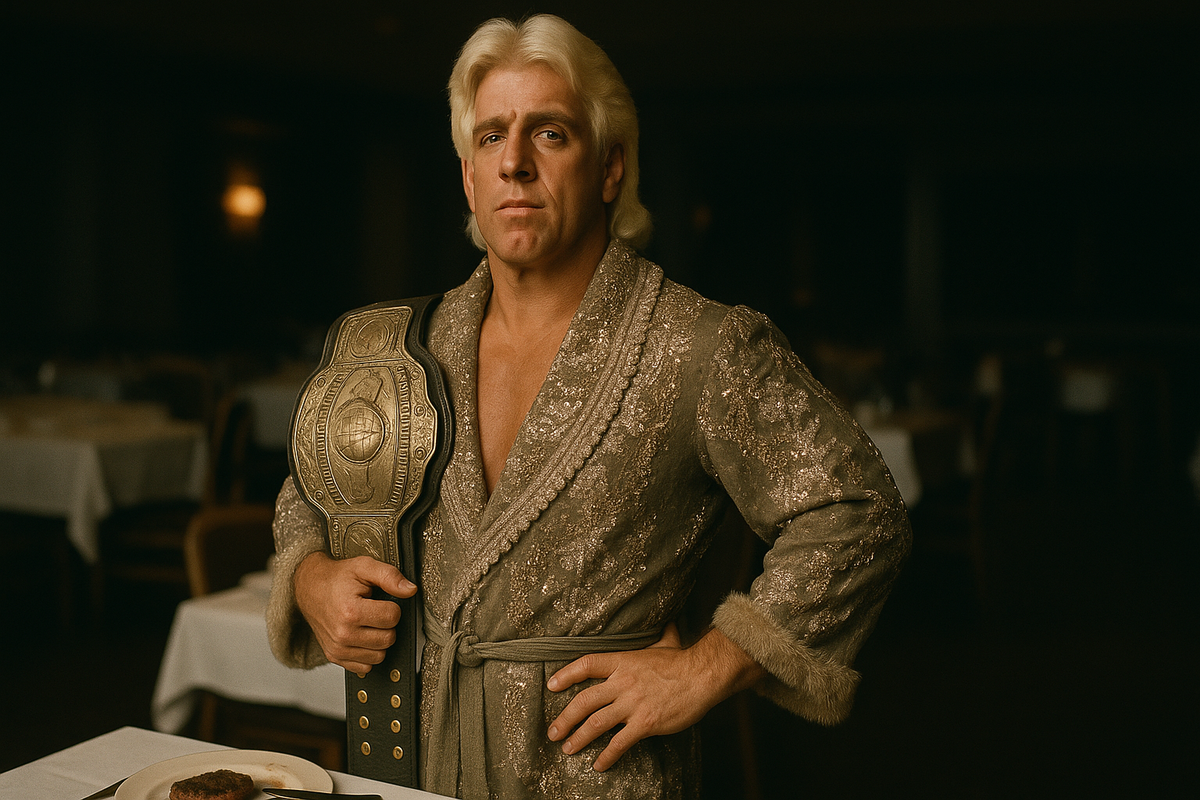
Not because it wasn't perfect—because he was perfect, and perfection demanded Dom Pérignon to match. This wasn't a wrestling interview. This was a coronation dinner, and Craig Peters of Pro Wrestling Illustrated had a front-row seat to the Nature Boy holding court in November 1985, champagne glass raised, NWA World Heavyweight Championship glinting nearby, dismantling every rival who dared claim his throne.
"It's hard to be humble," Flair told him, "when you're as great as I am."
That line—dripping with sequins, arrogance, and undeniable truth—became the centerpiece of "Ric Flair: The Arrogance of Greatness," a feature that didn't just profile a champion. It codified what wrestling excellence meant at the exact moment the sport was tearing itself in two.
Archive Details
Featured Champion: Ric Flair, NWA World Heavyweight Champion
Issue: Pro Wrestling Illustrated, November 1985
Feature Article: "Ric Flair: The Arrogance of Greatness" by Craig Peters
Historical Context: Third NWA Championship Reign, Post-WrestleMania I Era
1985: The Year Wrestling Chose Sides
By autumn 1985, professional wrestling stood at a crossroads it would never return from.
That spring, Vince McMahon's WWF had detonated WrestleMania I across closed-circuit television, fusing wrestling with MTV, Mr. T, and Cyndi Lauper. Hulk Hogan wasn't just a champion—he was a commercial juggernaut, flexing for photographers and signing movie deals. The territorial system, once the beating heart of the business, was hemorrhaging talent and television deals as McMahon's national expansion crushed regional promotions one market at a time.
But inside the National Wrestling Alliance, tradition still mattered. The NWA World Heavyweight Championship demanded a different breed of champion—one who could wrestle Harley Race to a sixty-minute draw in St. Louis on Saturday, then fly to Dallas Sunday to survive the Von Erich family in front of 40,000 Texans howling for blood. Technical mastery. Endurance. The ability to carry a promotion on your back across time zones and enemy territory.
Ric Flair, in his third reign, was that man.
And Pro Wrestling Illustrated—the most credible independent voice in wrestling journalism—wanted readers to understand exactly why.
Why PWI's Voice Mattered
Unlike WWF Magazine, which existed to sell action figures and arena tickets, Pro Wrestling Illustrated covered the entire wrestling universe: NWA, AWA, WWF, World Class Championship Wrestling, Mid-South. Its rankings ignited barbershop arguments. Its photo spreads decorated teenage bedrooms. Its editorial choices carried weight because PWI wasn't beholden to any promoter's narrative.
When PWI declared Ric Flair the gold standard of professional wrestling, it wasn't kayfabe. It was editorial judgment—and fans treated it accordingly.
The Flair profile demonstrated PWI's singular approach: blur the line between character and reality so skillfully that readers couldn't tell where the Nature Boy ended and Richard Fliehr began. The magazine showed Flair in his element—sequined robes, championship gold, gourmet meals—while documenting his legitimate technical dominance through action photography: figure-four leglocks on Kerry Von Erich, brawls with Michael Hayes, submission victories over contenders coast to coast.
Peters' narrative didn't just describe Flair. It interrogated what greatness meant when wrestling itself was being redefined.
The Champion as Cultural Force
Flair didn't merely defend his persona in the article. He performed surgical dismissals of every challenger to his throne.
This wasn't trash talk for a storyline. This was Flair articulating a philosophy: wrestling greatness required technical mastery, ring psychology, and the endurance to defend a championship across territories, not just pose for magazine covers.
"This is the best," Flair said, gesturing to his meal, "because I am the best."
The line captured everything. Flair wasn't selling a gimmick. He was living a worldview where excellence in the ring justified excess everywhere else.
The Magazine as Time Capsule
The November 1985 issue of Pro Wrestling Illustrated delivered more than celebrity journalism. It preserved a vanishing world.
The cover followed PWI's established visual grammar: bold masthead, stark black-and-white portraiture, headlines promising insider access. Inside, the Flair feature unfolded through carefully curated imagery—the champion standing above defeated opponents like Mike Von Erich, the championship belt draped across sequined robes, technical sequences demonstrating the figure-four leglock's brutal efficiency.
Peters' prose balanced spectacle with legitimacy, presenting Flair as both gracious dinner companion and ruthless competitor. The editorial framing treated wrestling with the seriousness it demanded while never losing sight of its theatrical soul.
This was wrestling journalism before the internet, before shoot interviews, before wrestlers broke kayfabe on podcasts. PWI's authority came from its independence and its ability to shape the conversation—to tell fans not just what happened in the ring, but what it meant.
The Collector's Significance
The issue captured Flair at the apex of his third NWA reign, just as McMahon's WWF expansion threatened to eclipse everything the territories represented. It's a document of wrestling's civil war—the moment before mainstream entertainment swallowed technical tradition.
"The Arrogance of Greatness" remains one of Flair's definitive profiles, capturing his persona before decades of reinvention and comebacks softened the edges.
References to Rhodes, Race, Von Erich, Magnum T.A., Koloff, and Hogan create a snapshot of wrestling's 1985 landscape—legends clashing across promotions, each claiming supremacy.
Because PWI wasn't tied to WWF or NWA storylines, its coverage carries archival weight. This wasn't promotional copy. This was journalism.
The photography—Flair in full regalia, championship gold, action sequences—represents wrestling portraiture at its finest, before digital homogenization flattened everything.
Owning this issue means possessing a primary source document from wrestling's most contentious era, when Ric Flair insisted he was the best and Pro Wrestling Illustrated gave him the pages to prove it.
Why Vintage PWI Still Matters
These magazines endure because they captured wrestling before the internet fractured fan culture into infinite niches. In 1985, PWI's rankings settled arguments. Its pinups decorated walls. Its feature stories defined who mattered.
For collectors and historians, vintage PWI issues are more than nostalgia objects—they're artifacts of how wrestling was covered, consumed, and celebrated when the sport still guarded its mystique. They preserve the voices, feuds, and philosophies of an era when Ric Flair was the yardstick, Hulk Hogan was the showman, and two visions of wrestling excellence battled for the future.
Explore the Archive
Thousands of original Pro Wrestling Illustrated magazines—from the territorial wars of the 1980s through the Attitude Era and beyond—are available in our collection. PWI documented wrestling with rankings, interviews, and photography that defined generations of fandom.
Browse Pro Wrestling Illustrated Magazine CollectionThe Last Word
The November 1985 issue of Pro Wrestling Illustrated didn't just profile Ric Flair. It captured the Nature Boy as cultural force—a champion who lived his gimmick so completely that the line between Richard Fliehr and Ric Flair ceased to exist. He ordered Dom Pérignon, dismissed Hulk Hogan as a weightlifter in costume, and insisted he was the best in every conceivable way.
Holding this issue today means holding proof: that one man, at one moment, defined wrestling greatness on his own terms—and made the world believe him.