
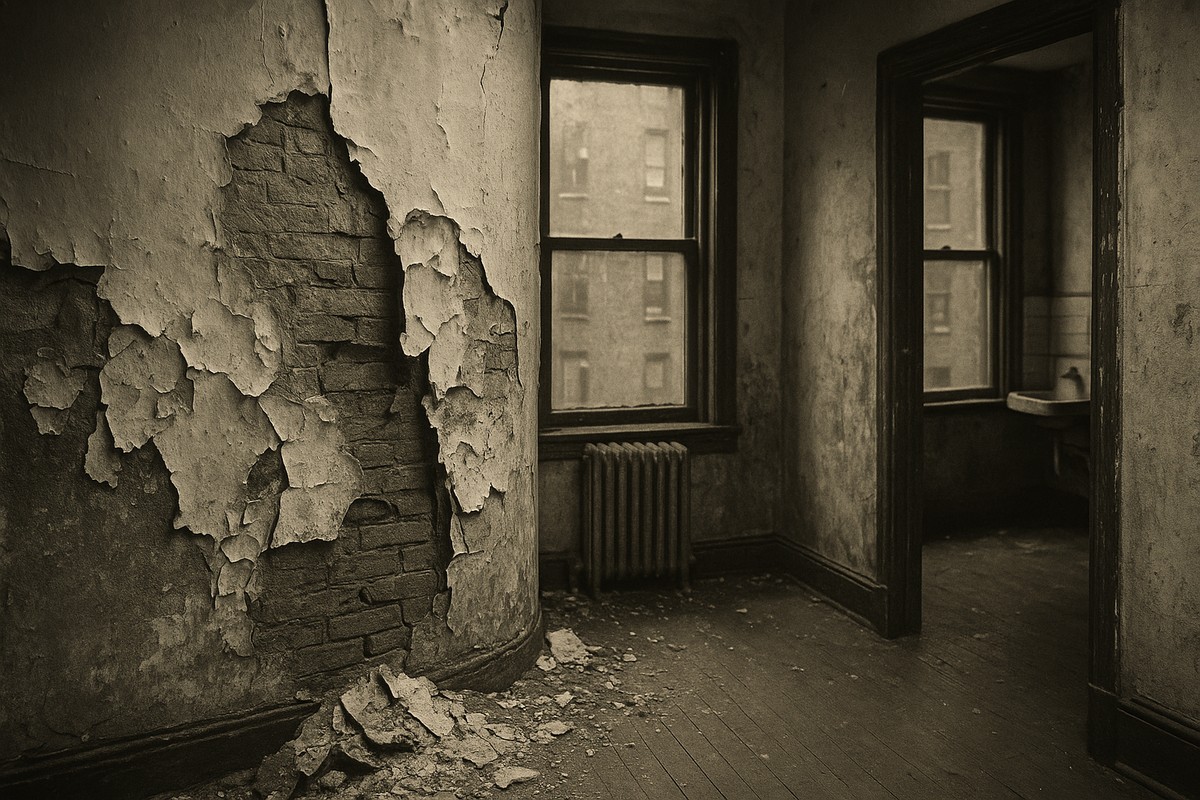
When Children Died From Their Walls
The Jet Magazine Exposé America Tried to Ignore
August 29, 1963. While the nation fixed its eyes on the Lincoln Memorial, where Martin Luther King Jr. was delivering "I Have a Dream" to a quarter-million marchers, another story was unfolding in the pages of Jet Magazine—one without cameras, without speeches, and without hope of a dream deferred becoming a dream fulfilled.
The headline struck like a fist: "Lead Poison 'Epidemic' Hits Children in Big Cities — Blame Slum Housing for Most."
This was not the civil rights movement as televised. This was the civil rights movement as lived—in cramped apartments where peeling paint looked like candy to toddlers, where landlords vanished when mothers begged for repairs, and where city health departments chose silence over action. For Jet's readers, the March on Washington represented what could be. This article represented what was.
And what was happening, quietly and lethally, was that America's slums were poisoning Black children to death.
Historical Record
Publication: Jet Magazine
Issue Date: August 29, 1963
Cover Story: "Stars March for Freedom" (Marlon Brando, Eartha Kitt, Lena Horne)
Featured Investigation: "Lead Poison 'Epidemic' Hits Children in Big Cities"
Historical Context: Published the same week as the March on Washington
The Anatomy of an Invisible Epidemic
By 1963, lead-based paint had been identified as a neurotoxin for decades. The danger was known. The science was settled. Yet in Chicago, Cleveland, Baltimore, and New York, the same pattern repeated in building after building: deteriorating housing stock, absentee landlords, families with nowhere else to go, and children drawn to the bright flakes of paint curling from rotted plaster.
Two-year-old Wanda McDowell of Chicago developed what her mother thought was a harmless habit—picking at the colorful paint chips peeling from their apartment walls. She was dead within weeks. Wanda was one of at least 14 children who died that summer in Chicago alone.
The numbers told a story municipal governments refused to read. New York reported 162 cases of child lead poisoning by mid-1963, with four fatalities. Cleveland matched its entire previous year's caseload—16 cases—by summer. These were not accidents. These were not acts of God. These were the documented consequences of housing policy, or rather, the absence of it.
Health officials issued statements about "parental education." Landlords claimed ignorance. City councils debated whether stricter housing codes might burden property owners. Meanwhile, children convulsed, suffered irreversible brain damage, or stopped breathing.
Jet refused to call it anything but what it was: an epidemic born of systemic neglect, with a victim profile as predictable as it was damning. Poor. Black. Powerless.
Why Jet Covered What Others Ignored
Mainstream newspapers of 1963 treated lead poisoning, if they covered it at all, as a minor health oddity—tragic but localized, a problem for public health columns buried on page 17. Jet Magazine understood something its competitors did not: in Black America, there were no minor tragedies. Every death was political. Every sick child was evidence.
Founded in 1951 by John H. Johnson, Jet had built its reputation on a simple editorial philosophy: tell the truth, tell it quickly, and make it impossible to look away. The magazine's pocket-sized format—small enough to fit in a purse or jacket—belied its outsize influence. Where Life and Look offered sweeping photo essays for white suburbia, Jet delivered raw, unfiltered documentation of Black life in America, from Emmett Till's open casket to the Montgomery Bus Boycott to, now, children dying from the walls of their own homes.
The August 29, 1963 issue exemplified Jet's unique editorial alchemy. The cover featured Marlon Brando, Eartha Kitt, and Lena Horne beneath the banner "Stars March for Freedom," linking celebrity activism directly to the March on Washington. Inside, readers found King's triumph and Wanda McDowell's death in the same issue—a deliberate editorial statement that freedom meant nothing if children couldn't survive their childhoods.
This was Jet's power: it refused to separate the iconic from the intimate, the celebrated from the suffering. Readers came for Sidney Poitier and stayed for the housing crisis. They came for sports scores and left understanding that a toddler eating paint chips was as much a civil rights issue as a lunch counter sit-in.
The Crisis Behind the Crisis
Jet's reporting revealed what officials worked to obscure: lead poisoning was not a mystery. It was a choice.
The magazine laid out the mechanics of the epidemic with clinical precision. Children under five, drawn to the sweet taste of lead paint, ingested chips or dust from deteriorating surfaces. Once in the bloodstream, lead attacked the nervous system, causing convulsions, developmental delays, and death. The remedy was straightforward: ban lead paint, enforce housing codes, hold landlords accountable.
None of this happened.
City health departments across the country adopted a uniform strategy of denial and deflection. Rather than mandate lead paint removal or impose penalties on negligent landlords, officials launched "education campaigns" targeting parents—most of whom were already stretched to desperation, living in substandard housing because redlining and discriminatory lending practices left them no alternatives.
The subtext was unmistakable: the burden of survival fell on Black families themselves. If a child died, it was framed as parental failure, not policy failure. Jet rejected this narrative wholesale, making the case that lead poisoning was fundamentally about power—who had it, who didn't, and who paid the price for that imbalance.
The magazine documented mothers who had begged landlords for months to repair peeling walls, only to be ignored. It quoted health officials who admitted enforcement was "difficult" when landlords were politically connected. It named the systemic forces—poverty, segregation, municipal indifference—that turned apartments into death traps.
This was environmental racism decades before the term existed, and Jet was documenting it in real time.
What the Investigation Revealed
Children as Primary Victims
Toddlers, drawn to colorful paint flakes peeling from slum walls, ingested lead that caused convulsions, irreversible brain damage, and death. What appeared to be innocent play proved lethal in poorly maintained housing.
Slum Housing at the Epicenter
Most cases occurred in deteriorating rental properties occupied by African American families. Landlords and health departments refused accountability, leaving families trapped in toxic environments.
Systemic Official Neglect
Cities resisted stricter housing codes, instead pushing responsibility onto impoverished parents who lacked power to demand safer conditions. Policy failures were reframed as parental failures.
The Human Cost
By telling stories like Wanda McDowell's death, Jet personalized the tragedy and made the crisis impossible to ignore. Statistics became children with names, families, and futures stolen.
Collector Significance: Why This Issue Endures
Historic Timing
Released the same week as the March on Washington, this issue stands as a testament to the dual realities of Black life in 1963. King's dream of equality shared shelf space with the nightmare of children poisoned by their own homes.
Editorial Courage
While mainstream outlets celebrated the March and moved on, Jet insisted that justice required more than speeches. It required safe housing, accountable governance, and recognition that civil rights extended to every corner of daily life.
Enduring Relevance
Lead poisoning would plague American cities for decades—Flint, Michigan's water crisis in 2014 proved the issue never died, it merely moved. This Jet issue serves as an early warning that went unheeded, making it both historical document and contemporary indictment.
Cultural Artifact
The juxtaposition of celebrity activism and community crisis defines Jet's legacy. Collectors prize issues that capture this tension—the simultaneous hope and suffering that characterized the civil rights era.
The Issue That Demands to Be Remembered
The August 29, 1963 Jet Magazine tells two stories—the one America wanted to celebrate and the one it preferred to ignore. On the National Mall, hundreds of thousands gathered to demand freedom. In Chicago, a mother buried her two-year-old daughter, killed by paint.
Both stories matter. Both are civil rights. Both are history.
Jet understood this when few others did, and its coverage of the lead poisoning epidemic remains a masterclass in journalism that refuses to flinch. It serves as a reminder that progress is never complete if it doesn't reach the most vulnerable, and that the past speaks most clearly through the artifacts brave enough to document uncomfortable truths.
This magazine didn't just report the news. It bore witness.
Explore the Full Collection
Discover more untold stories from the Jet Magazine archives—civil rights milestones, cultural icons, and the crises mainstream media ignored.
Browse Jet Magazine CollectionEach issue is an artifact of resistance, resilience, and the refusal to be forgotten.