
The Icon Who Wrote About Love
When Marlene Dietrich Published Her Philosophy on Romance in Ladies' Home Journal, January 1954
She told American women to trust their hearts, not their heads. To accept that not every day would feel like Sunday. To stop complaining and start understanding. In January 1954, Marlene Dietrich—Hollywood legend, cultural insurgent, symbol of defiant glamour—published a personal essay on love that was as brutally honest as it was romantic.
The essay, titled "How to Be Loved," appeared in Ladies' Home Journal, a magazine that had guided American households since the 19th century. For women opening that issue in living rooms across the country, Dietrich's byline carried weight. This was not advice from an anonymous columnist. This was wisdom from someone who had lived boldly, loved publicly, and refused to apologize for either.
The timing mattered. Postwar America in the 1950s was caught between tradition and transformation. Women were expected to find fulfillment in domesticity, yet cultural shifts were stirring beneath the surface. The seeds of second-wave feminism were being planted. More women were entering the workforce. Conversations about identity and independence were beginning to take shape.
Into this tension stepped Dietrich, offering not platitudes but philosophy—a meditation on love that acknowledged both its magic and its fragility.
Archive Details
Historical Figure: Marlene Dietrich (1901–1992), German-American actress, singer, cultural icon
Issue Date: January 1954
Archive Source: Ladies' Home Journal, Curtis Publishing Company
Essay Title: "How to Be Loved"
The Cultural Weight of the Moment
Ladies' Home Journal was more than a magazine. It was a cultural institution, a bridge between aspiration and reality for millions of American women. By the 1950s, it had spent decades shaping conversations about marriage, motherhood, and femininity. Its pages offered fiction, recipes, household tips, and increasingly, celebrity insight.
Dietrich's essay fit the magazine's mission—but it also exceeded it. Unlike generic advice columns, this piece carried authority earned through lived experience. Dietrich's life had been defined by independence, artistry, and romance conducted on her own terms. She had challenged gender norms on screen and off, wearing tailored suits, taking lovers of both sexes, and refusing to conform to Hollywood's expectations of female stars.
For her to write directly to American women about love gave the essay a charge of authenticity. She was not theorizing. She was reflecting.
The Philosophy: Romance Meets Realism
Dietrich's essay unfolds like a conversation—intimate, unsentimental, and unafraid of contradiction. She believed in the power of love, but she refused to pretend it was easy.
Trust the Heart, Not the Brain
Dietrich insisted that love could not be rationalized. "You cannot trust your brain. You can trust your heart." In a culture that often framed women's choices in pragmatic, domestic terms, this was a radical statement.
Regret Has No Place in Love
She discouraged looking back with regret. For Dietrich, if love was chosen honestly, second-guessing it was pointless. The choice had been made. Live with it.
The Magic of Youth and Innocence
She described the powerful innocence of young love, when simply being near someone feels like heaven. This was not cynicism—it was acknowledgment of love's most intoxicating stage.
Every Day Is Not Sunday
One of her most memorable warnings: love cannot exist only in idealized moments. It must survive ordinary days, disappointments, and imperfections. This phrase became the essay's most quoted line.
The Problem of Complaints
Dietrich criticized women who endlessly blamed their partners, warning that this erodes love and leaves men bewildered and burdened. It was a blunt assessment that challenged readers to examine their own behavior.
Admiration for Men's Endurance
She praised men for their quiet endurance of complaints, hardships, and expectations, highlighting their strength and patience. This balance between romantic idealism and everyday realism made the essay compelling.
The essay's power lay in its refusal to choose between fantasy and reality. Dietrich honored both the dream of romance and the grind of daily life. She did not offer solutions. She offered perspective.
The Photograph: Glamour as Philosophy
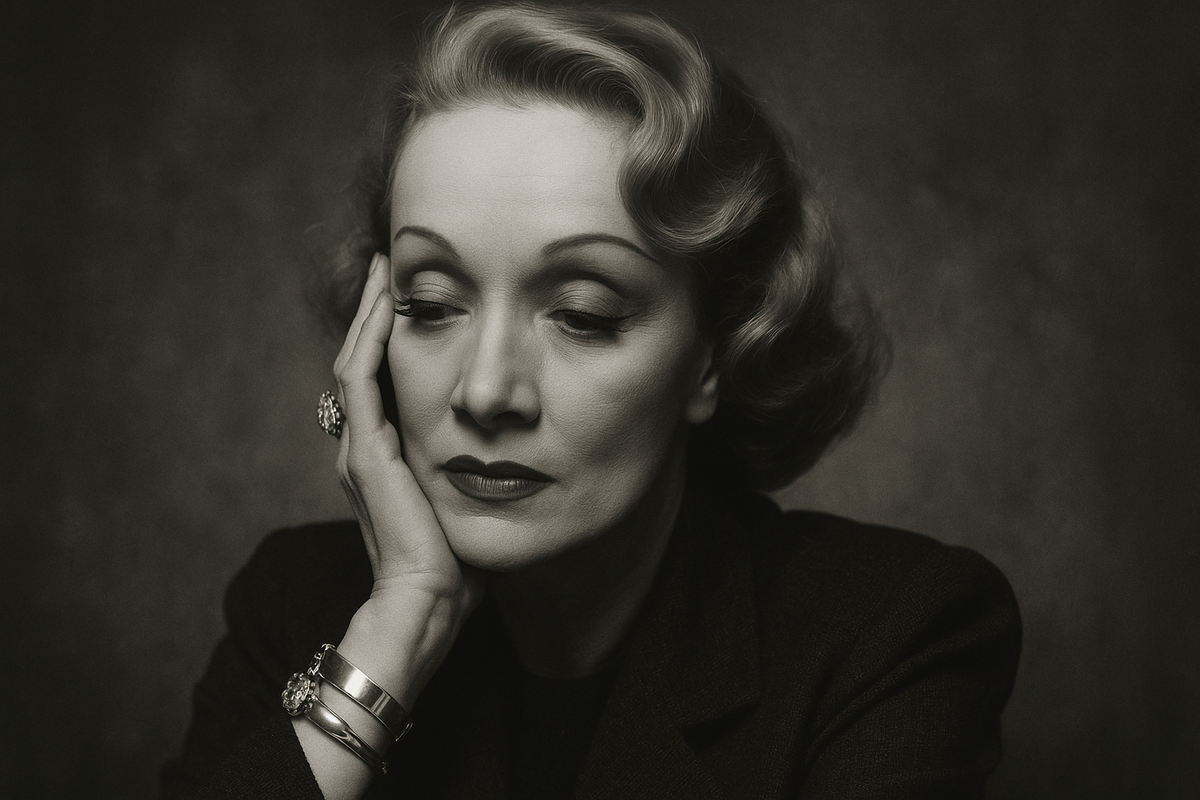
The essay was accompanied by a striking black-and-white portrait of Dietrich that reinforced the piece's duality. Her hand rested against her face, showing off rings and a bracelet. Her eyes were half-lidded, her lips painted dark, her expression serious and reflective. The lighting emphasized her cheekbones and her elegance, evoking both Hollywood glamour and philosophical introspection.
This was not the image of a domestic advice-giver. This was an icon—someone who had lived large and was now sharing the lessons of that life. The photograph told readers that glamour and wisdom were not opposites. They could coexist in the same woman, on the same page.
Unlike other illustrations in the magazine—domestic scenes, cheerful families, product advertisements—this portrait stood out. It was bold, dramatic, and unforgettable.
Why This Issue Mattered Then—and Now
Ladies' Home Journal shaped cultural norms about love, family, and gender roles throughout the 20th century. It connected women across America to both practical knowledge and aspirational ideals. It showed that advice could come not only from experts but from celebrities whose lives were both glamorous and instructive.
For millions of readers in 1954, this was more than an article. It was an experience. To read Dietrich's words was to feel seen—to have the contradictions of love acknowledged by someone who had lived them.
The essay also captured a moment of cultural transformation. Traditional ideals were still dominant, but cracks were beginning to appear. Women were questioning whether domesticity was enough. Dietrich's essay did not call for revolution, but it validated complexity. It said that love could be beautiful and difficult, magical and mundane, worth pursuing and worth questioning.
"You cannot trust your brain. You can trust your heart."
— Marlene Dietrich, January 1954
Collector Significance
Celebrity Authorship
Few vintage magazines feature essays directly authored by international film legends. Dietrich's byline makes this issue especially valuable to collectors of Hollywood memorabilia and women's history.
Iconic Photography
The stark, glamorous portrait of Dietrich adds to the issue's desirability as a display piece. It captures her at the height of her cultural influence.
Cultural Snapshot of 1954
The table of contents reflects the range of mid-century life: fiction, homemaking advice, and features on social issues. It's a time capsule of postwar America.
Historical Timing
Published during a period of cultural transformation, the issue captures both the traditional ideals of the 1950s and the shifts beginning to reshape American society.
Collectors value these issues not just as reading material but as artifacts. To hold one is to hold the same pages that women in 1954 read by lamplight, coffee cup in hand.
The Lasting Legacy
The January 1954 Ladies' Home Journal remains one of the most striking issues of its era, largely because of Marlene Dietrich's "How to Be Loved." In her essay, Dietrich combined romantic idealism with worldly realism, reminding readers that love is both a dream and a daily practice.
Her words resonated in 1954, and they continue to speak today. The advice remains timeless: trust your heart, embrace the magic of love, but prepare for the challenges of everyday life. Do not spend your days complaining. Do not look back with regret. Understand that not every day will feel like Sunday.
As a collectible, this issue is prized for its celebrity contribution, glamorous photography, and cultural significance. As a piece of history, it remains a testament to the power of women's magazines to shape, reflect, and preserve the voices of their time.
Holding this magazine is holding not just a glossy publication but a moment in history—when one of the world's greatest icons shared her heart with millions of women across America.
Explore the Archive
Thousands of original Ladies' Home Journal issues are available for collectors and historians. Each one offers a unique glimpse into American history through fiction, photography, advice, and cultural commentary.
Browse Ladies' Home Journal Magazine Collection