
When Baldwin Saw What America Refused to See
The 1972 Esquire Essay That Merged Two Martyrs
April 1972. America was still bleeding.
Four years after Memphis. Seven since Harlem. The civil rights movement had fractured into a hundred angry voices, each claiming the mantle of King or Malcolm—as if the two men had stood on opposite shores, shouting across an unbridgeable divide.
Then James Baldwin walked into the room and called it a lie.
In the April 1972 issue of Esquire, Baldwin published "Malcolm and Martin," an essay so raw and unsparing that it forced readers to confront an uncomfortable truth: by the time America killed these men, "there was practically no difference between them." Not in their vision. Not in their rage. Not in what they understood about the country that would rather murder its prophets than listen to them.
This wasn't journalism. It was a funeral sermon for a nation that had lost its moral compass.
Archive Details
Publication: Esquire Magazine
Issue Date: April 1972
Featured Essay: "Malcolm and Martin" by James Baldwin
Lead Photography: Carl Fischer
Historical Context: Published 4 years after MLK's assassination, 7 years after Malcolm X's death
The Wound Was Still Open
The early 1970s were a season of rot beneath the surface. Vietnam ground on. Nixon's paranoia metastasized. The civil rights victories of 1964 and 1965—those hard-won legislative triumphs—had revealed themselves as insufficient. Redlining persisted. Police violence escalated. Economic disparity widened.
America had signed the checks but refused to cash them.
Into this moment, Baldwin placed King and Malcolm side by side—not as opposing ideologies, but as converging prophets. He dismantled the sanitized narrative that had already calcified around King: the dreamer, the peaceful one, the acceptable martyr. Baldwin reminded readers that by 1967, King had turned his fire on militarism and economic violence, delivering his "Beyond Vietnam" speech and watching his political support evaporate.
And Malcolm? In his final year, after Mecca, after breaking with the Nation of Islam, Malcolm had begun speaking a language of global human rights that connected Harlem to Hanoi, Birmingham to Bandung. The militant and the minister were walking toward the same conclusion: America's refusal to change would be its undoing.
Both men paid for that clarity with their lives.
Baldwin Made It Personal—and That's Why It Still Burns
"Malcolm and Martin" is not a detached historical essay. Baldwin threaded his own grief through every paragraph. He wrote about the suit he wore to King's funeral, how it became unbearable with the weight of what it symbolized. He summoned private conversations, moments when mourning became witness, when loss demanded testimony.
This is why Baldwin remains essential. He understood that political commentary without personal cost is just performance. His essay was a lament from someone who knew both men, who felt their absence as a bodily wound, and who refused to let America turn them into comfortable statues.
He wrote like a man who knew the country would rather mythologize than listen.
Esquire Gave Baldwin the Stage—and Carl Fischer Gave Him the Image
The magazine didn't bury Baldwin's words in the back pages. It made them the centerpiece, surrounded by one of the most arresting photo essays of the era.
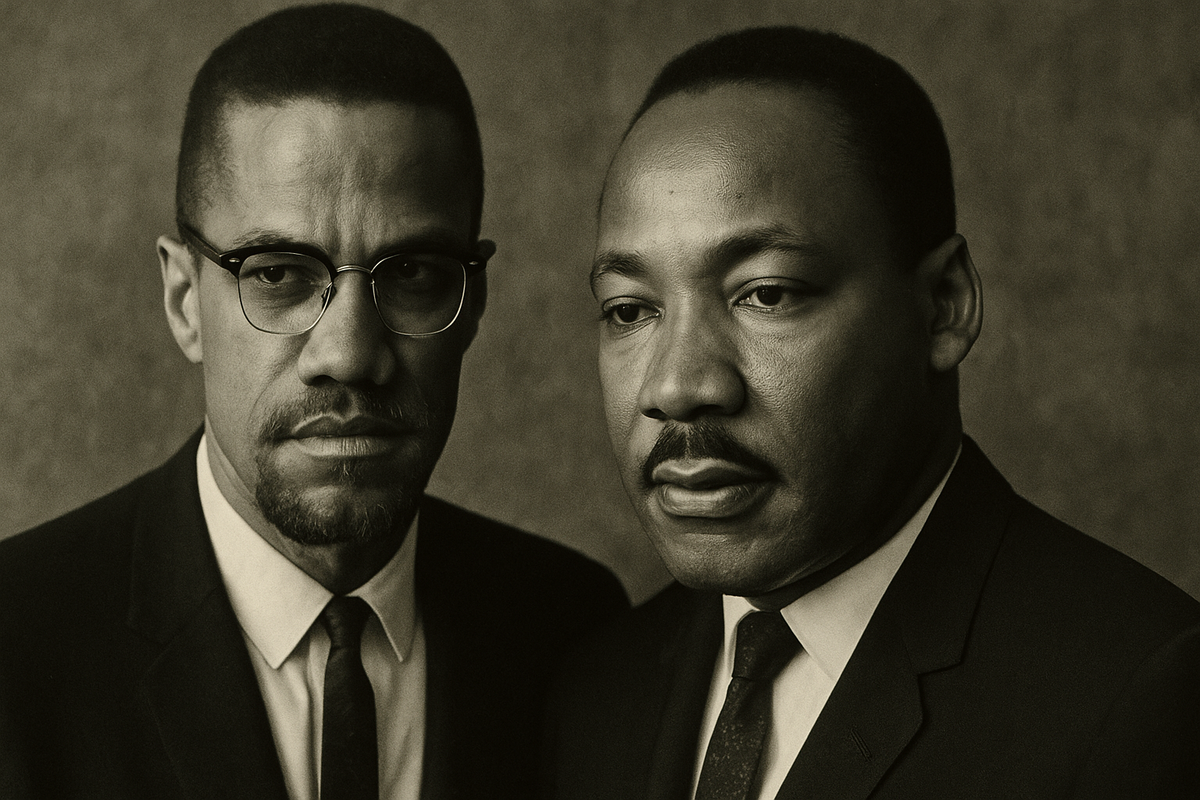
Carl Fischer's lead image: a double-exposure portrait merging Malcolm's face with Martin's. King's half in shadow, bearing the weight of martyrdom. Malcolm's glasses catching light, intensity and defiance crystallized. Two men, one impossible question.
The visual choice wasn't accidental. By fusing them into a single frame, Esquire confirmed what Baldwin was arguing in prose: whatever divisions existed in life, death had united them as twin witnesses against a nation unwilling to change.
This was Esquire at its sharpest—when the magazine understood that style and substance weren't opposites but collaborators. When it knew that great writing paired with great design could create something more than entertainment: a cultural document that refused to let history settle into comfortable lies.
Why This Magazine Was Never Just a Magazine
By 1972, Esquire had already established itself as the forum where America's most urgent conversations took place. It published Norman Mailer's dispatches from the Pentagon march. It gave Tom Wolfe space to invent New Journalism. It treated fiction, politics, and cultural criticism as equally vital.
Publishing Baldwin on King and Malcolm wasn't an editorial risk—it was a declaration of purpose. Esquire positioned itself as the magazine that wouldn't flinch, that would give its greatest writers room to speak uncomfortable truths.
This is why vintage Esquire issues remain more than collectibles. They are primary sources. They capture the texture of American thought at the moment it was being formed, before consensus smoothed the edges, before history decided which voices mattered.
For Collectors: Why This Issue Endures
The April 1972 Esquire occupies a rare space in the market for vintage magazines. It combines literary significance, historical urgency, and visual impact.
Historical Proximity
Published just four years after King's assassination, the essay captures the unresolved grief and rage of the moment. It exists before consensus, before the narratives hardened.
Baldwin's Stature
One of America's greatest writers at his most uncompromising. His presence elevates this beyond ephemera into literature.
Iconic Imagery
Fischer's merged portrait has become one of the defining visual statements about King and Malcolm—a collector's piece in its own right.
Cultural Turning Point
This issue sits at the hinge between the hope of the 1960s and the disillusionment of the 1970s. It's a document of American reckoning.
For collectors of civil rights history, Baldwin scholarship, or 20th-century cultural journalism, this issue is foundational. It's not reading material. It's evidence.
Why Physical Magazines Still Matter
Digital archives flatten history into searchable text. Vintage magazines preserve it as physical artifact—the paper stock, the layout decisions, the advertisements that frame the content. They demand slow reading. They resist skimming.
The April 1972 Esquire is a reminder that American magazines once trusted their readers with complexity. They didn't summarize or simplify. They gave writers like Baldwin the space to think on the page, to challenge, to grieve.
Holding this issue is holding a conversation that America still hasn't finished.
Find Your Copy
For collectors seeking authentic artifacts from America's most turbulent decades, the April 1972 issue represents both historical documentation and literary achievement. Whether you're building a Baldwin collection, preserving civil rights memory, or documenting the evolution of American magazine culture, this issue belongs in your archive.
Browse Esquire Magazine CollectionBaldwin wrote the essay for his moment. But its questions—about justice, violence, and America's capacity for self-deception—remain ours to answer.