
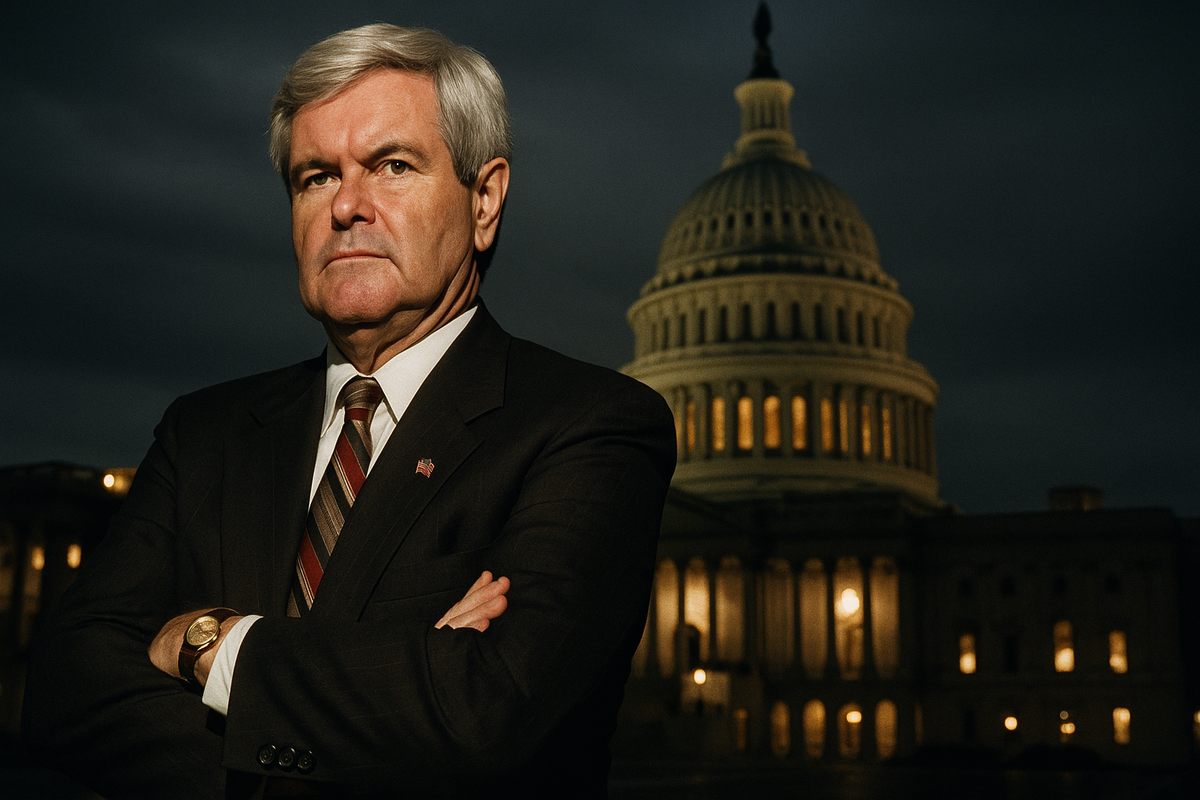
The Shutdown Gambler: When Time Magazine Crowned Newt Gingrich Master of Washington
How the December 25, 1995 issue captured the peak of the Republican Revolution—and the birth of modern partisan warfare
December 1995. The federal government had ground to a halt. National parks sat empty. Passport offices went dark. And on newsstands across America, Time Magazine placed a bet: the most hated man in politics deserved to be Man of the Year.
The headline didn't whisper. Splashed across a black background of Washington by night, massive red letters proclaimed: "MASTER OF THE HOUSE." Inside, editors made their case with surgical precision. Newt Gingrich, Speaker of the House for barely eleven months, had done what four decades of Republican predecessors could not—he'd broken the Democratic stranglehold on Congress and dragged American politics into a new, more brutal era.
Popularity never mattered for this honor. Influence did. And in 1995, no one wielded more of it than the former history professor from Georgia who'd turned the House of Representatives into his personal laboratory for partisan warfare.
Issue Profile
Historical Figure: Newt Gingrich, Speaker of the House
Issue Date: December 25, 1995
Archive Source: Time Magazine Man of the Year Edition
Headline: "Master of the House"
The Revolution That Wasn't Televised—It Was Marketed
The Republican sweep of 1994 didn't happen by accident. Gingrich orchestrated it like a military campaign, complete with a manifesto: the Contract with America. Term limits. Welfare overhaul. Tax cuts. A balanced budget amendment. Ten items, clear as daylight, packaged for maximum political impact.
For the first time in 40 years, Republicans controlled the House. Not since 1954 had the GOP held the Speaker's gavel. Gingrich didn't just accept it—he weaponized it.
Across the aisle sat President Bill Clinton, elected in 1992 as a bridge-building centrist. By 1995, he faced an opposition that had no interest in bridges. Gingrich and his freshmen lawmakers wanted something else entirely: a budgetary showdown that would prove conservatism could govern, even if it meant shutting the government down to do it.
That November, they made good on the threat. The machinery of federal government stuttered to a halt. The gamble was audacious, the stakes existential. Gingrich believed Americans would blame Clinton for refusing to slash spending. He was wrong—but that miscalculation came later. In December 1995, Time captured him at the apex, when revolution still felt inevitable.
Iconography of Power: How Time Framed the Fighter
Time's visual language told the story as sharply as its prose. The magazine didn't just report on Gingrich—it constructed him.
The Battering Ram: An image paired Gingrich with budget chair John Kasich, the duo positioned as the shock troops of fiscal conservatism, ramming reforms through congressional gridlock.
Helmet Maintenance: A barber's chair. Scissors. The Speaker getting groomed. The caption dripped with knowing humor—even revolutionaries need image consultants.
House Disciplinarian: Gingrich confronting freshmen representatives during the shutdown, jaw set, finger likely jabbing. The photograph crystallized his reputation: iron discipline, zero tolerance for defectors.
Who's the Deal Maker?: A contrasting shot with Senate Majority Leader Bob Dole exposed the fault line. Gingrich had vision and fire. Dole had the temperament for negotiation. The Republican Party had both—and the tension between them.
Writers Nancy Gibbs, Karen Tumulty, and Lance Morrow wove biography through political analysis. They traced Gingrich from his childhood through his teaching years and his methodical rise through Republican ranks. The portrait was unsparing: visionary, disruptor, occasional bully. A man who understood that in modern media politics, being seen fighting mattered as much as winning the fight.
The Doctrine of Permanent Combat
Earlier Speakers—Tip O'Neill, Jim Wright—sought accommodation when necessary. They fought, certainly, but within understood boundaries. Gingrich obliterated those boundaries and declared the rubble a feature, not a bug.
He pioneered procedural innovation as performance art. He turned C-SPAN into a weapon, delivering fiery speeches to an empty chamber but a growing cable audience. He united his caucus through shared combat, not shared ideology. Where Democrats had maintained power through incumbency and committee seniority, Gingrich held it through message discipline and the constant threat of primary challenges.
This was polarization as governing philosophy. Division wasn't a problem to solve—it was a resource to harvest. Time's editors grasped this shift. The 1995 Man of the Year issue didn't just document a political moment; it marked the death of one era and the birth of another.
The Contract with America would fade. Some promises delivered, others abandoned. But the methods—the confrontation, the soundbite warfare, the willingness to grind government to a halt for leverage—those would metastasize through both parties for decades to come.
Triumph and Overreach: The Vulnerability Inside the Victory
Time didn't canonize Gingrich. The magazine captured him at his contradictory peak: maximum influence, minimum popularity. Poll numbers showed him deeply unpopular with the American public. His reputation as "too pushy" wasn't media spin—it was measurable political liability.
The government shutdown that seemed tactically brilliant in November looked reckless by December. Clinton's approval ratings climbed. Gingrich's cratered. The Speaker had miscalculated the public mood, believing Americans' abstract distrust of government would translate into support for actually shutting it down. They didn't.
Within a year, Clinton would win reelection. Within three years, Gingrich would resign the Speakership after ethics violations and a failed impeachment gambit. The revolution didn't end—it just found new generals.
But in December 1995, none of that had happened yet. Time froze Gingrich at the moment of maximum possibility, when the Republican Revolution still felt unstoppable and the new rules of American politics were still being written.
Deep Dive: The Key Themes
Revolutionary Tactics
Gingrich was portrayed as a rule-breaker who used procedural innovation and relentless messaging to topple decades of Democratic dominance.
Government Shutdowns
The article highlighted the November 1995 shutdown as proof of Gingrich's willingness to gamble with the machinery of government to achieve his goals.
The Inner Circle
Figures like John Kasich were shown as enforcers of Gingrich's agenda. Together, they embodied a new generation of Republican leadership.
Polarization as Power
Where earlier Speakers sought compromise, Gingrich embraced division. He understood that fighting—and being seen fighting—was its own form of influence.
Vision and Vulnerability
Though hailed as a revolutionary, Gingrich's weaknesses were also clear: poor personal popularity, a tendency to overreach, and a reputation as "too pushy."
Media as Weapon
Time's editorial framing—bold visuals, sharp prose—demonstrated how the magazine itself shaped public understanding of Gingrich's influence and methods.
The Archive as Testament
Time Magazine in 1995 operated at the height of print journalism's cultural authority. A cover story didn't just add to the conversation—it set the agenda. By naming Gingrich Man of the Year, Time framed the narrative of American politics not as legislative skirmishes but as philosophical warfare over the purpose of government itself.
The magazine gave readers more than facts. It provided context, interpretation, meaning. It preserved not just what happened, but what it felt like to witness history accelerating.
The December 25, 1995 issue stands as testament to that moment: when a former backbencher from Georgia became the most powerful Republican in America, when the government shut down over budget ideology, when the political methods of the 21st century first emerged from the partisan combat of the late 20th.
Why This Issue Endures
Visual Impact
The bold red-and-black cover design remains striking three decades later. It's theatrical, unsubtle, impossible to ignore—much like its subject.
Historical Pivot Point
The issue captures the Republican Party at high tide, before internal fractures and public backlash eroded the unity Gingrich had forged. It documents the precise moment when partisan warfare became the new normal.
Cultural Artifact
In an age before digital news atomized media consumption, Time shaped national conversation. Its framing mattered. Declaring Gingrich Man of the Year wasn't just reporting—it was an editorial argument about what 1995 meant.
Political DNA
Anyone seeking to understand modern American conservatism must reckon with Gingrich's 1995. This issue provides the primary source material for that reckoning.
Collector Value
Man of the Year editions have always been among the most sought-after in Time's archive. Well-preserved copies without mailing labels or damage command particular interest.
Living History
Even worn copies carry value—they were read, carried, argued over. That wear tells its own story of a nation grappling with political transformation.
Collecting the Revolution
The December 25, 1995 issue of Time Magazine—featuring Newt Gingrich as "Man of the Year" with the headline "Master of the House"—captures the Republican Revolution at its apex. Bold photography, sharp political analysis, and historical significance make this a cornerstone piece for collectors of vintage Time magazines and anyone studying the origins of modern partisan politics.
Browse Time Magazine CollectionFrom World War II to the culture wars of the 1990s, Time chronicled the figures and moments that changed the world. Each issue isn't just reading material—it's an artifact of living history, waiting to be held.