
The Private World of Joan Didion
Inside Vogue's 1972 Portrait of Literary California
When Vogue's readers turned to page 140 of the October 1, 1972 issue, they crossed a threshold few magazines dared to offer: access to the working life of Joan Didion. Not Didion the public intellectual, but Didion at home—writing in a cramped room above the Pacific, cooking lunch for her husband and daughter, living the California dream at its most articulate.
"Writers' Roost," photographed by Henry Clarke, wasn't a celebrity puff piece. It was something rarer: a document of how two of America's most unsparing literary voices actually lived and worked. Joan Didion and John Gregory Dunne had spent the previous four years dissecting American chaos—Vietnam, Hollywood, the crumbling counterculture. Now Vogue was dissecting them, and the result was a feature that transcended lifestyle journalism to become cultural archaeology.
This wasn't accidental. By 1972, Vogue understood that fashion and intellect occupied the same territory. The woman who read about Halston also read Didion. The aesthetics of a Malibu writing room mattered as much as the cut of a sleeve. This single feature proved it.
Archive Details
Historical Figures: Joan Didion, John Gregory Dunne, Quintana Roo Dunne
Issue Date: October 1, 1972
Photographer: Henry Clarke
Feature Title: "Writers' Roost"
Archive Source: Vogue Magazine
The Moment: California as America's Nerve Center
The early 1970s were years of unraveling. Watergate hearings would begin within months. The Vietnam War ground on, filling American living rooms with nightly body counts. The women's movement was rewriting the rules of work, marriage, and domesticity. And California—sun-drenched, sprawling, contradictory—had become the nation's psychological laboratory.
Didion had already established herself as the era's most penetrating observer. Slouching Towards Bethlehem (1968) captured the fracturing of 1960s idealism. Play It As It Lays (1970) laid bare Hollywood's existential emptiness. Her prose was cool, precise, devastating. She wrote about dislocation as if it were weather.
John Gregory Dunne matched her intensity with a different register—acerbic, political, grounded. Together they formed a rare literary partnership, collaborating on screenplays while maintaining separate writing identities. By 1972, they had adapted Play It As It Lays for the screen and were navigating the strange machinery of Hollywood while raising their daughter, Quintana Roo.
Vogue's decision to profile them was shrewd. The Didion-Dunne household wasn't just a home—it was an emblem of how American intellectuals were living through national turbulence.
Post-War Malibu: The House as Character
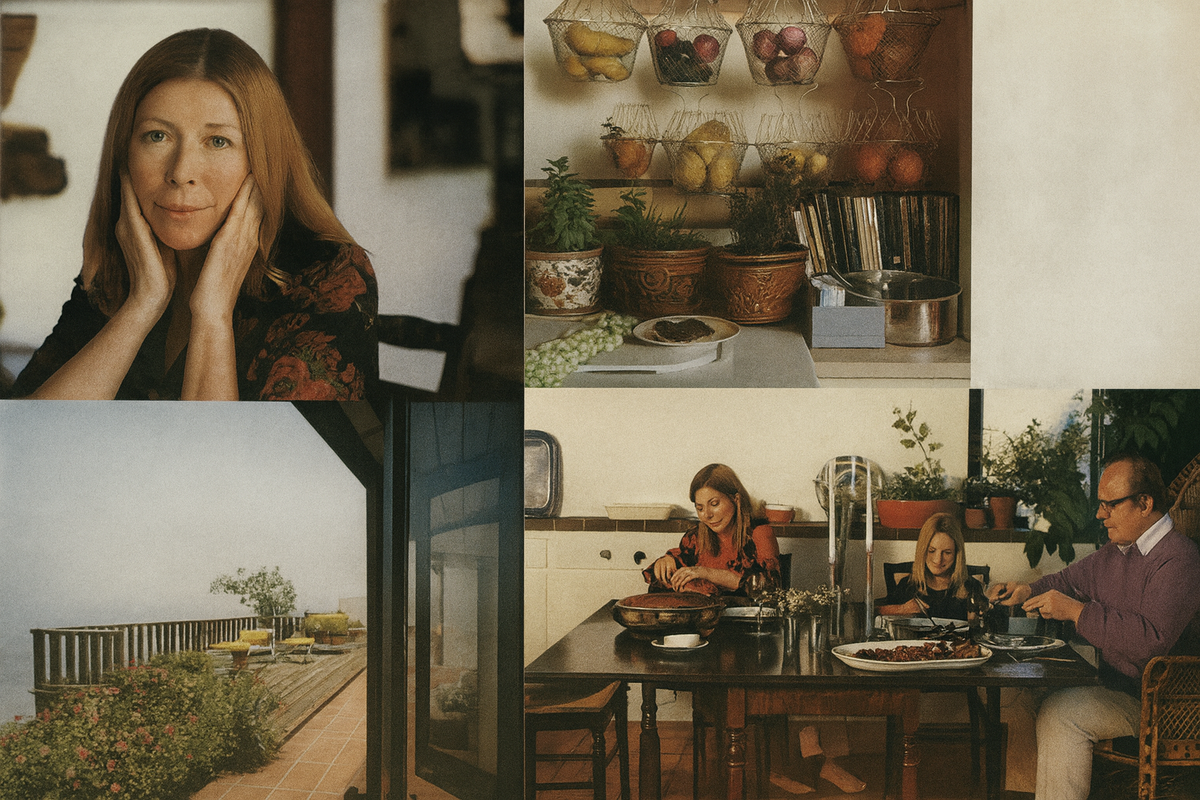
The house itself resisted grandeur. Perched above the Pacific, it embodied what Vogue called "Post-War Malibu" style—terracotta floors, French doors opening onto flowered terraces, Mexican tile in the dining room. Federal antiques sat alongside rustic crafts. The effect was unpretentious but considered, a studied casualness that reflected Didion's own aesthetic: severe clarity dressed in simplicity.
Henry Clarke's photographs captured this tension perfectly. Joan sits in a floral dress, her expression somewhere between present and absent—the face of someone perpetually observing. John works at a fourteen-foot table in the library, papers spread across its surface like evidence. Quintana Roo plays in sun-flooded spaces. The dining room, crowded with potted herbs and fruit baskets, looks lived-in rather than staged.
These weren't fashion photographs adapted for an editorial feature. They were anthropological studies disguised as portraiture.
The Discipline of Close Quarters
The article revealed something crucial: Didion's famous prose—those sentences that feel inevitable, irreversible—emerged from confinement. She wrote in a small room, deliberately cramped. "I like that close-quarters feeling," she explained. The compression wasn't metaphorical. She needed physical restriction to achieve stylistic control.
John worked differently. His process was steady, low-key, productive—hours at the long library table, methodical rather than feverish. Yet they collaborated seamlessly on screenplays, merging their distinct sensibilities into joint work. The house accommodated both modes: Joan's intensity, John's endurance.
Even their domestic rituals served the work. Joan cooked and served lunch—not as obligation but as structure. Meals marked time. The rhythm of the household supported the rhythm of writing. Secretary Christina Moore handled correspondence and logistics, the invisible infrastructure that allowed two full-time writers to function.
What Vogue documented was the truth most magazine profiles miss: creativity requires scaffolding.
"We Look Like the Three Bears"
The feature's most disarming moment came when Didion described their family dynamic: "We look like the Mama Bear, Papa Bear, and Baby Bear. The only thing is, I'll always think I'm the Baby Bear."
It's a startling admission from a writer whose public persona was cool detachment. That self-image—Didion as the perpetual child in her own household—suggested something about her relationship to domesticity, to marriage, to motherhood. She observed her own family life with the same slight remove she brought to everything else.
The quote humanized her without softening her. It was Vogue at its editorial best: intimate without being intrusive, revealing without exposing.
Deep Dive: Key Themes
Post-War Malibu Style
Terracotta tile, French doors, Mexican pottery, and Federal antiques created a setting that was both casual and considered—California refinement without pretension.
The Writing Partnership
Didion and Dunne maintained separate literary identities while collaborating on screenplays—a rare balance of independence and creative intimacy.
Domestic Discipline
Structured meals, defined workspaces, and administrative support revealed how two intense writers sustained parallel careers while raising a child.
The Three Bears Quote
Didion's self-image as "Baby Bear" offered a rare glimpse into her relationship with domesticity and family—tender yet characteristically self-aware.
Henry Clarke's Photography
Clarke's images transcended lifestyle photography to become anthropological documents—preserving the visual record of literary California at its peak.
Vogue's Editorial Ambition
The feature proved that fashion magazines could document intellectual life with sophistication—literature and style as inseparable cultural forces.
Why This Issue Commands Collector Attention
Photographic Record
Henry Clarke's images of the Malibu house are among the most complete visual documents of Didion and Dunne's domestic life during their most productive years. Comparable photographs simply don't exist in such editorial polish.
Cultural Intersection
The feature proves Vogue's editorial ambition during Diana Vreeland's final year as editor-in-chief. Literature wasn't side content—it was central to how the magazine understood women's lives.
Didion's Iconography
By the 2010s, Didion would become a literal fashion icon (see: the 2015 Céline campaign). This 1972 profile captures the origin point—when her style was incidental to her work, not yet commodified.
Historical Scarcity
Well-preserved issues are increasingly difficult to source. Magazine collectors and rare book dealers both pursue this issue, driving value in overlapping markets.
Contextual Completeness
The issue contains the full editorial context—advertisements, fashion spreads, cultural coverage—that surrounded the Didion feature. It's a snapshot of 1972 as a complete cultural moment.
Vogue as Archive
Vintage Vogue magazines function as accidental archives. They weren't designed for preservation, yet they've become indispensable records of how aspirations, anxieties, and aesthetics evolved across decades. The October 1972 issue exemplifies this: between its covers, you can trace the shifting definition of the American woman writer—from domestic background figure to cultural authority.
For collectors searching "Vogue magazine October 1972" or "Joan Didion Vogue feature," this issue represents a specific intersection that won't recur. Fashion magazines no longer profile writers this way. Writers no longer occupy this particular cultural position. The document is complete and irreplaceable.
Begin Your Collection
If you collect literary ephemera, California cultural history, or Vogue's editorial legacy, the October 1, 1972 issue belongs in your archive. It's more than a magazine—it's primary source material.
Browse Vogue Magazine CollectionFrom the 1930s through the 1990s, each issue preserves the aesthetics and intellectual currents of its era.
The Enduring Value of "Writers' Roost"
Vogue's 1972 profile of Joan Didion and John Gregory Dunne captured something that resists replication: the working life of two writers at the height of their powers, observed with editorial sophistication and photographic artistry. It documented not just a house in Malibu, but a way of thinking about work, family, and California during a pivotal American moment.
The feature succeeded because it trusted its subject and its audience. It didn't explain Didion—it showed her. Forty years before she became a fashion campaign, Vogue understood that her significance exceeded any single category.
For readers and collectors today, this issue remains what it was in 1972: evidence that great magazines don't just reflect culture—they create the record we inherit.