
The Magazine That Made Americans Witness
Edgar Snow's 1943 Report From Occupied Russia
On May 29, 1943, millions of Americans opened their mailboxes to find Norman Rockwell's latest cover staring back at them from The Saturday Evening Post. Inside, between the serialized fiction and advertisements for war bonds, they encountered something that would not let them look away: Edgar Snow's "I Saw It With My Own Eyes."
This wasn't commentary. It wasn't propaganda. It was testimony—photographs of orphaned children sitting in scorched villages, accounts of public hangings in Smolensk's central square, survivor interviews describing starvation so complete that people ate potato peelings and died in the streets. For most American readers, this issue represented their first sustained look at what Nazi occupation actually meant: systematic extermination, not as rumor, but as documented fact.
The juxtaposition was deliberate and devastating. Rockwell's cover offered the reassurance of American values. Snow's reporting showed what happened when those values faced annihilation.
Archive Details
Why This Moment Mattered
Spring 1943 sat at the war's pivot point. The Soviet victory at Stalingrad had turned back Hitler's eastern advance only months earlier. Allied forces had German troops retreating in North Africa. Yet the outcome remained uncertain, and the full scope of Nazi crimes was only beginning to penetrate Western consciousness.
Snow's eyewitness account from Smolensk and surrounding Russian villages arrived at this inflection point with forensic precision. He documented mass starvation campaigns, the deliberate razing of entire cities, the deportation of civilian populations, and executions staged as public spectacle. For Americans still processing the scale of the conflict, the article confirmed an essential truth: this was not a territorial dispute between nations. This was a fight against a regime committed to extermination as policy.
The Post as Cultural Witness
By 1943, The Saturday Evening Post commanded a circulation in the millions, making it one of America's most influential cultural platforms. Known for its Rockwell covers, serialized novels, and short fiction, the magazine occupied a unique space—simultaneously a source of entertainment and serious journalism capable of shaping national opinion.
Snow's report exemplified this dual mission. Unlike battlefield dispatches or government bulletins, his account gave the war a human architecture. Readers saw photographs. They encountered the voices of survivors describing fear so constant that children learned to sleep through bombardments, hunger so severe that weeds became meals, trauma so profound that teenage partisan fighters described killing German soldiers as "vengeance for my family."
For countless Americans, turning these pages constituted their closest encounter with Nazi crimes as they were happening.
Rockwell's Cover, Snow's Reality
The May 29, 1943 cover presented Rockwell's signature vision of American life—the values the nation was defending. Inside, Snow's reporting revealed what happened to those same values under fascist occupation.
This editorial architecture was strategic. It reminded readers why their sacrifices mattered: rationing, enlistments, war bond purchases, the transformation of peacetime industries. Rockwell showed what America was protecting. Snow showed what would happen if it failed.
The combination of fiction, essays, illustration, and investigative reporting made the Post distinct. It wasn't merely a magazine. It was a national conversation about identity, purpose, and survival.
What Snow Saw
The article contained details that remain among the most visceral published in American media during the war:
Orphans of Occupation
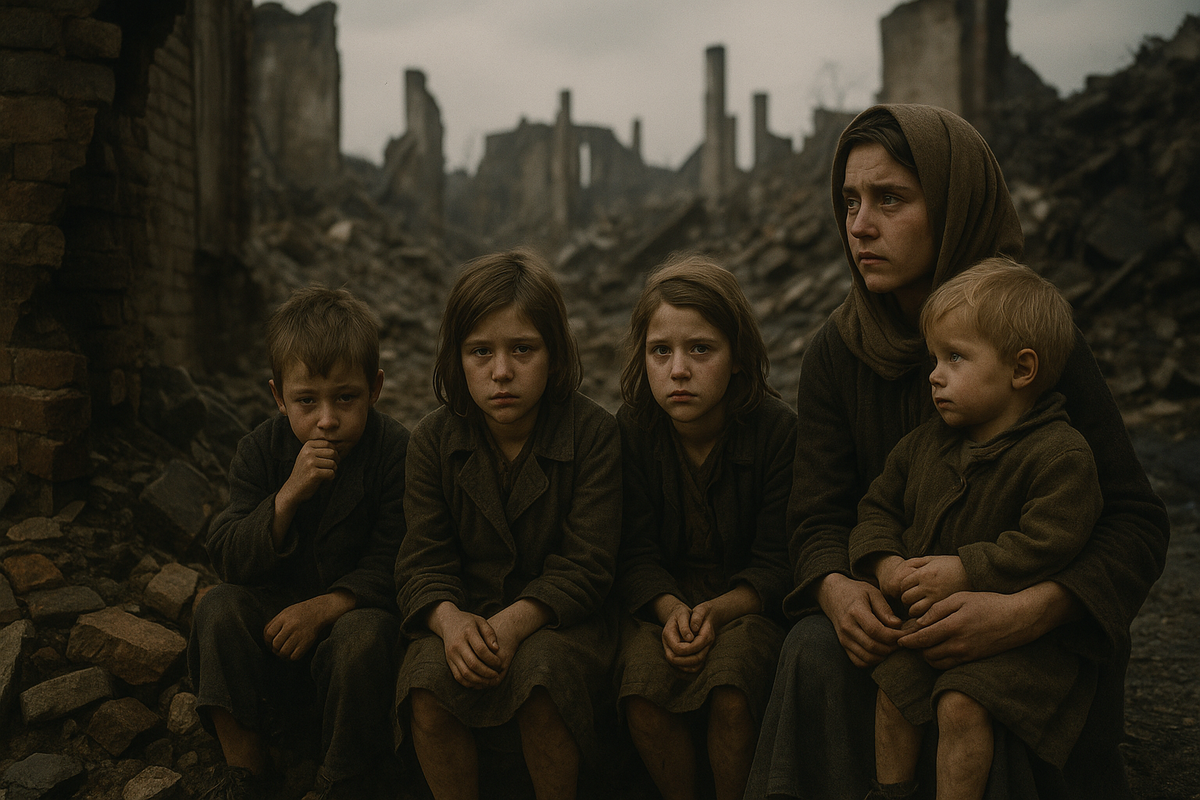
Snow documented Russian children left alone after their parents were executed or deported to Germany as forced labor. Photographs showed these children sitting in ruins, the sole survivors of their villages.
Public Terror
In Smolensk, Snow witnessed the aftermath of a hanging: a Russian woman's body left displayed in the square, a calculated act of intimidation meant to paralyze resistance.
Engineered Starvation
Civilians survived on bread crusts, rotting potatoes, and foraged weeds. Some interviews described weeks of hunger so acute that corpses appeared daily in the streets.
Partisan Resistance
Snow spoke with guerrilla fighters, including teenage girls, who acknowledged killing German soldiers without hesitation. One young woman stated: "I am glad I killed them. It was vengeance for my family."
Obliterated Cities
Entire towns had been leveled—factories, schools, hospitals reduced to rubble. In some regions, Snow reported, only one-third of the prewar population remained alive.
Systematic Extermination
Snow emphasized that these were not isolated atrocities but deliberate Nazi policy: destroy infrastructure, eliminate civilians, starve survivors, deport the rest.
Each detail reinforced the article's essential argument: the war concerned the survival of civilization itself.
The Permanence of Paper
Wartime issues of The Saturday Evening Post endure because they operate as time capsules. Every page reflects the urgency, fear, and resolve of the 1940s. Unlike digital news that vanishes into archives, these magazines were saved, reread, and passed through generations.
That physical permanence makes them invaluable for research and collection. They preserve survivor testimony, Rockwell's visual rhetoric, and the narratives that defined a nation at war.
Why Collectors Pursue This Issue
The May 29, 1943 Saturday Evening Post commands significant interest among serious collectors for overlapping reasons:
Historical Positioning
Published immediately after Stalingrad, it captured the moment when Allied momentum began shifting but victory remained uncertain.
Snow's Eyewitness Account
The article stands as one of the earliest widely distributed American reports documenting Nazi crimes in Eastern Europe with on-the-ground specificity.
Rockwell's Wartime Art
Covers from this period, when Rockwell's illustrations directly engaged themes of sacrifice and national purpose, attract sustained collector attention.
Preservation and Rarity
Well-maintained issues with intact covers, sharp color reproduction, and complete pages draw interest from collectors, cultural historians, and research institutions.
These magazines function as more than reading material. They are primary sources—artifacts of journalism, propaganda, and cultural memory.
Explore the Archive
If you're researching this issue or exploring similar wartime publications, thousands of original Saturday Evening Post magazines remain available through specialized collections. From the Great Depression through the postwar decades, these issues trace the evolution of American culture, politics, conflict, and art as events unfolded in real time.
Browse The Saturday Evening Post Magazine CollectionWhether you collect for investment, research, or family history—honoring relatives who lived through the war years—these magazines offer something increasingly rare: the chance to encounter history as it was first reported, before retrospective analysis reshaped the narrative.
Why This Issue Still Matters
The May 29, 1943 Saturday Evening Post remains one of the most consequential wartime publications of its era. Edgar Snow's "I Saw It With My Own Eyes" revealed, through testimony and photographs, both the systematic nature of Nazi occupation and the resilience of those who survived it.
For Americans in 1943, the article clarified the stakes of their sacrifice. For readers today, it demonstrates why eyewitness journalism matters and why preserving these issues means preserving more than paper—it means preserving memory itself.
To hold this issue is to hold the story of orphans in ruins, of civilians starving in occupied cities, of resistance fighters who refused to yield. It is also to hold the story of America, committing to fight until such atrocities would end.