
When America's Divorce Courts Ran on Lies
The 1950 Exposé That Shook the Nation
On February 18, 1950, millions of Americans opened their mailboxes to find the latest issue of The Saturday Evening Post—and inside, a truth so uncomfortable it had been hiding in plain sight for decades.
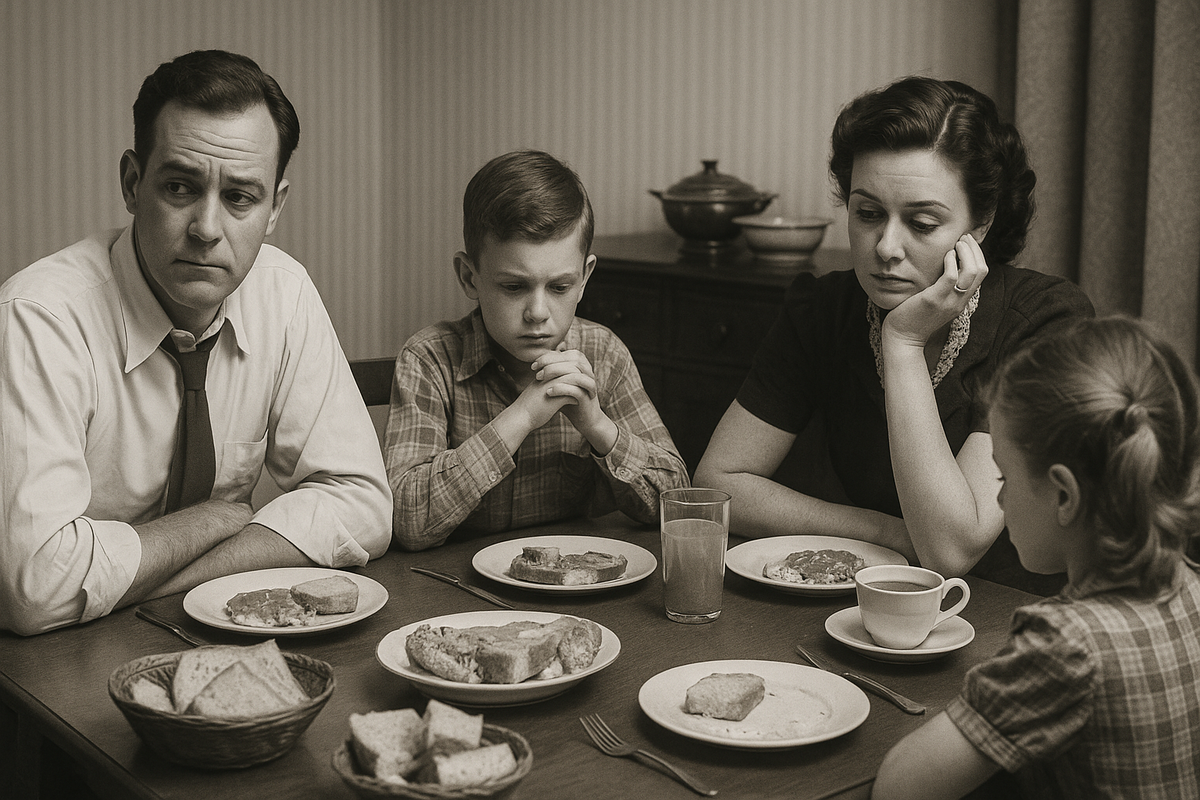
The cover, painted by Jack Welch, showed a father at the supper table surrounded by his children: the picture of postwar domestic bliss. But turn past the advertisements for Coca-Cola and Cadillac, and readers found something else entirely: "Perjury Unlimited" by David G. Wittels, the fifth and final installment in the Post's explosive series on divorce.
The article's thesis was as simple as it was damning: America's divorce courts didn't just tolerate dishonesty. They required it.
Judges admitted they ignored perjury as a matter of routine. Lawyers confessed their clients had no choice but to lie. And in courtrooms from Detroit to Reno, the machinery of justice ground forward on a foundation of false testimony, staged cruelty, and legal fictions so transparent they might as well have been scripted.
This wasn't a fringe problem. By 1950, more than 300,000 divorces were being filed annually—and nearly all of them depended on fabricated evidence. The American Bar Association didn't mince words: "Our divorce laws are a mess … rotten."
For a nation that prided itself on prosperity, faith, and family values, this was more than a legal embarrassment. It was a moral crisis.
Historical Archive
Publication: The Saturday Evening Post
Issue Date: February 18, 1950
Featured Article: "Perjury Unlimited" by David G. Wittels
Cover Artist: Jack Welch
Series: Five-part investigation on American divorce
The Contradictions of 1950
The year itself was a study in contrasts. America had survived the Depression, won the war, and was riding high on economic growth and suburban expansion. The baby boom was remaking demographics. Consumer culture was exploding. The future looked bright.
But beneath the chrome and optimism, something had fractured. Divorce rates had skyrocketed during and after World War II, and religious leaders were sounding alarms about moral decay. The family—cornerstone of American identity—was under siege, and the institutions meant to protect it were failing.
Enter Dr. William J. Goode, a sociologist at Wayne University who studied 425 Detroit families navigating the wreckage of broken marriages. His research became the backbone of the Post's series, revealing not just statistical trends but human toll: children growing up mistrustful and unstable, spouses trapped in legal absurdities, and a system that rewarded dishonesty.
"Perjury Unlimited" was the capstone—a forensic dissection of how the law had become complicit in the very breakdown it was supposed to prevent.
Why The Saturday Evening Post Mattered
By 1950, the Post was more than a magazine. It was a cultural institution, second only to Life in circulation and influence. With its Norman Rockwell covers, its serialized fiction, and its blend of humor and hard-hitting commentary, the Post shaped how middle-class America saw itself.
But it wasn't a tabloid. When the Post investigated something, it did so with the authority of photographs, case studies, and expert testimony. Wittels' article featured the stern, world-weary face of Judge Samuel Silbert of Cleveland, who had presided over more than 70,000 divorce cases—a man who had seen it all and knew exactly how broken the system was.
The juxtaposition was deliberate: cheerful domesticity on the cover, brutal honesty inside. It mirrored the contradictions of American life itself—the gap between what the country wanted to believe about itself and what was actually happening behind closed doors.
That balance made the Post indispensable. It wasn't preaching to the converted or pandering to sensationalism. It was bringing uncomfortable truths into living rooms, forcing a national conversation that no one else dared to start.
The Anatomy of a Broken System
Wittels didn't rely on abstract analysis. He gave readers cases—real, named, absurd.
The Campbell Case
A couple received an "automatic divorce" without ever appearing in court, only to discover later they were still legally married. Their story became shorthand for systemic farce.
Judge Silbert's Testimony
With decades on the bench, he admitted the quiet truth: the system essentially forced couples into dishonesty because no-fault divorce didn't exist.
Nevada's Divorce Industry
Nevada had turned divorce into commerce, with minimal residency requirements and scant oversight. Thousands fled there to dissolve marriages that couldn't be legally ended in their home states.
Perjury as Standard
Lawyers coached clients on what to say. Witnesses testified to events they'd never seen. Judges, exhausted and cynical, waved it all through.
The Cost to Children
Children bore the deepest scars: emotional trauma, mistrust, instability. The institution designed to protect them was teaching them that authority figures lie.
Call for Reform
The American Bar Association urged a uniform national divorce law, warning that the patchwork of state regulations was undermining American justice.
If you wanted out of a marriage, you had to accuse your spouse of cruelty, desertion, or adultery—whether it was true or not. The alternative—enforcing the law—would have ground the courts to a halt.
The cost wasn't just legal. It was human. The very institution designed to protect families was teaching the next generation that marriage is disposable and the law is a charade.
The Echo Across Decades
The issues Wittels identified in 1950 didn't vanish. It took until 1969 for California to pass the first no-fault divorce law, and another two decades before the rest of the country followed. Even today, debates over marriage, family law, and the role of courts in private life remain unresolved.
What makes the Post's series enduring is its refusal to offer easy answers. It didn't blame individuals. It blamed a system that trapped people in impossible choices—and then punished them for lying their way out.
Unlike fleeting digital media, these magazines are permanent records. They show us how Americans grappled with their most intimate struggles in public, how journalism could shape policy, and how even prosperity and progress can coexist with profound dysfunction.
Why Collectors Seek This Issue
Historical Timing
Published at the moment when America was renegotiating what family meant, capturing a cultural turning point between public prosperity and private turmoil.
Editorial Courage
Few mainstream publications dedicated five issues to divorce—a subject still considered taboo in polite company. The Post's boldness makes these issues historically important.
Cultural Juxtaposition
The gap between Welch's wholesome cover and Wittels' unflinching reporting wasn't an accident. This issue embodies the duality of mid-century America.
Permanent Record
A time capsule of how journalism forced a nation to confront itself, preserved exactly as readers first encountered it in their mailboxes.
Explore the Archive
Thousands of original Saturday Evening Post magazines—from the 1930s through the 1970s—are available in our collection. Each issue is a window into the culture, politics, and social debates of its moment.
Browse The Saturday Evening Post Magazine CollectionThe February 18, 1950 issue of The Saturday Evening Post remains one of the most significant artifacts of mid-century American journalism. "Perjury Unlimited" didn't just report on a broken system—it forced the country to admit the break existed.
To hold this issue is to hold a contradiction: a nation prosperous in public, troubled in private. A legal system designed to uphold morality, running on deceit. An editorial tradition that balanced aspiration with exposure, optimism with honesty.
Seventy-five years later, that honesty still cuts. And that's exactly why it matters.