
The Day Forbes Predicted Your Wallet Would Disappear
How a 1976 magazine article foretold the death of paper checks, the rise of ATMs, and the cashless economy we live in today
July 1, 1976. Bicentennial summer. America is drowning in paper checks.
A housewife in Lincoln, Nebraska writes 47 checks a month—grocery store, electric bill, mortgage, department store. Each one gets mailed, sorted, physically transported between banks, stamped, filed. The system is choking on its own paperwork. Banks employ armies of clerks just to shuffle checks from one building to another.
And then Forbes Magazine publishes something extraordinary.
Not a prediction. A blueprint.
"The U.S. Has a Date With Electronic Banking" hit newsstands that summer like a manifesto from the future. While America celebrated 200 years of independence with tall ships and fireworks, Forbes was explaining how money itself was about to be reinvented—how plastic cards would replace paper, how machines would replace tellers, how electrons would replace envelopes.
They weren't guessing. The revolution had already begun.
The Paper Chase Was Ending
By mid-1976, the American banking system had reached an absurd crescendo. The Federal Reserve processed billions of checks annually. Armored trucks crisscrossed cities carrying bags of paper. Bank vaults overflowed with canceled checks—your only proof that you'd paid the landlord, that you'd settled up with the dentist.
Forbes understood what most Americans couldn't yet see: this was unsustainable.
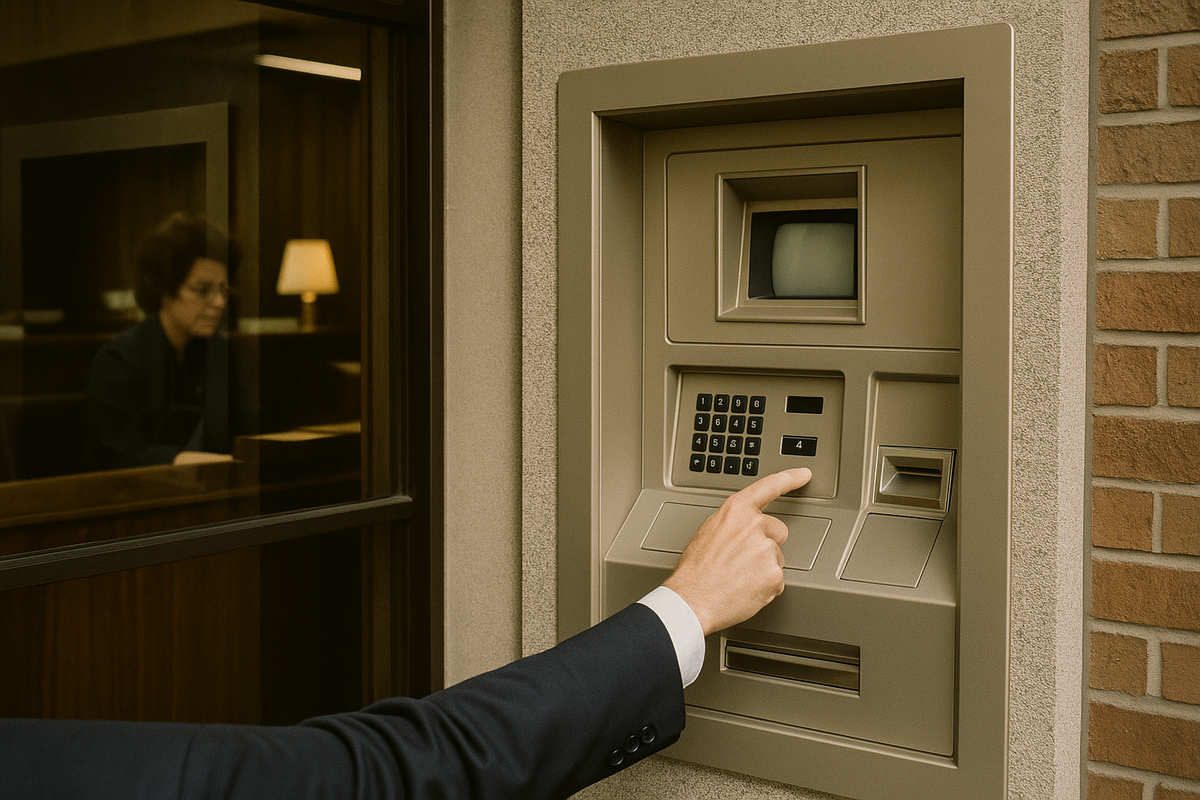
The magazine laid out the coming transformation with surgical precision. BankAmericard and Master Charge were preparing to launch debit cards nationwide—plastic rectangles linked directly to checking accounts, bypassing checks entirely. Atlanta had already installed "Alltime Teller" machines in shopping centers, metal boxes that dispensed cash at midnight on Sunday. In Lincoln, Nebraska, grocery stores were testing terminals that let customers pay electronically at checkout.
This wasn't Wall Street innovation. This was revolution at the supermarket.
Forbes described a shopper in 1980—just four years away—sliding a card through a terminal instead of fumbling for a checkbook. A factory worker watching his paycheck materialize in his account electronically, no paper stub required. A college student withdrawing twenty dollars from a glowing machine at 2 a.m., no banker necessary.
The vision was so practical, so inevitable, that it read less like journalism and more like time travel.
Archive Details
Publication: Forbes Magazine
Issue Date: July 1, 1976
Feature Article: "The U.S. Has a Date With Electronic Banking"
Historical Context: Published during America's Bicentennial celebration
Key Figure: Virginia Knauer, Consumer Affairs Advisor to President Gerald Ford
The Privacy Warning Nobody Heeded
But Forbes didn't serve up utopia without consequences.
The article spotlighted Virginia Knauer, consumer affairs advisor to President Gerald Ford, who raised a question that reverberates today: What happens when your canceled check—your physical proof of payment—vanishes into electronic ether? When every transaction becomes a data point stored in a bank's computer? When governments and corporations can track your spending with perfect accuracy?
Knauer's warning in 1976 reads like prophecy in 2025. Data breaches. Digital surveillance. Financial privacy erosion. Forbes understood that electronic banking wasn't just about convenience—it was about power. Who controls the data controls the money.
The magazine presented this tension without melodrama, letting readers grapple with the trade-off: efficiency versus oversight, speed versus security, progress versus privacy.
Fifty years later, we're still grappling.
Why This Issue Matters
Forbes in the 1970s operated with a swagger that made competitors look timid. Malcolm Forbes ran the magazine like a capitalist performance art piece—bold covers, unapologetic editorials, a worldview that celebrated wealth creation without apology.
This July 1, 1976 issue exemplified that confidence. The article didn't hedge. It didn't wonder if electronic banking would arrive. It declared that America "has a date"—an appointment that couldn't be postponed.
The visual storytelling reinforced the message. Photographs contrasted ornate bank lobbies with their marble columns and wood paneling against sleek ATM terminals with glowing buttons and digital displays. The old guard versus the new machine. The aesthetic shift alone told the story: finance was moving from temples to terminals.
Forbes understood that business journalism wasn't about reporting the present—it was about shaping the future. This article didn't just describe debit cards and ATMs. It legitimized them. It told executives, investors, and everyday Americans that electronic banking was serious, inevitable, necessary.
And they were right.
The Artifacts That Document the Revolution
Debit Cards Go Universal
BankAmericard evolved into Visa. Master Charge became Mastercard. Today, billions of transactions flow through these networks daily.
ATMs Colonize the Landscape
From 2,000 machines in 1976 to over 470,000 in the United States today, the "Alltime Teller" became as common as the telephone.
Supermarkets as Financial Hubs
That Lincoln, Nebraska experiment? Now you can cash checks, load prepaid cards, and send money transfers from the grocery store checkout lane.
Privacy Debates Intensify
Knauer's concerns metastasized into Congressional hearings, data protection laws, and ongoing battles over financial surveillance.
Paper Died
The Federal Reserve processed 30 billion checks in 1990. By 2022, that number had fallen to 3.4 billion—and dropping fast.
Forbes Got It Right
They didn't just document this transformation. They announced it before most Americans understood it was happening.
For Collectors: A Blueprint in Newsprint
Historical Timing
Released during the U.S. Bicentennial, it captures America at an inflection point—looking backward at two centuries of history while unknowingly stepping into the cashless economy we inhabit today.
Technological Breakthrough
Contains one of the earliest mainstream examinations of the technologies that now govern how we pay rent, buy groceries, and transfer money across continents.
Enduring Relevance
As we debate cryptocurrency, central bank digital currencies, and the death of cash, Forbes' 1976 analysis remains startlingly relevant. The questions haven't changed. Only the technology has evolved.
The Magazine That Saw Tomorrow
Nearly fifty years after publication, the July 1, 1976 Forbes Magazine endures as one of the most prescient business articles of the 20th century. It captured the birth of electronic banking not as distant theory but as imminent reality—machines in supermarkets, cards in wallets, money moving at the speed of electricity.
This wasn't speculation. It was documentation of a revolution already underway.
For collectors, historians, and anyone fascinated by how the future arrives, vintage business magazines like this Forbes issue are irreplaceable artifacts. They preserve the moment when tomorrow became visible—when journalists could see what most people couldn't yet imagine.
The cashless economy didn't emerge overnight. It was announced, explained, and illuminated by publications willing to look past the next quarter and see the next century.
Forbes looked. And they told us what was coming.
Explore the Archive
Discover more historic Forbes magazines and other rare 20th century publications that documented the moments when the future became visible.
Browse Forbes Magazine Collection