
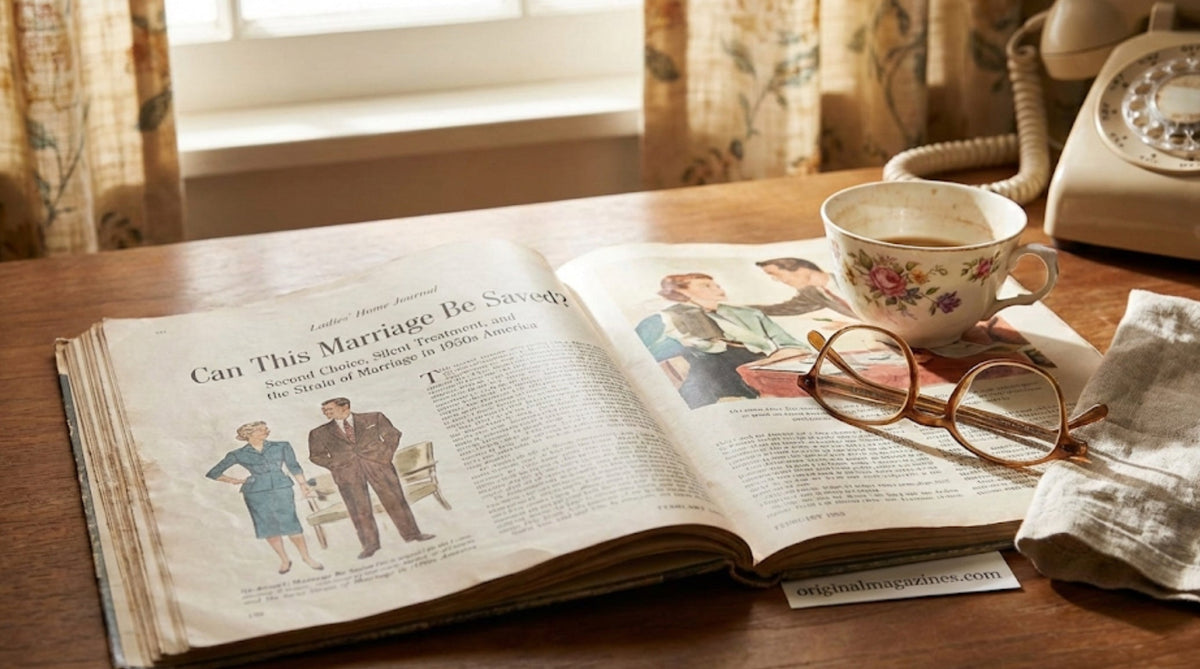
The Marriage That Held a Mirror to 1953 America
When Ladies' Home Journal exposed the private wars behind postwar domesticity
Ralph wouldn't speak to his wife for five days straight.
Not a word. Not even to ask for salt at dinner while their four children watched in silence. Alice knew why—she'd confronted him again about Sally, the woman he'd loved before her, the ghost who haunted their marriage like cigarette smoke that wouldn't air out.
When readers opened the February 1953 Ladies' Home Journal, they found Alice and Ralph's story in the second installment of "Can This Marriage Be Saved?"—a feature that would become one of the most enduring columns in American magazine history. But this wasn't just another advice piece. It was a fissure in the gleaming facade of postwar domesticity, a rare admission that behind the picture windows and new appliances, American marriages were collapsing under the weight of impossible expectations.
Historical Context
Publication: Ladies' Home Journal, February 1953
Feature: "Can This Marriage Be Saved?" (Second Installment)
Counselor: Dr. Paul Popenoe
Cultural Moment: Postwar domestic pressure cooker, pre-Friedan feminism
The Confession Box of Postwar America
The early 1950s sold prosperity with a hidden price tag. The nuclear family stood as both achievement and obligation—proof you'd made it, proof you belonged. Women who'd welded bombers and managed war production were now expected to find complete fulfillment in domesticity. Men carried the sole-provider burden in an economy that promised abundance but delivered anxiety.
Alice's words cut through the decade's cheerful veneer: "Everything is dead between Ralph and me." Ralph's counter-punch landed just as hard: "My wife is driving me crazy."
These weren't confessions whispered to friends over coffee. They were printed testimonies, read by millions of women who recognized their own silent wars in someone else's typed testimony. The Journal had discovered something profound: in an era that demanded perfection, imperfection was magnetic.
By 1953, Ladies' Home Journal commanded a readership in the millions, but its editors understood that women didn't just want recipes and sewing patterns. They wanted witnesses to their lives. The magazine's genius lay in creating a space where private desperation could become shared experience, where the unspeakable could be spoken—as long as an expert promised salvation at the end.
The Anatomy of Rupture
The Journal's formula was surgical in its precision. First, raw testimony: Alice felt like "second choice," a replacement wife haunted by Ralph's former love. Then the rebuttal: Ralph accused her of jealousy, financial incompetence, emotional vampirism. Finally, the prescription: Dr. Paul Popenoe, one of America's most prominent marriage counselors, diagnosed their failures and offered hope through professional intervention.
This three-part structure transformed marital failure into narrative arc—confession, confrontation, redemption. It gave readers a map for their own suffering.
The magazine's visual grammar told its own story. The cover presented the standard postwar ideal: polished, aspirational, warm. Inside, a shadowed beach photograph showed two figures standing apart, the physical distance between them measuring something that couldn't be bridged by moving closer. On the facing page, a Brillo soap pad advertisement promised to deliver "shine in half the time"—the consumer culture's gleaming lie positioned inches from the messy truth of family life.
Seven Fractures in the Foundation
Each element formed a portrait of marriage under impossible strain. Readers in 1953 saw themselves. We still do.
The Archive as Evidence
Vintage women's magazines endure because they preserved the intimate history that official records miss. These aren't just artifacts of fashion and food—they're documents of how millions of women understood their lives, their marriages, their futures. They recorded the expectations women carried and the realities they navigated.
The February 1953 Ladies' Home Journal matters to anyone studying 1950s women's culture, the emergence of marriage counseling in mainstream consciousness, the gap between postwar domestic ideals and lived experience, or the evolution of women's magazines as cultural arbiters.
Each surviving copy is a direct line to the women who read these words seventy years ago, who saw Alice and Ralph and recognized something true.
Why This Issue Endures
For collectors of vintage magazines, the February 1953 Ladies' Home Journal represents more than nostalgia. This is the issue that cemented "Can This Marriage Be Saved?" as a permanent feature—a column that would run for decades, shaping how Americans understood their intimate lives.
The issue captures contradictions that defined an era: the domestic ideal and its daily erosion, the consumer promises and the emotional bankruptcy, the public cheerfulness and the private desperation. From Brillo advertisements to staged photography, it serves as a three-dimensional record of postwar America's domestic culture.
Explore the Archive
From the groundbreaking "Can This Marriage Be Saved?" series to decades of fashion, literature, recipes, and cultural commentary, these magazines capture the intimate architecture of American women's lives.
They are artifacts of cultural change, documents of social history, and tangible connections to the private struggles that shaped public consciousness.
Browse Ladies' Home Journal Magazine Collection