
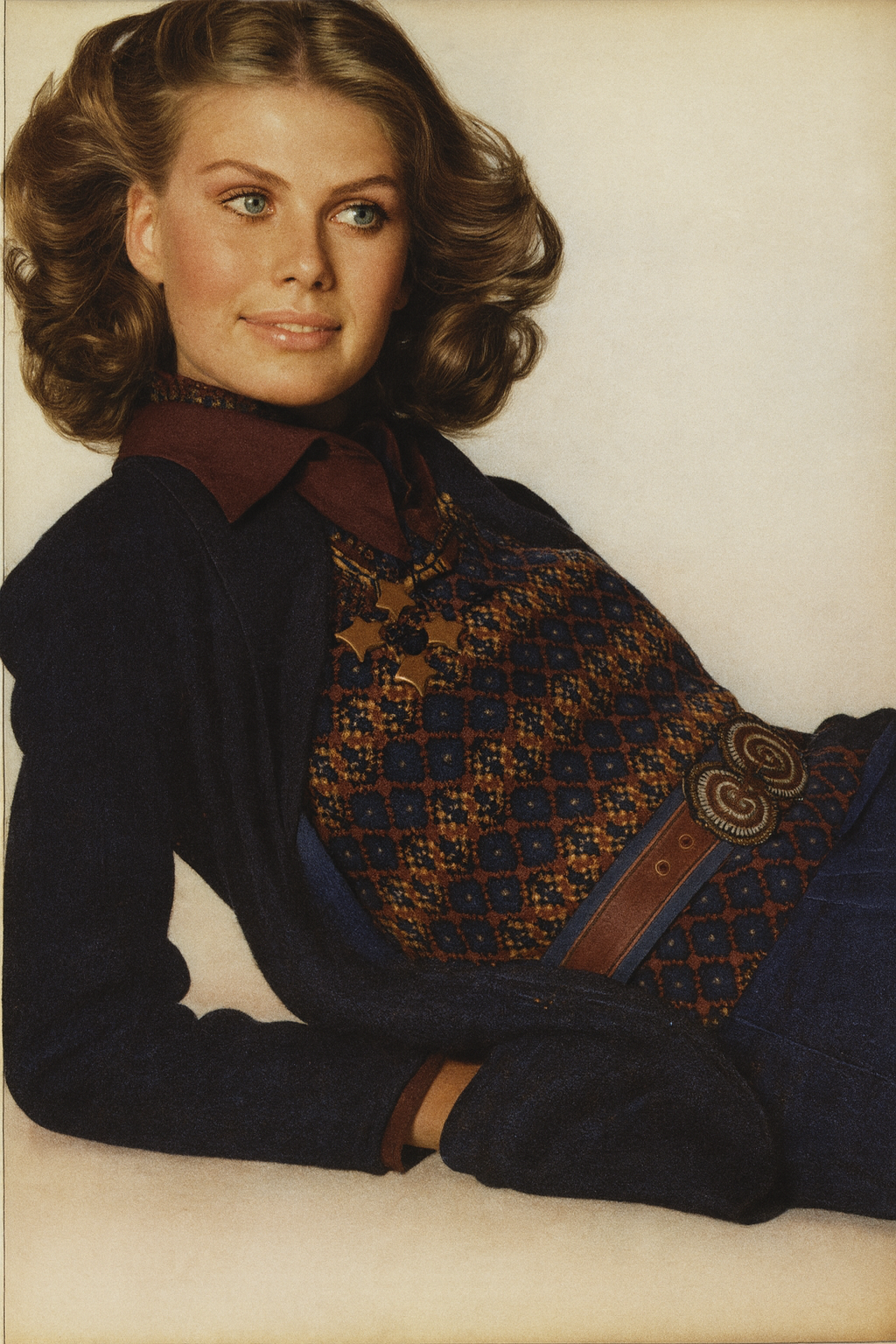
The September They Stopped Waiting for Paris
How Vogue's 1971 New York Collections Issue Captured American Fashion's Declaration of Independence
When women opened their mail in late August 1971 and found the September issue of Vogue, they weren't just looking at clothes. They were looking at proof.
Proof that American designers had stopped apologizing. Proof that a woman could walk into a boardroom in trousers and be taken seriously. Proof that the runways of Seventh Avenue—long dismissed as mere manufacturers copying Parisian ideas—had become the center of something unprecedented: a fashion revolution built for women who actually worked.
"Vogue's Point of View: The New York Collections" wasn't just a feature. It was a manifesto photographed in real time.
Archive Details
Publication: Vogue Magazine
Issue Date: September 1, 1971
Featured Story: "Vogue's Point of View: The New York Collections"
Cover Photographer: David Bailey
Historical Context: Peak of the women's liberation movement; emergence of American ready-to-wear
The Fault Line of 1971
The cultural ground was shifting fast. Only five years earlier, women wearing pants to an office could expect raised eyebrows or worse. But by September 1971, the women's liberation movement had blown open institutional doors. Women were flooding into law schools, newsrooms, and corporate offices—and they needed clothes that matched their new reality, not their grandmother's fantasy of femininity.
The designers understood this before the rest of America did.
Anne Klein was layering knit vests over slim trousers. John Anthony was cutting navy pantsuits with the precision of Savile Row tailoring. Halston was stripping away ornament entirely, leaving only fluid lines and audacious simplicity. Oscar de la Renta was proving that romance didn't require a corset. Bill Blass was designing clothes that moved from conference room to cocktail party without a costume change.
This was ready-to-wear as strategy. Separates as independence. The pantsuit as a declaration of arrival.
And Vogue was there to document it—not as gossip, but as history in motion.
The Magazine as Witness
By 1971, Vogue had spent decades perfecting a particular alchemy: transforming fabric and thread into aspiration. Its editors knew that most American women would never sit front-row at a Seventh Avenue show. But they could turn pages. They could study photographs. They could see themselves in the future being sketched out by New York's designers.
The September 1 issue delivered that future in vivid detail. David Bailey's cover photograph set the terms immediately—bold, direct, modern. No soft-focus fantasy. No European aristocrat gazing wistfully into the distance. Just a model whose steady gaze seemed to say: This is who we are now.
Inside, the editorial unfolded like a visual argument. Two-page spreads showed models striding, not posing. Pantsuits photographed in motion. Coats layered for practicality. Gowns that flowed rather than constrained. The captions didn't just describe—they interpreted, connecting each silhouette to the larger transformation of women's lives.
Other magazines showed fashion. Vogue showed what fashion meant.
What the Runways Revealed
Why Vintage Vogue Endures
These magazines are not nostalgia objects. They are research archives. Every advertisement, every editorial choice, every photograph preserves the aesthetic and social codes of a specific moment. Today's fashion moves at digital speed—consumed, forgotten, replaced. But these pages were meant to be studied, saved, revisited.
That permanence gives them power. They are witnesses. And unlike memories, they don't fade or distort. The evidence remains, exact and tangible, waiting for anyone curious enough to look.
Why Collectors Hunt for This Issue
To hold this issue is to hold the moment American fashion declared independence.
For Collectors and Historians
Thousands of original Vogue magazines—spanning the 1930s through the 1970s—are available for those interested in tracing the evolution of American style, culture, and aspiration as it was first recorded.
Browse Vogue Magazine CollectionThe Lasting Image
More than fifty years later, the September 1, 1971 issue of Vogue remains a benchmark—not just for fashion journalism, but for understanding how a society documents its own transformation. It captured Seventh Avenue at the moment of ascent and American women at the moment of redefinition.
The designers didn't just make clothes. They made arguments. And Vogue made those arguments visible.
For anyone who values the intersection of style, culture, and history, this issue isn't just collectible. It's essential. The past doesn't often speak this clearly—but when it does, it's worth listening.