
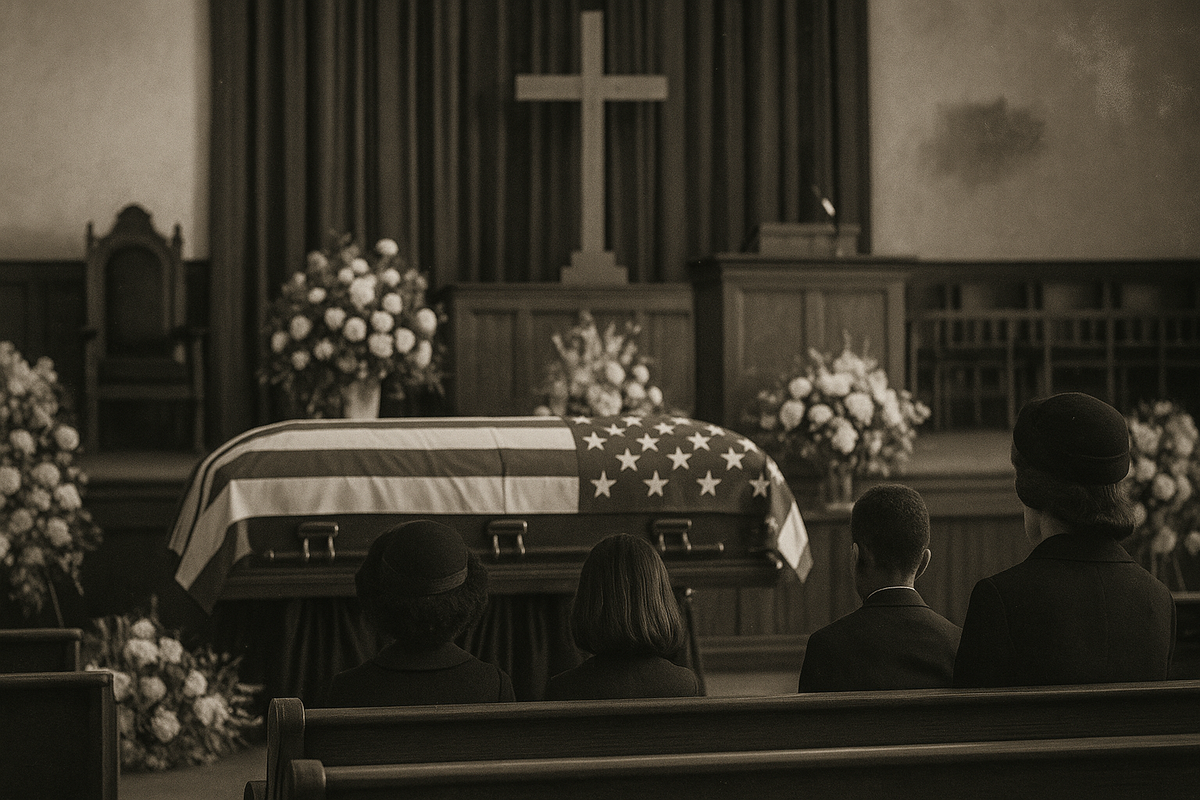
The Widows Who Held a Nation Together
Inside Ladies' Home Journal's Forgotten Portrait of Grief
June 1968. America was hemorrhaging. Two months after Martin Luther King Jr. fell to an assassin's bullet in Memphis, the nation still hadn't found its footing. Riots had scorched cities. The Democratic Party was fracturing. And in living rooms across the country, families who'd barely recovered from burying John F. Kennedy five years earlier were now watching Coretta Scott King bury her husband.
When readers opened that month's Ladies' Home Journal, they found something unprecedented: two widows, side by side—one Black, one white, both draped in mourning veils that had become symbols of American tragedy itself. The article binding them was written by a third widow, Myrlie Evers, whose husband Medgar had been gunned down in Mississippi in 1963. The piece, "Mrs. King & Mrs. Kennedy," wasn't grief porn. It was a reckoning.
This wasn't supposed to be what women's magazines did. But in 1968, the old rules were burning along with everything else.
Archive Details
Publication: Ladies' Home Journal
Issue Date: June 1968
Featured Article: "Mrs. King & Mrs. Kennedy" by Mrs. Medgar Evers
Historical Context: Published weeks after Dr. Martin Luther King Jr.'s assassination
Cultural Significance: Paired portraits of Coretta Scott King and Jacqueline Kennedy as symbols of national grief
When Assassinations Became the National Rhythm
The 1960s didn't just witness political violence—it was structured by it. Kennedy in '63. Malcolm X in '65. King in April '68. Robert Kennedy two months later, before this issue even hit newsstands. The pattern was so relentless that grief stopped being private. It became civic infrastructure.
Myrlie Evers understood this better than most journalists ever could. When she sat down to write about King's funeral in Atlanta—the crowds, the hymns, the sight of Coretta and her children in the front pew—she wasn't reporting. She was translating. She'd lived it when Medgar died. She knew what it meant to perform dignity while your world collapsed, to mother children who'd inherited targets on their backs, to become a symbol before you'd finished being a person.
Ladies' Home Journal gave her eight pages to say it plainly: American widowhood, when your husband dies for justice, is a public office you never campaigned for.
The Magazine That Rewrote Its Own Job Description
For decades, Ladies' Home Journal had been the kingdom of pot roast recipes and spring cleaning tips—the kind of magazine that taught women how to stretch a grocery budget and iron a fitted sheet. It was cheerful, practical, deeply middle-class.
But by 1968, that formula couldn't hold. The same readers who clipped meatloaf recipes were also watching body counts from Vietnam scroll across the evening news. Their teenage daughters were marching. Their sons were burning draft cards. You couldn't publish a magazine about "home" when the country itself felt unmoored.
So the June 1968 issue did something radical: it honored both realities. Turn the page from a feature on summer salads, and there's Myrlie Evers dissecting national trauma. The juxtaposition wasn't careless—it was the point. Women weren't just tending homes. They were holding the moral center while everything else cracked apart.
The editorial team understood what historians would later confirm: Coretta Scott King and Jacqueline Kennedy weren't just grieving wives. They were architects of memory, curators of legacy, and—whether they wanted the job or not—the emotional scaffolding for a country that couldn't process what it had done to itself.
Two Portraits, One Unbearable Truth
The visual rhetoric of Evers's article hit before the words did. At the top of the spread: two photographs, precisely parallel. Jackie Kennedy in her widow's veil from 1963. Coretta Scott King in hers from 1968. No caption needed.
The framing was deliberate and devastating. These weren't "before and after" shots or a cheap comparison. They were an indictment. Look what we keep doing, the layout whispered. Look who we keep asking to clean up the wreckage.
Evers's prose matched the solemnity. She described the Atlanta funeral not as spectacle but as sacrament—the silences between hymns, the weight of children too young to understand why cameras followed their mother everywhere, the strange algebra of public mourning where your private devastation becomes everyone's catharsis.
She circled back to her own story, too. Medgar's funeral in Mississippi. The heat. The fear that the violence wasn't over. The realization that her grief would never again be entirely hers. In threading these three stories together—Kennedy, King, Evers—she mapped a geography of American loss that newspapers couldn't touch.
This was intimate history. And Ladies' Home Journal, a magazine theoretically about domesticity, was the only publication positioned to tell it this way.
What the Article Actually Said (And Why It Still Stings)
It was advocacy dressed as elegy. And it worked.
Why Vintage Magazine Collections Outlast Everything Else
Newspapers yellow and crumble. Digital archives get paywalled or deleted. But original magazines—printed on better stock, designed to sit on coffee tables for months—survive. They're durable cultural artifacts.
And unlike newspapers, which reported what happened, magazines like Ladies' Home Journal captured what it felt like. They translated national events into the language of private life. That's irreplaceable for historians trying to understand not just the 1960s, but how Americans lived the 1960s.
Women's magazines, in particular, carry a double archive. They documented both the public sphere (politics, culture, justice) and the domestic sphere (fashion, food, family). That dual record makes them richer sources than any single-focus publication could be.
Why This Issue Became a Collector's Holy Grail
For anyone building a serious collection of mid-century American culture, this issue isn't optional. It's foundational.
Access the Archive
If you're ready to hold the same pages families turned in June 1968—to see the ads, read the recipes, and sit with Myrlie Evers's words as they were originally printed—there's only one way to do it right.
Browse Ladies' Home Journal Magazine CollectionWhether you're a collector, a researcher, or someone who wants to understand how their grandparents processed the hardest decade in modern American history, these magazines are the most direct line to that world.
The Final Word
The June 1968 issue of Ladies' Home Journal proved that women's magazines weren't shallow. They were load-bearing. In a year when American men kept killing each other and the country kept shattering, it was women—Coretta Scott King, Jacqueline Kennedy, Myrlie Evers—who were asked to model what survival looked like.
This magazine captured that dynamic in real time. Not as history, but as emergency.
More than fifty years later, it still reads like an open wound. And that's exactly why it matters.