
The Magazine That Refused to Look Away
How Jet Documented Myrlie Evers' Grief and Defiance in the Summer That Changed America
Twenty-nine days after the assassination, America was still reeling. But while network television moved on to other stories and white-owned newspapers buried Medgar Evers' death in their back pages, one pocket-sized magazine made a different choice. The July 11, 1963 issue of Jet Magazine didn't just report what happened in that Jackson, Mississippi driveway. It showed the nation what came after—the widow who refused to collapse, the children who asked where their father had gone, and the movement that would not be silenced by a single bullet.
For the millions of African Americans who picked up this issue at newsstands, barbershops, and churches across the country, it was more than journalism. It was a reckoning.
Archive Details
Historical Figure: Myrlie Evers (widow of Medgar Evers)
Issue Date: July 11, 1963
Archive Source: Jet Magazine
Historical Context: Published 29 days after Medgar Evers' assassination on June 12, 1963
Cover Story: "The Astonishing Widow Medgar Evers Left Behind"
The Summer America Changed
June 1963 marked a breaking point in American consciousness. The Civil Rights Movement had moved from courtrooms to streets, and the violence against those demanding equality had become undeniable. Medgar Evers, the NAACP's field secretary in Mississippi, had spent years organizing boycotts, registering voters, and dismantling Jim Crow brick by brick. White supremacists had marked him for death long before Byron De La Beckwith pulled the trigger.
The timing was deliberate in its cruelty. Just hours before Evers was shot in his own driveway, President John F. Kennedy had delivered a landmark address declaring civil rights a "moral issue" facing the nation. The assassination was an answer—brutal, immediate, and calculated to terrify anyone else who might dare to continue the fight.
Myrlie Evers, thirty years old and suddenly a widow, had a different answer in mind.
What Jet Knew That Others Didn't
By 1963, Jet Magazine had earned something most publications never achieve: the absolute trust of its readers. Its compact format—small enough to slip into a coat pocket or purse—meant it traveled everywhere, from factory floors to college campuses. But its real power lay in its refusal to sanitize Black life for white comfort.
Where mainstream outlets offered sterile obituaries and distant commentary, Jet brought its readers inside the Evers home. The magazine published what others wouldn't: photographs of children sobbing at their father's funeral. Images of Mrs. Evers clutching the folded flag from Arlington National Cemetery. The widow reading condolence letters at her kitchen table, grief raw on her face.
Most significantly, Jet gave Myrlie Evers her own voice. "Regardless what happens, I intend to keep going," she told the magazine. These weren't words chosen for her by editors or filtered through intermediaries. This was testimony—direct, unvarnished, and powerful.
The magazine transformed private mourning into public witness, ensuring that Medgar Evers' assassination would fuel national outrage rather than fade into another footnote of Southern violence.
The Cover That Stopped Hearts
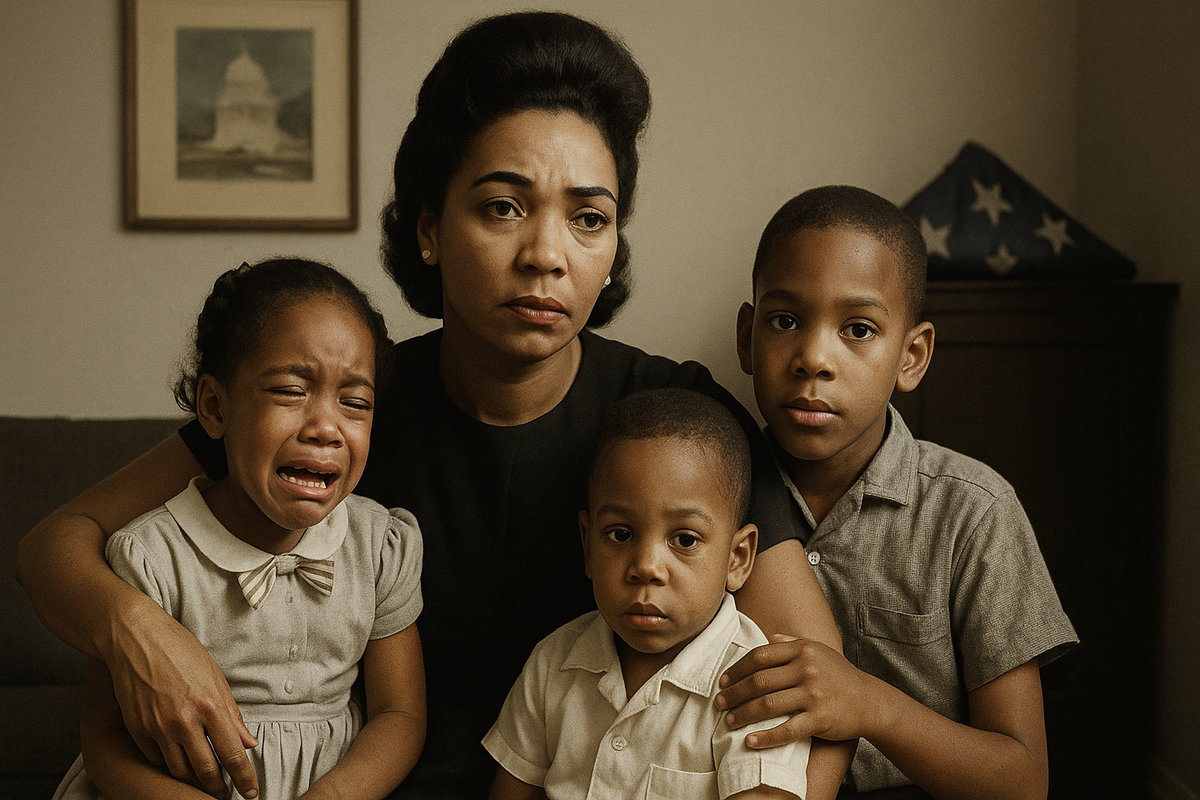
The July 11 cover is impossible to forget. Myrlie Evers sits with her three children—Denise, Van Dyke, and Darrell—in a stark portrait that captures both dignity and devastation. Her face carries an expression that would become iconic: solemn, resolute, unbowed. The children lean into their mother, innocence colliding with incomprehensible loss.
The cover text, printed in bold black and purple, declared: "The Astonishing Widow Medgar Evers Left Behind." The word choice was deliberate—not "tragic" or "grieving," but astonishing. Even in announcing her husband's murder, Jet recognized what Myrlie Evers was about to become: not just a symbol of suffering, but a force in her own right.
Inside, the photographs built a narrative that transcended reportage. Young Van Dyke asking his mother, "Where is my daddy?" Her gentle answer: "He is still sleeping." President Kennedy's personal letter of condolence, reproduced in full. Mrs. Evers declaring that her husband "belonged to all the people," his sacrifice given to the freedom movement and the nation itself.
Each image carried weight. Each quote landed like a blow. This was history being written in real time, documented with an urgency that made turning away impossible.
Direct Testimony
Jet gave Myrlie Evers her own voice without editorial filtering, allowing her words to speak directly to millions of readers across Black America.
Visual Documentation
Photographs from Arlington Cemetery to the family kitchen created irreplaceable visual testimony of grief, dignity, and determination.
Community Witness
The magazine transformed a private tragedy into collective memory, ensuring the movement's sacrifices would not be forgotten.
Historical Preservation
Unlike newspapers or television, Jet created a permanent archive that families kept for generations, preserving both facts and emotional truth.
The Widow Who Became a Movement
The Jet feature revealed dimensions of grief that statistics and policy debates could never capture. Myrlie Evers told the magazine that the greatest tribute to her husband would be continuing the boycott of Jackson merchants who resisted desegregation—the very strategy Medgar had championed. She wasn't interested in symbolic gestures or empty condolences. She wanted action.
President Kennedy's letter, printed alongside the family photographs, acknowledged what many were only beginning to understand: "Although comforting words are difficult at a time like this, surely there can be some solace in the realization that the justice of the cause for which your husband gave his life will triumph."
But Myrlie Evers wasn't waiting for triumph to arrive on its own. Her vow to Jet—"I intend to keep going"—was not grief speaking. It was strategy. She would spend the next three decades fighting for justice, eventually seeing her husband's murderer convicted in 1994, thirty-one years after the assassination. She would become a civil rights leader, author, and chair of the NAACP herself.
The July 11 issue of Jet captured the moment that transformation began.
The Archive That Keeps Speaking
Jet's true achievement was understanding that documentation equals memory, and memory equals power. The magazine created an archive of Black life—the struggles, the celebrations, the ordinary moments and the extraordinary ones—that would otherwise have been lost or distorted by mainstream institutions.
The July 11 issue endures because it's more than a chronicle of one family's loss. It's a time capsule of collective determination, proof that violence could murder individuals but couldn't kill a movement. Every page carries the weight of 1963, yet the themes remain urgent: racial justice denied, resilience in the face of terror, and the power of ordinary people to demand change.
Why Collectors Prize This Issue
Temporal Immediacy
Published less than a month after the assassination, the issue preserves raw shock and grief with no historical distance. This is history in the present tense.
Women's Leadership
Long before scholars examined how women sustained civil rights organizing, this issue captured Myrlie Evers' transformation from widow to movement leader as it happened.
Visual Documentation
The photographic series—from Arlington Cemetery to the family kitchen—provides irreplaceable visual testimony that circulated through Black communities nationwide.
Cultural Permanence
Unlike newspapers or broadcasts, Jet was saved by families for decades, ensuring future generations would access both facts and emotional reality.
Museum curators, university libraries, and serious private collectors recognize that owning this issue means possessing a fragment of American history that millions of people held in their hands during one of the nation's most turbulent summers. For those building collections of civil rights history or African American media, issues like this July 11 edition are foundational—primary sources that tell stories no secondary account can fully capture.
What Remains
The July 11, 1963 issue of Jet Magazine stands as one of the publication's most powerful editions—not because it exploited tragedy, but because it refused to let tragedy become invisible. It showed a widow who turned personal devastation into public courage. Children who bore the cost of freedom. A movement that violence could not silence.
Holding this issue today means holding the grief of 1963, but also its fierce determination. It's a reminder that progress has never been free. It's been purchased with sacrifice, sustained by resilience, and won through courage that people like Myrlie Evers demonstrated in their darkest hours.
Thanks to Jet, those stories didn't disappear into the past. They remain alive, ready to be studied, honored, and learned from. For anyone who values history as more than dates and abstractions, vintage Jet magazines aren't just reading material. They're living documents that connect us directly to the people who shaped America—one pocket-sized issue at a time.
Build Your Collection of American History
Original Jet magazines offer direct access to pivotal moments in civil rights history, preserved as primary sources for collectors, educators, and historians.
Browse Jet Magazine Collection