
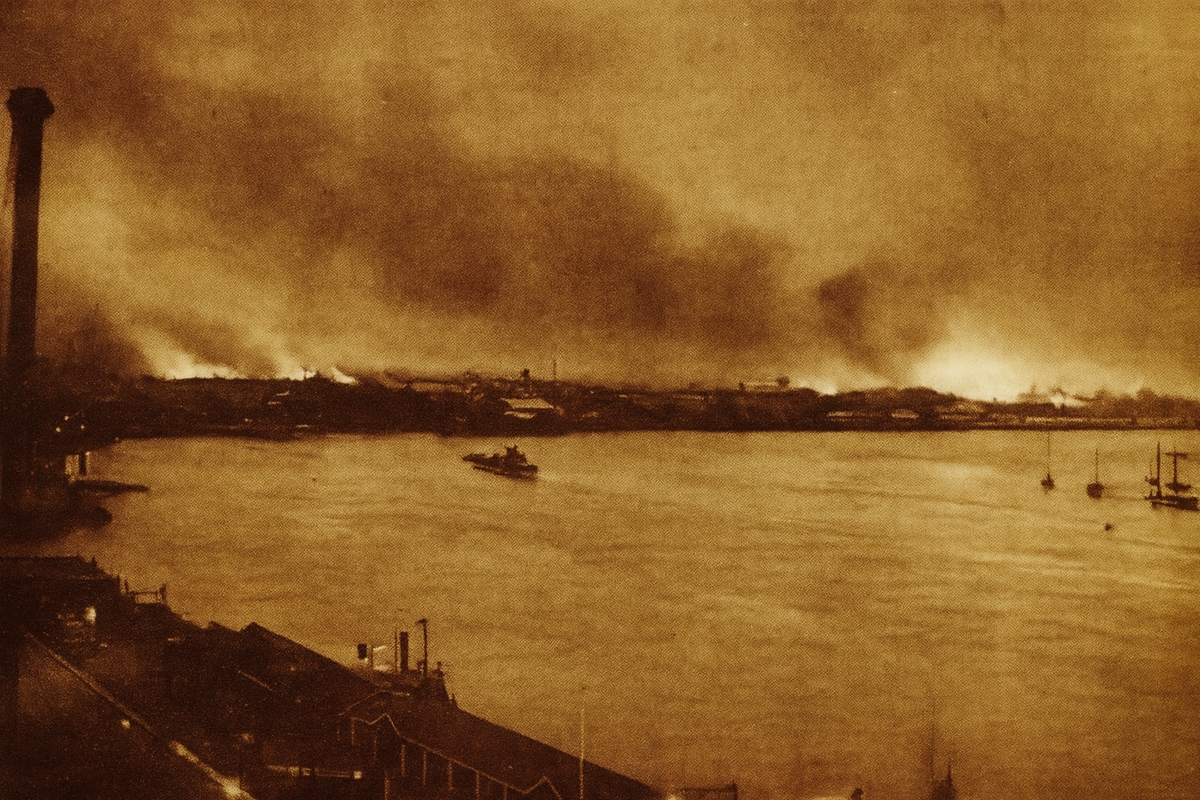
Shanghai in Flames
When Life Magazine Brought Modern War to America's Doorstep
On September 13, 1937, Americans opened their mailboxes to find something they had never seen before: a city burning in real time.
The cover of Life Magazine showed Shanghai ablaze across the Whangpoo River—smoke rising in massive plumes, flames silhouetting the skyline of China's most cosmopolitan metropolis. Inside, a photo-essay titled "The Chinese Outfight the Japanese as Shanghai Blazes" delivered what words alone never could: the raw, unfiltered face of modern urban warfare. For a nation still insulated from global conflict, these images were a jolt—a preview of the kind of devastation that would soon engulf the entire world.
This wasn't distant news. It was a warning.
The Powder Keg: August 1937
Just weeks earlier, the Marco Polo Bridge Incident had ignited full-scale war between China and Japan. What began as a skirmish near Beijing exploded into the Second Sino-Japanese War—an eight-year conflict that would ultimately merge into World War II and claim millions of lives.
Shanghai became the epicenter. On August 13, 1937, Japanese forces launched a massive offensive against the city. The Chinese Nationalist Army, led by commanders like General Pai Tsung-hsi, mounted a ferocious defense that stunned observers. The result was one of the most brutal urban battles of the era: air raids pummeling residential districts, artillery fire ripping through crowded streets, soldiers fighting house-to-house in a city that had been a symbol of modernity and international commerce.
By early September, entire neighborhoods lay in ruins. Refugees flooded the foreign-controlled International Settlement. The Whangpoo River—lined with American, British, and French gunboats—became a thin line between chaos and fragile neutrality. Damage estimates reached $75,000,000, a staggering sum in 1937 dollars.
And Life was there to document it all.
Issue Details
Publication: Life Magazine
Issue Date: September 13, 1937
Feature: "The Chinese Outfight the Japanese as Shanghai Blazes"
Historical Context: Battle of Shanghai, Second Sino-Japanese War
Key Figure: General Pai Tsung-hsi
Damage Estimate: $75,000,000 (1937)
Photojournalism as Witness
Life Magazine had revolutionized American media with a simple premise: show, don't just tell. By 1937, it had become the undisputed leader in visual storytelling, and the September 13 issue proved why.
The photographs were visceral. Readers confronted the wreckage of Japanese Heinkel bombers—German-made aircraft scattered across rice paddies, their U.S.-manufactured Hamilton propellers still gleaming in the mud. They saw the bodies of Japanese pilots killed instantly in midair combat over Nanking, thrown from their cockpits before the planes crashed. They witnessed Chinese civilians sleeping on sidewalks in the International Settlement, clutching blankets in exhausted huddles. One haunting image showed a British Sikh policeman from India, killed at his post during an explosion, his body left hanging unnoticed for hours as the battle raged.
The editors didn't flinch. Refugees streamed across Garden Bridge in endless columns as artillery shells burst behind them. Bodies littered streets near Shanghai's amusement park after bombing raids. Chinese fighters celebrated rare victories—shooting down Japanese bombers gave them something to cling to in an otherwise desperate struggle. Meanwhile, 6,500 inmates remained trapped in Shanghai's Ward Road Jail as shells pounded the building, their fates uncertain.
This was war without euphemism. Life transformed Shanghai's suffering from abstraction into intimate, undeniable reality. American families gathered around kitchen tables and turned these pages together, confronting images that shattered any illusions about "civilized" modern conflict.
The Editorial Architecture
The brilliance of the September 13 issue wasn't just in the photographs—it was in how Life constructed the narrative. The images weren't mere illustrations; they were the story.
Each spread presented stark juxtapositions: wrecked aircraft beside the pilots who had flown them. Crowded refugee bridges against the shells of destroyed neighborhoods. The deceptively calm waters of the Whangpoo hiding carnage just beyond its banks. Captions provided crucial context, noting that Japanese bombers carried German engineering and American components—a reminder that global commerce had armed both sides of this conflict.
Unlike competitors who relied on delayed dispatches or artists' renderings, Life offered immediacy. Its photographers captured the battle as it unfolded, and the magazine delivered those images to American homes within weeks. No publication had ever brought foreign war this close, this fast.
The cover itself became iconic: Shanghai burning across the water, a symbol of both China's defiance and the scale of destruction that modern weapons could inflict on civilian populations. It was more than journalism—it was a visual record that would outlast the headlines.
Aerial Combat
Chinese Air Force success in downing German-made Heinkel bombers with U.S. Hamilton propellers—rare victories documented in striking detail.
Civilian Catastrophe
Refugees flooding bridges, families sleeping on sidewalks, bodies in streets—the human cost rendered inescapable.
International Tensions
Foreign gunboats on the Whangpoo, the International Settlement as refuge, global commerce arming combatants.
Urban Warfare
House-to-house fighting, $75 million in damage, entire districts ablaze—modern conflict consuming a cosmopolitan city.
What Americans Saw, What It Meant
For readers in 1937, these photographs carried multiple meanings. They revealed Japan's military aggression and territorial ambitions—a direct threat to American interests in the Pacific. They showed China's unexpected resilience, challenging assumptions that Japan would roll through Asia unopposed. And they demonstrated, with brutal clarity, that modern warfare spared no one. Civilians bore the heaviest burden.
The images also raised uncomfortable questions. If Shanghai could be reduced to rubble in weeks, what city was safe? If Chinese fighters could down Japanese bombers, how long before American cities faced similar threats? The issue arrived at a moment when isolationist sentiment still dominated U.S. politics, yet these photographs made neutrality feel increasingly untenable.
Life didn't editorialize heavily—it didn't need to. The images spoke for themselves, offering a preview of the global conflagration that would consume the next decade.
The Permanence of Print
In an age where images vanish in seconds, scrolled past and forgotten, vintage Life magazines remind us that history was once absorbed differently. These pages were studied, discussed, saved in family collections, passed down through generations.
The September 13, 1937 issue captured a moment of global transformation—when modern warfare revealed its true face, when photojournalism proved its power, when Americans began to understand that the world's conflicts would eventually reach their shores.
Every page carries the urgency and uncertainty of that moment: soldiers determined to hold their positions, civilians caught in crossfire, the terrible efficiency of modern weapons. These magazines are physical witnesses to the past, offering insights that remain relevant for anyone seeking to understand conflict, resilience, and the human cost of war.
Why Collectors Covet This Issue
Historical Timing
Published mere weeks into the Battle of Shanghai, it gave Americans one of their earliest, most vivid accounts of the Second Sino-Japanese War—a conflict most had barely registered.
Iconic Photography
The images of burning Shanghai, downed aircraft, and desperate refugees remain among the most powerful pre–World War II war photography ever published in a mainstream American magazine.
Cultural Significance
This issue shaped early American perceptions of Japanese militarism and Chinese resistance. It planted seeds of awareness that would bear fruit after Pearl Harbor.
Scarcity
Pre-war Life issues with dramatic international coverage are rarer than their wartime counterparts. Fewer were saved, making surviving copies highly prized among collectors, historians, and families researching their heritage.
Owning this issue means holding the same pages that first revealed Shanghai's agony to the American public. It's not just reading about history—it's touching it.
Explore the Archive
Thousands of original Life magazines spanning the 1930s through the 1970s are available in our collection. Trace entire decades as they unfolded in real time—culture, politics, war, art, all preserved in their original form.
Browse Life Magazine CollectionWhether you're a seasoned collector, a history enthusiast, or someone honoring relatives who lived through these times, these magazines offer something irreplaceable: a chance to see history exactly as it was first reported.
The September 13, 1937 issue of Life Magazine remains one of the most significant pre-war publications of its era. Its unflinching coverage of the Battle of Shanghai captured both the destruction of a great city and the resilience of its defenders.
To hold this issue today is to hold a piece of history—the very pages that showed Americans, for the first time, the full scope of violence spreading across Asia. It was photojournalism at its finest and a preview of the global war to come.
For anyone who values history, this isn't simply reading material. It's a living artifact. And through it, the past speaks directly to us.