
When Students Sat Down and America Stood Still
The Ebony Issue That Captured a Revolution
On a February morning in 1960, four college freshmen walked into a Woolworth's in Greensboro, North Carolina, sat down at a whites-only lunch counter, and refused to leave. Within weeks, their quiet defiance had ignited a firestorm across the American South. By June, when Ebony Magazine published "What Sit-Downs Mean to America," more than 50,000 students had joined the sit-in movement, thousands had been arrested, and the nation's moral compass was spinning.
That June 1960 issue didn't just report the news. It preserved a revolution in real time.
Archive Details
Publication: Ebony Magazine
Issue Date: June 1960
Feature Article: "What Sit-Downs Mean to America" by Lerone Bennett Jr.
Historical Context: Published four months after the Greensboro sit-ins began
Cover Model: Luz Guerrero
The Powder Keg Spring
Six years after Brown v. Board of Education declared school segregation unconstitutional, the American South remained defiantly segregated. Lunch counters, buses, libraries, public pools—all still enforced the brutal logic of Jim Crow. Court victories had changed the law, but not the lived reality of Black Americans.
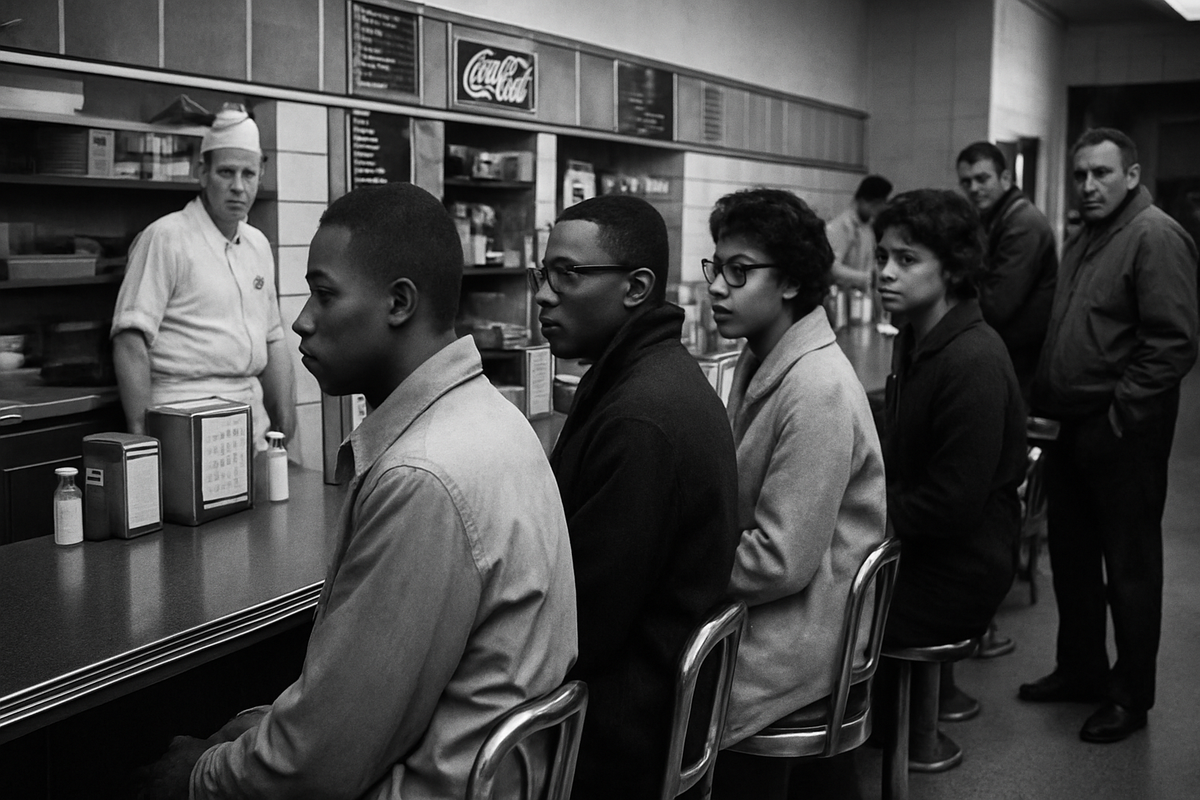
Then came February 1, 1960. Ezell Blair Jr., David Richmond, Franklin McCain, and Joseph McNeil—four freshmen from North Carolina A&T College—executed an act of defiance so simple it was revolutionary. They sat down at Woolworth's lunch counter, asked for coffee, were refused, and stayed seated until closing time.
The sit-ins spread like wildfire. Durham. Nashville. Orangeburg. Atlanta. Memphis. Richmond. By spring's end, the movement had touched dozens of cities and galvanized a generation. The students weren't just protesting lunch counter segregation—they were challenging America to live up to its stated ideals.
Ebony's Witness
By 1960, Ebony had become the most influential Black publication in America. Founded in 1945 by John H. Johnson, it occupied unique cultural territory: part Life magazine, part political journal, entirely unapologetic in its celebration of Black achievement and its documentation of Black struggle.
Lerone Bennett Jr.'s June 1960 article, "What Sit-Downs Mean to America," was journalism as moral reckoning. Bennett understood that these protests transcended the immediate goal of integrated lunch counters. "This is not about hamburgers or coffee," he wrote. This was about whether America believed in its own founding mythology—democracy, equality, human dignity.
The magazine's photography told the story with devastating clarity. Four students seated at a Nashville Greyhound counter, backs straight, eyes forward. Four hundred students jammed behind chain-link fencing in Orangeburg after a mass arrest. Memphis police "protecting" a public library from young Black students whose only crime was wanting to read. College women in Atlanta, arrested during sit-ins, sitting with quiet dignity in detention cells. Protest signs declaring "Jim Crow Must Go" at demonstrations as far north as Ohio.
These weren't action shots designed to sensationalize violence. They were portraits of moral courage—young people exercising discipline and restraint in the face of institutional brutality.
The Ebony Paradox
The June 1960 cover featured Luz Guerrero, an elegant fashion model whose poise and beauty seemed worlds away from lunch counter confrontations. But this was precisely Ebony's genius: the insistence that Black life contained multitudes. A people could fight for their freedom and celebrate their culture, endure hardship and pursue beauty, document injustice and showcase achievement.
Where white mainstream publications often reduced civil rights coverage to "regional disturbances" or "negro unrest," Ebony presented the sit-ins as what they were: a generational uprising with profound moral stakes. The magazine gave its readers documentary rigor wrapped in dignified presentation—a combination unmatched in American journalism of the era.
What the Issue Captured
The sit-ins represented a generational shift in the Civil Rights Movement. As Dr. Martin Luther King Jr. observed at the time: "This is an era of offensive on the part of oppressed people." The students weren't waiting for gradual change or asking permission. They were forcing the issue.
Leon Holt of the Congress of Racial Equality compared the student protesters to early Christians, willing to endure persecution for moral truth. The comparison wasn't hyperbolic. These young people faced verbal abuse, physical violence, mass arrests—and returned to lunch counters day after day with the same calm determination.
National leaders scrambled to respond. President Dwight D. Eisenhower offered cautious praise for the peaceful nature of the protests. Eleanor Roosevelt called them necessary. Former President Harry Truman dismissed them as disruptive stunts.
One of the issue's most powerful moments came from Tallahassee, where a young woman refused to let her mother pay her jail fine. "I am not free," she told her mother, "and I'm not free because your generation didn't act. I want my children to be free. That's why I'll stay in jail."
That quote—preserved in Ebony's pages—captured the generational reckoning underway. The students weren't just protesting segregation. They were confronting their parents' compromises, their communities' caution, their nation's hypocrisy.
The movement expanded beyond lunch counters. Boycotts targeted segregated businesses. "Selective buying" campaigns applied economic pressure. White students from Hunter College in New York and southern universities joined demonstrations, broadening the coalition. Church leaders struggled to reconcile their Sunday sermons about justice with their weekday acceptance of segregation.
Ebony made the stakes unmistakably clear: America could no longer ignore its racial contradictions. The sit-ins were a test of whether democracy meant anything at all.
The Movement's Defining Moments
National Scale
From Greensboro to Nashville, from Memphis to Orangeburg, the sit-ins spread across the South with astonishing speed, touching dozens of cities by spring's end.
Youth Leadership
This was a new youth-led phase of the Civil Rights Movement—students taking direct action rather than waiting for incremental change.
Moral Witness
Leon Holt compared the students to early Christians, forcing the South to reckon with its moral failures through nonviolent persistence.
Political Response
National leaders revealed their positions—Eisenhower cautiously praised the protests, Eleanor Roosevelt supported them, Truman dismissed them.
Generational Confrontation
The Tallahassee student who refused bail spoke for a generation: "I'm not free because your generation didn't act."
Economic Pressure
The movement expanded to include boycotts and "selective buying" campaigns, applying financial consequences to segregation.
Why This Issue Matters to Collectors
Historical Timing
Published mere months after the Greensboro sit-ins began, it captured the movement at its explosive origin point, before outcomes were known, before history had rendered its verdict.
Photographic Record
The images remain among the most iconic of the early Civil Rights Movement—raw, immediate, unflinching portraits of moral courage.
Moral Documentation
This wasn't just news coverage. Bennett's article created a moral argument, capturing voices from national leaders to anonymous students, from cautious politicians to fearless teenagers.
Cultural Completeness
True to Ebony's mission, the issue balanced groundbreaking civil rights journalism with fashion, entertainment, and profiles of Black achievement—a full portrait of African American life at a pivotal moment.
Editorial Excellence
The writing, photography, and design reflected Ebony at the height of its influence, when it served as both mirror and megaphone for Black America.
Living Archive
To own this issue is to hold a moment when students forced a nation to confront its conscience. These aren't just magazines—they're time capsules of courage.
The Living Archive
Ebony understood something that mainstream media often missed: civil rights stories weren't regional curiosities or temporary disturbances. They were the central narrative of American democracy in the twentieth century. The magazine's commitment to documenting these stories with respect, rigor, and visual power created an archive that remains vital more than six decades later.
The sit-in coverage of June 1960 stands as testament to what happens when a publication sees its role clearly: not just to report events, but to preserve the voices and images that might otherwise be lost, to insist on the dignity of people demanding their rights, to create a record worthy of the moment.
For anyone tracing the arc of African American history—from the front lines of social movements to the stages of culture, from athletic triumphs to political breakthroughs—vintage Ebony issues provide an unmatched primary source.
The June 1960 issue of Ebony Magazine remains one of the most important civil rights publications ever printed. It captured students in the act of remaking America, preserved their voices before history could soften or distort them, and reminded readers that democracy without justice is just a word.
Hold this issue in your hands and you're holding February 1960—the sound of four freshmen asking for coffee, the sight of 400 students behind chain-link fencing, the voice of a young woman choosing jail over compromise. Thanks to Ebony's unflinching journalism, that moment still breathes.
Explore the Complete Collection
Thousands of original Ebony magazines are available—living artifacts that preserve the voices, images, and struggles of generations.
Browse Ebony Magazine Collection