
The Hospital Room That Changed Everything
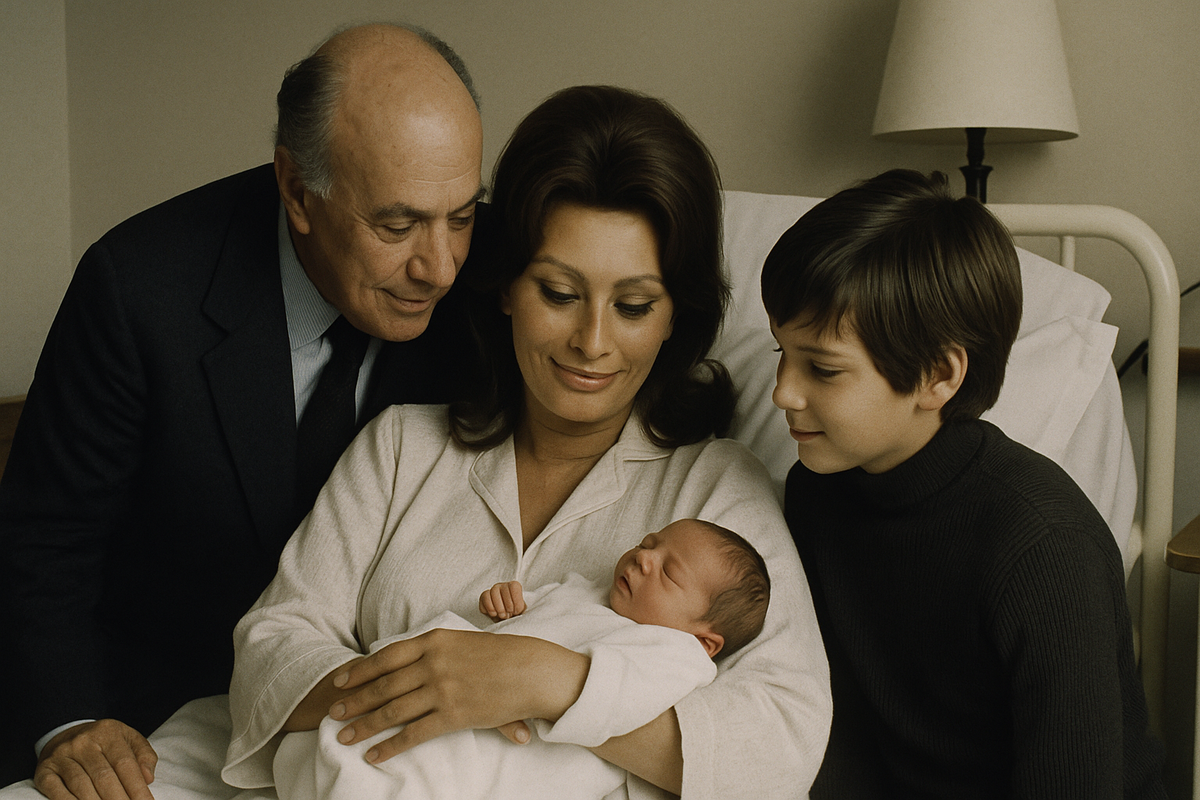
April 1973. A hospital in Geneva. Sophia Loren—one of the most photographed women on earth—sits propped against white pillows, cradling her newborn son Edoardo. Her husband Carlo Ponti leans in with unguarded tenderness. Her eldest boy, Cipi, peers at his baby brother with wide-eyed wonder. The photographer clicks.
This wasn't a movie set. It wasn't a publicity stunt. It was the culmination of years of private anguish—miscarriages, medical procedures, the kind of loss that doesn't make headlines—transformed into a moment of hard-won joy. And Ladies' Home Journal put it on magazine stands across America.
The feature, titled "Sophia Loren: The Three Men in Her Life," landed at a cultural flashpoint. Just three months earlier, the Supreme Court had issued Roe v. Wade. Three years before that, feminist activists had staged a sit-in at the Journal's own offices, demanding the magazine stop reducing women to recipes and decorating tips. The women's liberation movement was in full roar. Yet here was Sophia Loren—international star, sex symbol, Oscar winner—talking not about film contracts or red carpets, but about cesarean births, sibling bonding, and the textures of domestic life.
The contradiction wasn't a problem. It was the point.
Archive Details
Historical Figure: Sophia Loren
Issue Date: April 1973
Archive Source: Ladies' Home Journal
Cultural Context: Published three months after Roe v. Wade, during the height of second-wave feminism
When "Never Underestimate the Power of a Woman" Meant Something Dangerous
By 1973, Ladies' Home Journal had been walking a tightrope for years. Its masthead declared: "Never Underestimate the Power of a Woman." But what kind of power? The power to fold fitted sheets? Or the power to rewrite the terms of American womanhood?
The magazine's answer was both. And neither.
The April 1973 issue exemplified this tension perfectly. Flip through its pages and you'd find the familiar architecture of mid-century women's magazines: recipes for budget-friendly casseroles, decorating advice for suburban homes, fashion spreads featuring A-line skirts and wide-collared blouses. But nestled between the ads for Clairol and Campbell's Soup were features that crackled with something sharper—articles on health crises, the psychology of marriage, and now, Sophia Loren discussing miscarriage and maternal struggle with startling candor.
This wasn't Betty Friedan's revolution. But it wasn't Donna Reed's domestic fantasy either. It was something stranger and more slippery: a magazine trying to honor both the life women had built and the life they were demanding.
The Star Who Spoke the Quiet Language of Ordinary Loss
Sophia Loren's celebrity had always carried a certain gravity. Born into poverty in war-torn Italy, she'd clawed her way to Hollywood royalty through talent, determination, and a beauty that seemed almost mythological. By 1973, she'd won an Academy Award, starred opposite Cary Grant and Marcello Mastroianni, and married one of Europe's most powerful film producers.
But the Journal feature didn't dwell on any of that. Instead, it focused on what Loren herself wanted to talk about: the years of miscarriages. The medical consultations. The bed rest. The fear that she might never have the family she ached for. And finally, at age 38, the birth of Edoardo—a second son who felt like a miracle.
For readers in 1973, this confession was radical. Miscarriage wasn't discussed in polite company. It certainly wasn't fodder for celebrity profiles. Yet here was one of the most glamorous women alive, speaking the quiet language of loss that countless women understood but rarely heard reflected back to them.
The Journal understood what it had. The photograph of Loren in that Geneva hospital room—not styled, not performing, just being—became the visual centerpiece. She wasn't selling perfume or promoting a film. She was simply a mother, surrounded by her children and husband, radiating an exhaustion and contentment that needed no translation.
The Three Men, and the Woman Who Refused to Be Outnumbered
The article's title—"The Three Men in Her Life"—could have been cloying. In lesser hands, it would have reduced Loren to an accessory in her own story. But the piece itself had teeth.
Loren described her partnership with Carlo Ponti not as romantic gloss but as a working marriage between two formidable people. She talked about preparing Cipi for his brother's arrival, traveling with his favorite toys to ease the transition, managing the emotional architecture of a household. And when a journalist asked how it felt to be "outnumbered three to one" by men, she delivered the article's best line with characteristic steel: "Good. I am not afraid of men."
That sentence—defiant, amused, utterly self-possessed—captured everything the Journal was trying to do. Loren wasn't choosing between career and family, glamour and domesticity, strength and softness. She was inhabiting all of it simultaneously, without apology.
This was the unspoken promise the magazine extended to its millions of readers: You don't have to be one thing. You can be a mother who also has ambitions. A homemaker who also has opinions. A woman who loves her family and demands respect in the world beyond it.
Motherhood After Loss
Loren's candid discussion of miscarriages and medical struggles gave voice to experiences rarely acknowledged in mainstream media of the era.
Family Unity
The article highlighted the bond between brothers Cipi and Edoardo, and the deliberate care taken to nurture sibling relationships.
Partnership Beyond Romance
Carlo Ponti appeared not as romantic accessory but as equal partner in both personal and professional spheres.
Refusal of Binary Choices
Loren embodied the complexity many women were navigating—international star and devoted mother, glamorous and grounded.
Why This Issue Still Matters—And Why Collectors Hunt for It
Vintage magazine collecting isn't just about nostalgia. It's about preserving the primary documents of cultural evolution—the raw material of how people actually lived, thought, and imagined themselves.
The April 1973 Ladies' Home Journal is a near-perfect artifact of that kind. It exists at the hinge point between two Americas: one where women's primary identity was domestic, and one where that assumption was being dismantled piece by piece. The Sophia Loren feature embodies that pivot—celebrating motherhood without reducing women to it, honoring family without erasing individual identity.
Collector Significance
The Loren Factor
Any primary coverage of Sophia Loren has inherent value, but this intimate portrait—published at the height of her fame and showing her at her most vulnerable—is especially prized.
Cultural Time Capsule
Published just months after Roe v. Wade, this issue captures a specific moment when reproductive rights, women's autonomy, and family values were all being renegotiated in real time.
Iconic Photography
That hospital room image is not glamorous or staged, but deeply human. It's the kind of photograph that belongs in archives of 20th-century visual culture.
The Advertisements
Beyond editorial content, the ads for beauty products, household goods, and health remedies are sociological gold, revealing the aspirations and anxieties of 1970s consumer culture.
Editorial Sophistication
The issue's blend of celebrity intimacy, practical advice, and cultural commentary represents Ladies' Home Journal at its most sophisticated.
Historical Timing
This issue documents how women navigated change during second-wave feminism, making it essential for understanding mid-century women's history.
Finding Your Way Back to 1973
For collectors, historians, and enthusiasts of mid-century media, original issues of Ladies' Home Journal offer something digital archives can't replicate: the tactile experience of holding an era in your hands. The paper stock. The color saturation of the ads. The way articles flow into each other without the frantic pagination of later decades.
If you're searching for the April 1973 issue specifically, or exploring the broader landscape of vintage Ladies' Home Journal magazines, you're not just collecting—you're preserving. These publications document how women navigated change, carved out authority, and built lives that refused to fit into simple categories.
The Sophia Loren feature is an ideal entry point: intimate enough to move you, culturally significant enough to matter, and visually striking enough to display with pride.
Explore the Archive
Each issue is more than reading material. It's a window into how women saw themselves—and how they insisted on being seen.
Browse Ladies' Home Journal Magazine CollectionThe Afterlife of a Magazine
The April 1973 Ladies' Home Journal didn't solve the tensions it documented. Women are still negotiating the balance between family and career, still fighting for bodily autonomy, still demanding to be taken seriously on their own terms. But the magazine captured something essential about that negotiation—the way it happens not in manifestos but in hospital rooms, living rooms, and the pages of publications that met women where they actually were.
Sophia Loren understood this instinctively. She gave the Journal an interview that was both deeply personal and subtly political. She showed millions of readers that you could be a movie star and a mother, a beauty icon and a woman who'd endured loss, powerful and vulnerable in the same breath.
That hospital photograph from Geneva—Loren surrounded by her three men, exhausted and radiant—remains a perfect distillation of what Ladies' Home Journal aimed for at its best: not a fantasy of womanhood, but a recognition of its full, messy, magnificent complexity.
Hold a copy of that issue today, and you're holding more than nostalgia. You're holding evidence of a revolution that happened one family, one choice, one magazine at a time.