
Stalin, Hitler, and the Red Army: The Saturday Evening Post Exposé That Warned America
How a defector's testimony in a mainstream magazine revealed the Nazi-Soviet alliance—and cost him his life
On June 1, 1940, Americans reached into their mailboxes and pulled out a document of treason.
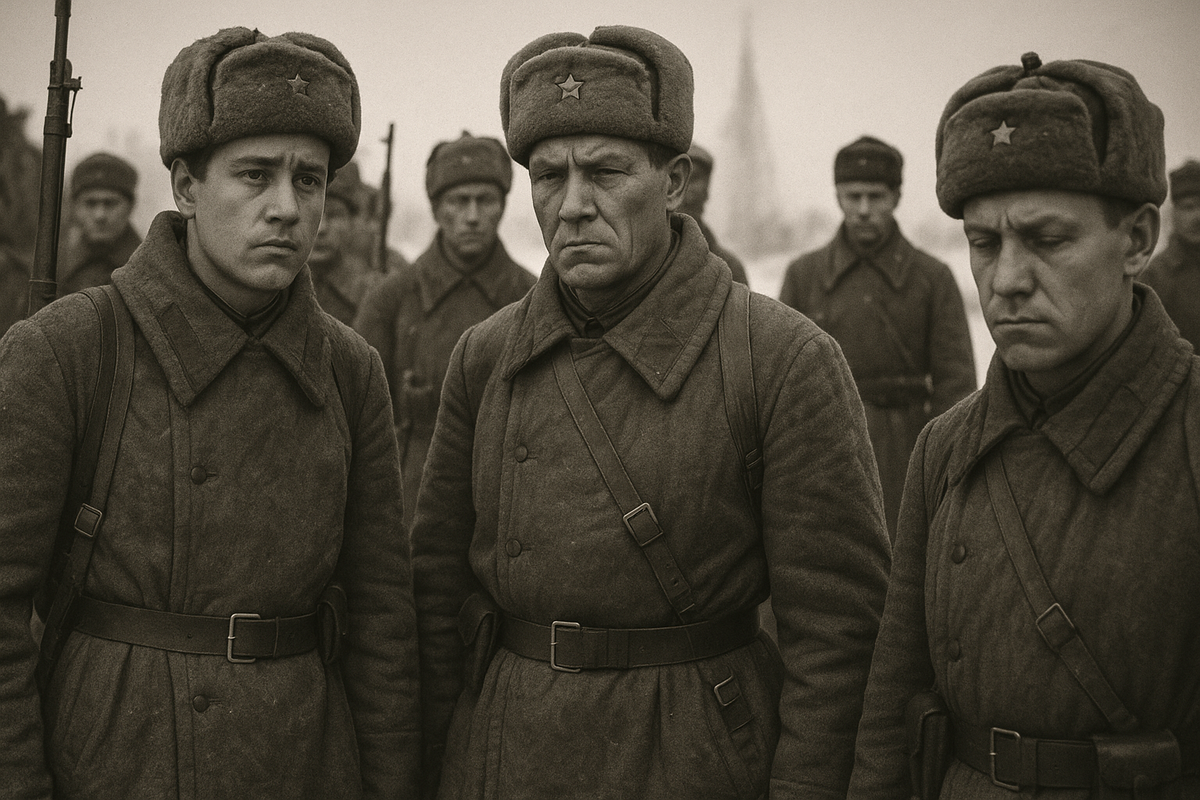
The latest issue of The Saturday Evening Post—that reliable weekly companion of short fiction, Norman Rockwell covers, and advertisements for Knox Gelatine—had become something else entirely. Its cover bore no idyllic small-town scene. Instead: stark photographs of Red Army soldiers in Finnish snow. Faces half-frozen. Columns of prisoners stretching toward the horizon. And inside, filling page after page, the testimony of a dead man walking.
His name was W.G. Krivitsky. Former Soviet general. Former intelligence officer. Current defector. And in the summer of 1940, he was about to tell Americans what their government would not: that Stalin's Red Army had become an auxiliary unit of Hitler's war machine.
Within a year, Krivitsky would be found dead in a Washington, D.C. hotel room, a bullet in his head, the door locked from the inside. The authorities called it suicide. No one believed them.
But on that June day, his words were still alive—and they carried a warning that would reverberate across a nation on the edge of war.
The World on Fire
By the time Krivitsky's exposé reached American breakfast tables, Europe had already begun to collapse.
Poland had been carved up between Hitler and Stalin the previous September, a butchery sanctioned by the Molotov-Ribbentrop Pact—that devil's bargain that split Eastern Europe into Nazi and Soviet spheres. Norway had fallen. Denmark, overrun in hours. Belgium and the Netherlands, crushed. France was days from surrender.
Across the Atlantic, America debated. Isolationists insisted the ocean would protect them. Interventionists argued the stakes were existential. And into this argument came Krivitsky, offering not rhetoric but evidence: the two great dictatorships of the 20th century were not rivals. They were partners.
The Saturday Evening Post—then the most widely circulated magazine in America, reaching over three million households weekly—had chosen to publish the account. It was a gamble. The magazine's readers expected comfort: uplifting fiction, humor columns, aspirational advertising. Instead, they got a blueprint of totalitarian collaboration written by a man who had helped engineer it.
Archive Details
Historical Figure: W.G. Krivitsky (Walter Krivitsky), Soviet intelligence officer and defector
Issue Date: June 1, 1940
Publication: The Saturday Evening Post
Context: Published weeks before the fall of France, during the Nazi-Soviet alliance established by the Molotov-Ribbentrop Pact of August 1939
Krivitsky's Fate: Found dead February 10, 1941, in Washington, D.C.—officially ruled suicide, widely believed to be NKVD assassination
Inside Stalin's Machine
Krivitsky did not write like a journalist. He wrote like a confessor.
His article detailed the methodical destruction of the Red Army from within—not by external enemies, but by Stalin himself. The Great Purge of 1937-38 had gutted the officer corps, executing thousands of experienced commanders on fabricated charges of espionage and treason. Marshal Tukhachevsky, one of the Soviet Union's most capable strategists, was tortured until he signed a false confession, then shot. Generals who had led armies were replaced by political commissars whose primary qualification was ideological purity, not tactical competence.
The result was catastrophic. When the Red Army invaded Finland in November 1939—a campaign Stalin expected to last weeks—it became a bloodbath. Krivitsky reported Soviet casualties approaching half a million men, a figure so staggering that it dwarfed American losses in all of World War I. Finnish forces, outnumbered five-to-one, had held the line for months, inflicting humiliating defeats on an army that Soviet propaganda claimed was invincible.
But the most explosive revelation was this: German and Soviet officers had been training together for years.
In secret airfields and tank ranges, hidden from the Treaty of Versailles inspectors, Wehrmacht officers had taught their Soviet counterparts. German engineers tested forbidden weapons on Soviet soil. Pilots practiced dive-bombing runs. The relationship was symbiotic—Germany rebuilt its military in violation of international law, and the Soviet Union modernized its own. By 1940, the two regimes had been collaborating for more than a decade.
Krivitsky knew these details because he had facilitated them. As an intelligence officer, he had watched the machinery of cooperation from the inside. And now, from exile, he was dismantling it piece by piece in the pages of a magazine better known for serialized westerns.
The Magazine as Weapon
What made this issue of The Saturday Evening Post so potent was not just what it contained, but where it appeared.
This was not a policy journal read by Washington insiders. It was not an academic quarterly debated in seminar rooms. It was a mass-market magazine that sat on coffee tables in Des Moines and Denver, that barbers left in their waiting rooms, that families passed around after Sunday dinner. Krivitsky's testimony reached ordinary Americans in the same edition that carried cartoons, Cream of Wheat ads, and short stories about frontier life.
The juxtaposition was jarring—and deliberate. On one page, Krivitsky described how the NKVD (Stalin's secret police) executed officers for imaginary crimes. On the facing page, an advertisement for Spam promised "a taste of home." The effect was cognitive whiplash: the comforts of American domesticity set against the machinery of totalitarian terror.
The Saturday Evening Post had always understood this formula. Since its founding in 1821 (it claimed lineage to Benjamin Franklin's Pennsylvania Gazette), the magazine had balanced serious journalism with popular entertainment. But in 1940, that balance took on new weight. The world was burning, and Americans needed both information and reassurance. The Post delivered both.
The Anatomy of Dictatorship
Krivitsky's article succeeded because it was not an ideological screed. It was forensic. He dissected the Soviet system with the precision of a surgeon, identifying five structural failures that had turned the Red Army into a broken instrument:
The Purge of Competence
Stalin's terror had eliminated merit as a criterion for command. Officers advanced not through skill but through survival. Initiative was punished. Obedience was rewarded. The result was an army led by men too frightened to make decisions.
The Commissar System
Political officers embedded within every unit ensured ideological control—and paralysis. No military decision could be made without their approval. Battlefield commanders spent as much time managing internal surveillance as fighting external enemies.
The German Alliance
Years of secret collaboration had created institutional dependency. Soviet officers had learned to fight using German methods, German equipment, German doctrine. When the alliance fractured (as Krivitsky predicted it would), the Red Army would be fighting with a borrowed playbook against the authors.
The Winter War Catastrophe
Finland exposed all of these failures simultaneously. Soviet troops, poorly equipped and badly led, froze in the forests. Supply lines collapsed. Communications failed. And the world watched as a superpower bled itself against a nation of three million people.
The Propaganda Trap
Official Soviet media portrayed the Red Army as unstoppable, a narrative so entrenched that even Stalin seemed to believe it. Internal reports told a different story: chaos, incompetence, and casualties on a scale that would have toppled any government that allowed its citizens to know the truth.
For American readers in 1940, these revelations reframed the war. The Soviet Union was not a bulwark against fascism. It was an enabler. And the Red Army, far from being a counterweight to Hitler, was a compromised force that had already proven incapable of defeating a much smaller adversary.
The Echoes of 1940
Krivitsky's article did more than inform. It predicted.
He warned that the Nazi-Soviet alliance was tactical, not ideological—that Hitler would eventually turn on Stalin, and that the Red Army would be catastrophically unprepared. Fourteen months later, Operation Barbarossa proved him correct. The German invasion in June 1941 shattered Soviet defenses, captured millions of soldiers, and drove to the gates of Moscow. Stalin's purges had worked exactly as Krivitsky described: they had gutted the army's ability to respond.
But by then, Krivitsky was gone. Found in a hotel room. A single bullet wound. A note that investigators found suspiciously generic. And a closed case that no one trusted.
His death made his Saturday Evening Post article something more than journalism. It became testimony—the final words of a man who had seen too much and paid the price for speaking.
Why This Issue Matters to Collectors
The June 1, 1940 Saturday Evening Post is not simply a vintage magazine. It is a primary historical document—and one of the rarest artifacts of early World War II journalism.
Historical Timing
Published at the apex of the Nazi-Soviet alliance, weeks before France fell, this issue captured a moment when the future of Western civilization hung in the balance. American readers did not yet know that Hitler would invade the Soviet Union a year later, or that Krivitsky would be dead within months. The article exists in the narrow window between revelation and erasure.
Insider Testimony
Krivitsky's account remains one of the most important English-language exposés of Stalin's system ever published. He was not a journalist speculating from afar. He was a participant—someone who had helped build the apparatus he was now describing. His assassination in February 1941, officially ruled a suicide but widely believed to be an NKVD execution, only amplified the credibility of his warnings.
Visual Documentation
Unlike most Saturday Evening Post covers, which featured painted illustrations, this issue used photographs. The images of Soviet soldiers and Finnish prisoners were not artistic interpretations—they were evidence. For a magazine that had built its reputation on Norman Rockwell's sentimental Americana, the shift to documentary realism signaled the gravity of the subject.
Cultural Artifact
As with all Post issues, the magazine preserves not just journalism but the texture of American life. The advertisements, the fiction, the humor columns—all of it forms a composite portrait of a nation trying to navigate normalcy while the world collapsed. Holding this issue is like holding a time capsule of American consciousness in 1940.
Explore the Archive
Original copies of the June 1, 1940 Saturday Evening Post remain available to collectors, historians, and anyone interested in the primary documents of World War II. These magazines are not reprints or digital facsimiles. They are the actual issues that Americans held in their hands as France fell, as the Blitz began, as the world teetered on the edge.
Browse The Saturday Evening Post Magazine Collection