
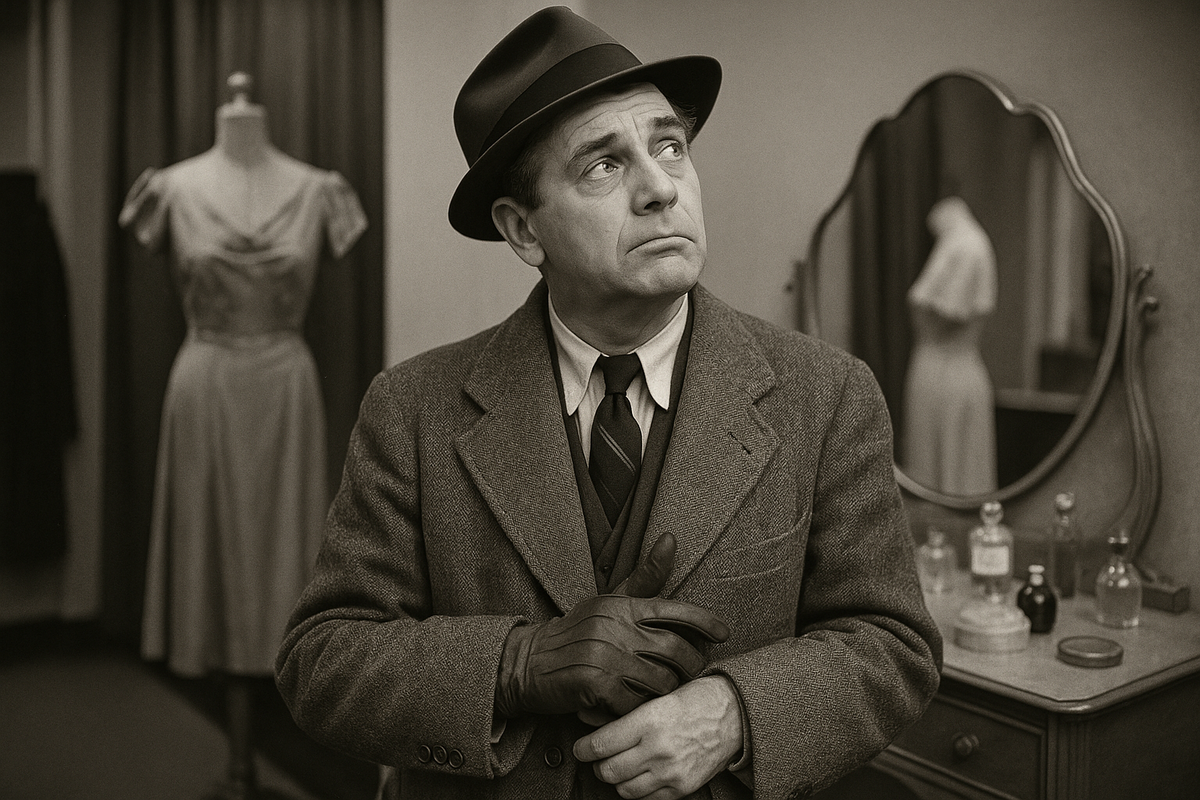
The Day America Met Walter Mitty
How a Single Issue of The New Yorker Changed the Language
When James Thurber's "The Secret Life of Walter Mitty" appeared in The New Yorker on March 18, 1939, readers had no idea they were witnessing the birth of a verb. Within a decade, psychiatrists would reference "Mitty syndrome" in clinical journals. By the 1950s, Webster's had absorbed "Walter Mitty" into the dictionary as shorthand for the chronic daydreamer. Thurber had done something few writers achieve: he'd captured a universal human experience so precisely that his character's name became the only word for it.
But the story's endurance isn't just linguistic—it's psychological. And to understand why this single issue remains one of the most collectible magazines in 20th-century publishing, you need to understand what ordinary Americans were feeling in the spring of 1939.
Archive Details
Author: James Thurber
Issue Date: March 18, 1939
Publication: The New Yorker
Story: "The Secret Life of Walter Mitty" (First Publication)
Historical Context: Six months before World War II
A Nation Trapped Between Depression and War
The year 1939 was defined by waiting. The Great Depression still shadowed daily life across America, its grip loosening but not yet broken. Europe, meanwhile, was sliding toward inevitability. Hitler had already annexed Austria and dismembered Czechoslovakia. Poland would fall within six months of this issue reaching newsstands.
Against this backdrop of economic exhaustion and gathering dread, Thurber introduced Walter Mitty: a middle-class man running errands with his nagging wife, slipping in and out of fantasies where he commanded naval destroyers, performed impossible surgeries, faced down firing squads with aristocratic calm. He was not a hero. He was not even particularly competent. He was ordinary—and that was precisely the point.
For readers in 1939, Mitty wasn't comic relief. He was a mirror. His fantasies of competence and bravery reflected a country that knew, somewhere beneath the surface, that ordinary men would soon be asked to do extraordinary things. The story captured the psychological truth of its moment: most people feel small in their actual lives, whatever grandeur plays out in their heads.
Why The New Yorker Owned the American Psyche
The New Yorker didn't publish hard news—newspapers did that. What the magazine did, with surgical precision, was capture tone. It documented not what Americans were doing, but what they were feeling. And in the late 1930s, that meant grappling with modernism's central revelation: that inner life and outer life were often violently incompatible.
Freud's ideas had filtered into popular consciousness. Modernist writers—Joyce, Woolf, Faulkner—had shattered linear narrative to explore the chaos of thought. Thurber distilled these intellectual currents into eight pages of crystalline prose that anyone could understand. The story moved like consciousness itself: Mitty commands a naval crew through a hurricane, then—"You're driving too fast!"—he's back in the car with Mrs. Mitty, going twenty miles per hour.
The rhythm was instantly recognizable. Every reader had lived it.
The Architecture of a Classic
Thurber's prose in this story is deceptively simple. The daydreams have the breathless pacing of pulp adventure—"The Commander stared at the ice forming on the pilot window"—while reality intrudes with domestic banality: "Not so fast! You're driving too fast!" The contrast creates a tragicomic oscillation that feels less like fiction and more like documentation.
The March 18, 1939 issue itself was a cultural artifact. The cover featured a woman at her vanity, painting her face with anxious intensity—a visual echo of the magazine's preoccupation with the gap between appearance and interior truth. Inside, Thurber's story shared space with the magazine's signature cartoons, theater reviews, and cultural commentary, all calibrated to the sensibility of educated, urban, psychologically curious readers.
What made The New Yorker essential wasn't just the quality of individual pieces. It was the editorial alchemy: literature, art, and observation synthesized into a vision of how intelligent people might understand their world.
The Story's Enduring Elements
Heroic Daydreams
Mitty's fantasies ranged from commanding a naval mission to performing delicate surgery, each rendered with the vividness of pulp fiction and adventure films.
Comic Interruptions
Reality always intruded—his wife scolding him, an errand to complete, the simplest tasks pulling him back from grandeur to ordinariness.
Psychological Insight
Beyond humor, the story tapped into themes of masculinity, identity, and the yearning for significance in an increasingly modern, mechanized world.
Cultural Symbol
"Walter Mitty" soon entered the American lexicon. To be a "Mitty" became shorthand for someone lost in daydreams, disconnected from reality yet deeply human.
Why Vintage New Yorker Issues Endure
These magazines aren't periodicals—they're time capsules. Every issue documents not just events but atmosphere: the cartoons, the advertisements, the tone of the writing, the preoccupations of the editors. They show how Americans saw themselves in real time, without the distortion of hindsight.
The March 18, 1939 issue proves the principle. The story of Walter Mitty endures because it captured something universal: the chasm between the lives we live and the lives we imagine. In 1939, that gap felt especially acute. In 2025, it still does.
The Collector's Case
First Publication
This is where "The Secret Life of Walter Mitty" first appeared—not in a book, not in an anthology, but in these exact pages. For collectors of American literature, it's the equivalent of owning Shakespeare's First Folio.
Cultural Lexicon
The story didn't just entertain—it created language. "Walter Mitty" entered the dictionary. It spawned films, stage adaptations, academic papers, endless parodies. Owning this issue means possessing the origin point of a cultural phenomenon.
Historical Intersection
Published six months before World War II began, the story inadvertently captured the psychological state of a nation about to be transformed. The daydreams of a man who felt insignificant would soon be echoed in millions of soldiers' letters home.
Thurber's Ascension
While Thurber was already a respected humorist and cartoonist for the magazine, this story elevated him into the American literary canon. It remains his most anthologized, most taught, most referenced work.
Explore the Archive
Thousands of original New Yorker magazines—from the 1920s through the end of the 20th century—are available in our collection. Each issue offers a direct line to how literature, art, politics, and culture unfolded in the moment they happened.
Browse The New Yorker Magazine CollectionWhether you're building a serious collection, researching cultural history, or simply want to experience these publications as their first readers did, these magazines offer something irreplaceable: history without revision, preserved exactly as it was written, drawn, and imagined.