
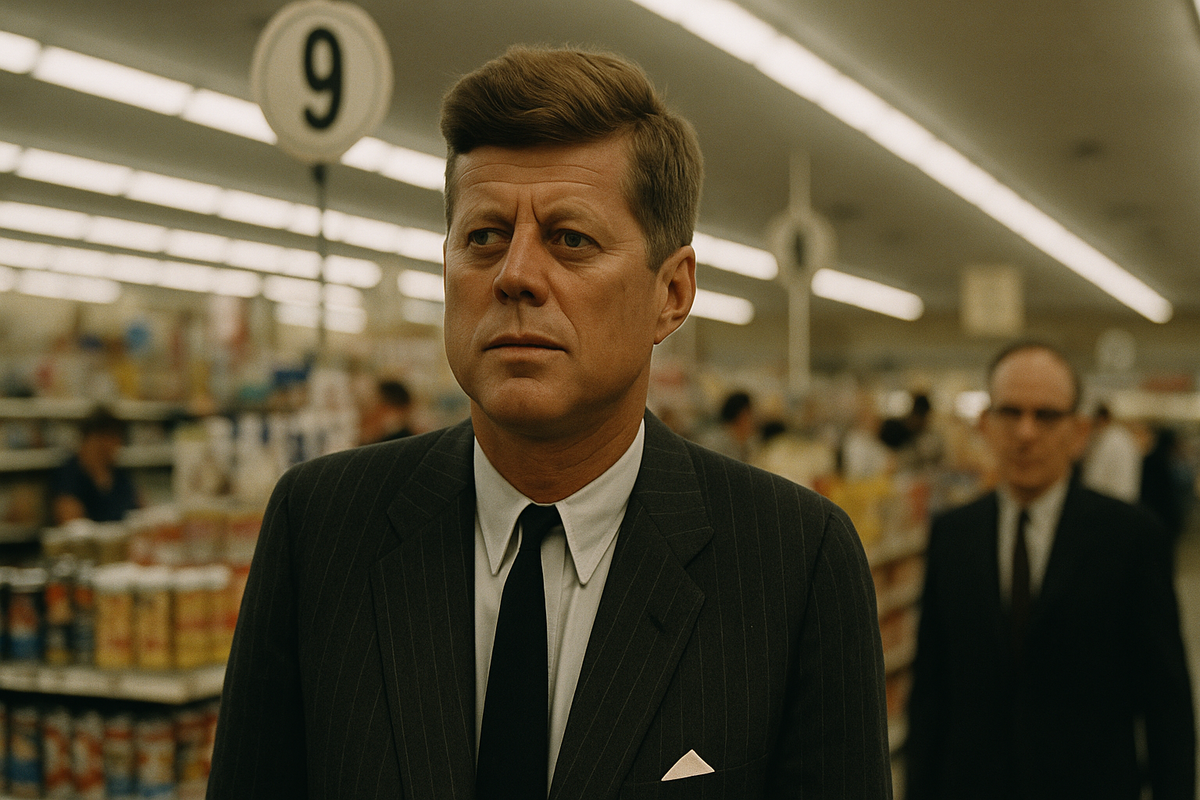
The Night Norman Mailer Saw the Future
Esquire, November 1960, and the Essay That Predicted Modern American Politics
Something shifted in American politics between the summer and fall of 1960, and Norman Mailer was the first to name it.
When Esquire's November issue hit newsstands, readers expecting the magazine's usual blend of sharp fiction and men's style found themselves holding something else entirely: a prophecy. Mailer's "Superman Comes to the Supermart" didn't just cover John F. Kennedy's Democratic nomination—it diagnosed a new species of American power. Politics had merged with advertising. The convention floor had become a supermarket. And Kennedy, Mailer argued, was the first politician manufactured for the television age.
For readers in 1960, the essay landed like a revelation. For collectors today, this issue remains one of the most significant magazines of the twentieth century.
The Moment America Became a Spectacle
The year 1960 was a hinge. The Cold War had frozen into nuclear standoff. Civil rights protests were fracturing the South. Suburban supermarkets and television sets were remaking daily life into a consumer ritual. And for the first time, a presidential election would be decided not in smoke-filled rooms but in the blue glow of TV screens.
Kennedy and Nixon's televised debates proved the thesis: image now rivaled substance. Kennedy's poise and youth gave him the edge over Nixon's perspiration and five o'clock shadow. Millions of Americans absorbed the lesson—politics had become visual, branded, performative.
Mailer seized this transformation and turned it into literature. In Esquire, he framed Kennedy not as a traditional candidate but as a "Superman" emerging in a culture of supermarkets and spectacle. Kennedy's glamour wasn't incidental—it was the message itself. His youth contrasted with Eisenhower's fading authority. His charisma outshone Nixon's rigid calculation. Mailer saw Kennedy as both symptom and solution: a figure who embodied Cold War anxieties while offering the first politician fluent in the language of mass media.
The essay wasn't neutral. It was electric, controversial, and prescient. Mailer wrote politics as if it were a novel, casting the Democratic convention as theater and myth-making in real time.
Archive Details
Historical Figure: John F. Kennedy, Norman Mailer
Issue Date: November 1960
Archive Source: Esquire Magazine
Essay Title: "Superman Comes to the Supermart"
Historical Context: Published during the Kennedy-Nixon presidential election
Why Esquire Was the Only Magazine That Could Publish This
By 1960, Esquire had evolved far beyond its men's fashion origins. Under editor Arnold Gingrich and his successors, the magazine had become the most ambitious cultural publication in America—mixing serious literature, biting satire, political commentary, and cutting-edge design. Writers like Mailer, Gay Talese, and Tom Wolfe found in Esquire the editorial freedom to invent what would later be called "New Journalism."
The November 1960 issue exemplified this ambition. The cover's mid-century modern design—clean typography, bold graphics, stylish photography—signaled sophistication. This wasn't a newsmagazine rushing to deadline. This was a publication curating culture.
Inside, Mailer's essay stretched across multiple pages, written with the intensity of a novel and the insight of a sociologist. He described the convention not as political process but as consumer theater. Democracy, he suggested, had become a product line. And Kennedy was the most compelling brand America had ever produced.
The essay became an event. Readers debated it. Academics studied it. And decades later, it remains required reading in journalism schools as a defining work of political literature.
What Mailer Saw That Others Missed
Mailer didn't treat Kennedy as a man with policies. He treated him as a mythic figure—young, vigorous, carrying the hopes of a nation exhausted by Cold War dread. Kennedy became a symbol of American vitality at a moment when nuclear annihilation felt possible.
By calling the convention a "supermart," Mailer identified the merger of politics and advertising. Voters weren't choosing leaders; they were choosing between brands. Kennedy's team understood this instinctively. They sold him like a product, complete with image, slogan, and style.
Mailer recognized that Kennedy's image mattered as much as his speeches. The televised debates had proven it. Politics was no longer about backroom deals—it was about mass spectacle. And Kennedy was the first politician to master the medium.
The essay implied that Eisenhower's America—steady, paternal, cautious—was over. Kennedy represented a break: younger, faster, more cinematic. Mailer framed this shift as inevitable, even thrilling. But he also captured the anxiety beneath it. What happens when politics becomes performance? What happens when image replaces substance?
These observations weren't just timely. They were prophetic. Mailer was describing the future—a future where image, branding, and television would dominate American democracy. In 2025, his insights feel less like analysis and more like a warning we didn't heed.
The Legacy
Esquire's November 1960 issue stands as proof that magazines once shaped culture, not just reflected it. Mailer's essay didn't just describe Kennedy's rise—it defined how Americans understood that rise. It taught readers to see politics as spectacle, candidates as brands, and television as the arena where democracy would now unfold.
Today, when every politician is a media product and every campaign is a branding exercise, Mailer's insights feel inevitable. But in 1960, they were revolutionary.
For collectors, this issue represents a threshold. It's the moment when American politics crossed into the age of image. And it's preserved here, in the original pages, written by one of the great literary voices of the twentieth century.
Why This Issue Matters to Collectors
Published during the Kennedy-Nixon election, this issue captured the birth of a new political era in real time. Readers were witnessing history, even if they didn't yet know it.
Mailer's essay is studied alongside works by Truman Capote, Joan Didion, and Hunter S. Thompson as foundational New Journalism. It proved that political writing could be literature.
The issue reflects the moment when media, politics, and consumerism fused into a single force. This wasn't just about Kennedy—it was about America remaking itself.
The magazine's mid-century modern layout and photography make it a design artifact in its own right. It looks like 1960 felt—confident, sleek, poised for transformation.
Kennedy-era publications hold unique value among collectors. The assassination three years later only deepened his mythic status. Owning this issue means holding the original pages where Mailer first framed Kennedy as Superman—before Camelot, before Dallas, when the future still felt open.
Add This to Your Collection
The November 1960 Esquire is a cornerstone for anyone serious about vintage magazines, Kennedy memorabilia, or the history of American media. These aren't reprints or digital archives—these are original issues, preserved as cultural time capsules.
Browse Esquire Magazine CollectionWhen you hold this issue, you're not reading history. You're holding it.