
When Democracy Required a Canvas Roof
Ebony's 1961 Tent City Exposé and the Families Who Refused to Disappear
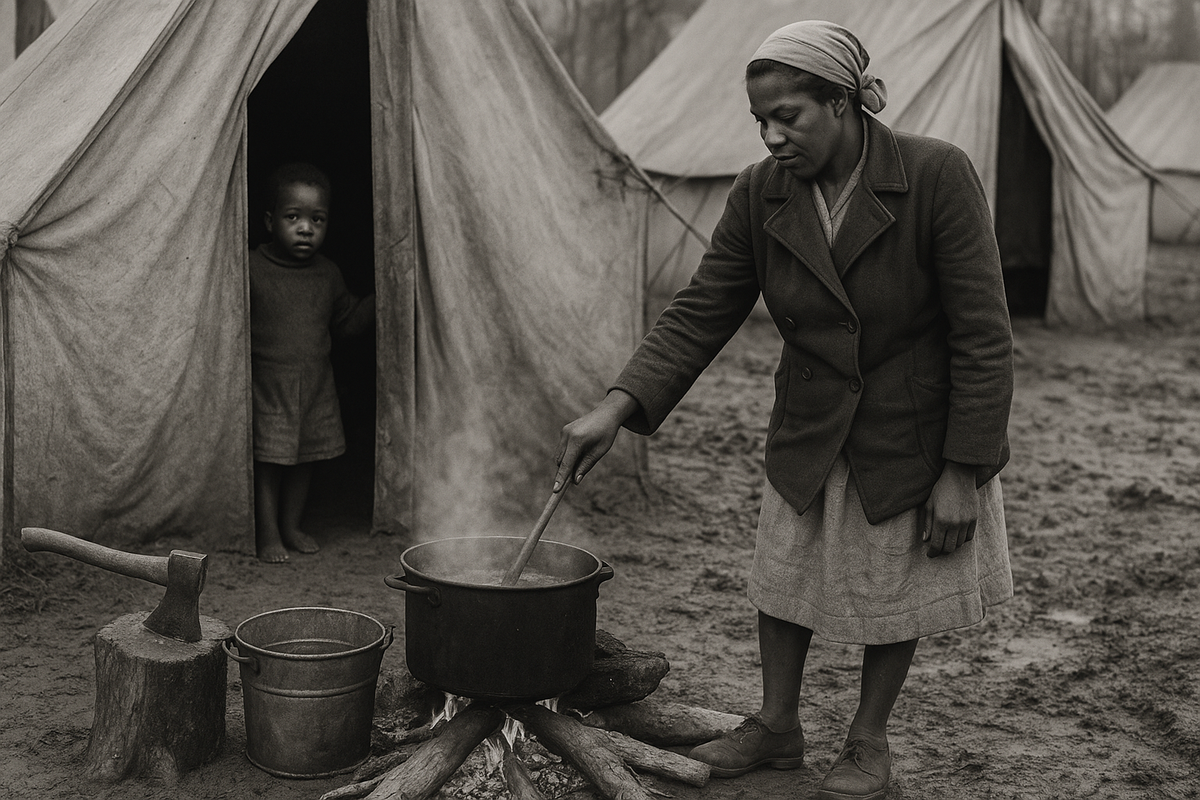
A child's face appears in the opening of a tent, eyes fixed on a yard of churned mud. Behind that single photograph in the March 1961 issue of Ebony Magazine lies a truth most Americans never saw: in Fayette County, Tennessee, the cost of registering to vote was eviction, starvation, and exile to a settlement of canvas and scrap wood.
This wasn't a refugee camp in a distant country. This was America. And the crime these families committed was claiming their constitutional right.
The Ebony feature "Tent City, Tenn.: Fighters for Civil Rights Face Hardship in Fayette County" didn't just report the story. It weaponized photography, turned documentation into evidence, and made the magazine an instrument of witness when mainstream press looked away.
The Eviction Campaign: How Voting Became Grounds for Expulsion
By 1960, Fayette County's white landowners had perfected a strategy of control. Of 8,000 eligible Black residents, fewer than a handful had been allowed to register before 1959. When local activists launched mass registration drives, the response was systematic and brutal.
Families who registered found themselves evicted—not just fired, but physically removed from land their grandparents had farmed. Sharecroppers were blacklisted from stores. Credit vanished. Jobs disappeared. The message was unambiguous: exercise your rights, lose your home.
Nearly 200 people—men, women, children—erected tents on donated land. They called it Freedom Village. The rest of the country would know it as Tent City.
What white landowners intended as punishment became a monument.
Historical Context
Publication: Ebony Magazine
Issue Date: March 1961
Feature: "Tent City, Tenn.: Fighters for Civil Rights Face Hardship in Fayette County"
Location: Fayette County, Tennessee
Key Figures: John McFerren, Early B. Williams
Archive Source: Original mid-century African American photojournalism
Why Ebony Was Built for This Moment
Founded by John H. Johnson, Ebony had spent fifteen years constructing something no other publication offered: a platform where African Americans controlled the narrative of their own lives. Not as subjects. As authors.
The Tent City feature deployed that authority with surgical precision.
The child at the tent door became the issue's visual anchor—not to exploit suffering, but to crystallize injustice into a single, undeniable frame. Innocence. Mud. Democracy denied.
Scenes of survival showed families chopping wood, hauling water, cooking over open fires. These were not portraits of defeat. They were records of refusal—refusal to submit, to disappear, to accept that voting required forfeiting shelter.
Faces of leadership elevated John McFerren and Early B. Williams from local organizers to national symbols. Ebony didn't wait for history to canonize them. It did the work in real time.
Networks of solidarity appeared in every frame: Chicago teachers, Mennonite volunteers, Memphis church women delivering supplies. The magazine proved civil rights was not regional—it was a coordinated national resistance.
Other outlets might have reduced Tent City to a tragedy. Ebony presented it as a battlefield where ordinary people were winning.
Photojournalism as Legal Testimony
The March 1961 issue functioned as more than journalism. It operated as evidence.
Images documented the material conditions of retaliation: cardboard floors, children huddled in makeshift shelters, paths of mud connecting rows of canvas. Federal investigators could ignore testimony. They couldn't ignore photographs.
The text contextualized federal failures: the Justice Department had issued decrees allowing registration, but enforcement remained theatrical. Intimidation continued. Ebony named the gap between law and reality.
The editorial balance was surgical—documenting crisis without erasing agency. Yes, children were catching colds and going without milk. But their parents were also organizing supply chains, maintaining schools, and building infrastructure from nothing. Suffering and strength occupied the same frame.
This dual vision—pain acknowledged, dignity preserved—became Ebony's signature. It's why readers trusted the magazine not just to report, but to represent.
Ten Moments That Defined the Feature
What Ebony Understood That Others Didn't
Mainstream outlets in 1961 treated civil rights as political theater—protests, speeches, courtroom drama. Ebony showed readers what it actually meant to be Black in America: the courage required, the sacrifices extracted, the small victories that accumulated into movement.
Other magazines documented events. Ebony documented being.
For modern readers, the March 1961 issue offers something contemporary media can't replicate: unfiltered access to how African Americans saw themselves at the height of the movement. Not victims awaiting rescue. Architects of their own liberation.
Democracy wasn't secured in Congress. It was fought for in mud, under canvas, by families who refused to let eviction erase their names from voter rolls.
Why Collectors Prize the March 1961 Issue
Among the earliest major publications to expose rural voter suppression through sustained photojournalism. Most archives focus on urban protest. This revealed the countryside.
The tent doorway photograph remains one of the most reproduced civil rights images—and Ebony published it first.
This wasn't white journalists interpreting Black struggle. It was Black editors, photographers, and writers controlling their own historical record in an era when that was rare.
With voting access under renewed attack, the issue reads as both history and warning. Democracy's fragility hasn't changed. Neither has the cost of defending it.
Collectors value such issues not as curiosities, but as primary sources—the kind historians cite, museums display, and families pass down as proof that resistance happened.
The Tent City Legacy
The March 1961 Ebony feature on Tent City, Tennessee stands as one of the most important pieces of civil rights journalism ever published. It preserved a story that segregationists wanted buried: that African Americans were being punished—evicted, starved, exiled—for attempting to vote.
The photographs remain visceral. Mothers tending fires. Fathers splitting wood. Children peering from doorways, trying to make sense of why claiming a constitutional right required living in a tent.
For collectors, this issue is essential. For readers, it's an education. For all of us, it's a reminder that freedom was never granted. It was constructed, one tent pole at a time, by people who understood that democracy without access is theater.
They chose the mud. They chose the cold. They chose to stay visible.
And Ebony made sure the country couldn't look away.
Explore the Archive
The March 1961 issue exists within a larger continuum—Ebony's decades-long chronicle of African American life, from the 1940s through the 1970s. The magazine tracked civil rights battles, cultural shifts, political ascensions, and artistic revolutions with unmatched consistency.
Browse Ebony Magazine Collection