
The Magazine That Showed America What Television Wouldn't
Jet's Seven Days in Selma
When the March 25, 1965 issue of Jet Magazine landed on newsstands, African American readers weren't just picking up a publication. They were picking up evidence.
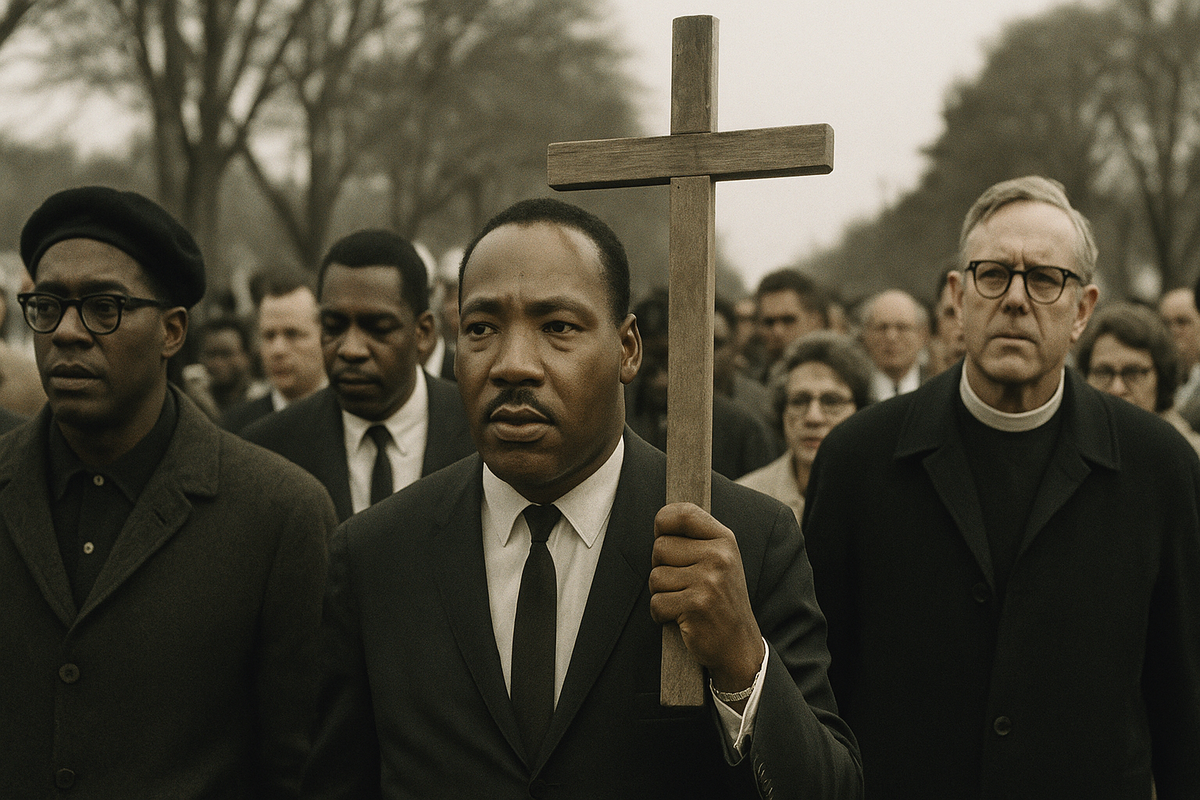
The cover photograph was deceptively simple: Dr. Martin Luther King Jr., framed by a large white cross, his face carrying the weight of a week that had nearly killed him. Inside, Jet's pages revealed what network cameras had missed—the assassination plots, the armed men arrested near civil rights headquarters, the 500 state troopers who had turned Selma into a siege zone, and the volunteers who formed human shields around King as he marched through streets that wanted him dead.
This wasn't sanitized coverage. This was the unfiltered truth of what it cost to demand the right to vote in 1965. And Jet—more than any mainstream outlet—delivered that truth directly into Black homes across America.
Archive Details
Historical Figure: Dr. Martin Luther King Jr.
Issue Date: March 25, 1965
Archive Source: Jet Magazine
Historical Event: Selma to Montgomery Marches / Bloody Sunday Aftermath
When Bloody Sunday Became a National Reckoning
March 7, 1965. State troopers and armed vigilantes attacked peaceful marchers on Selma's Edmund Pettus Bridge with such brutality that the nation recoiled. The televised beatings exposed Jim Crow's violence in real time, but it was the aftermath—the seven days that followed—that Jet documented with unmatched urgency.
Dr. King rushed to Selma immediately. What he walked into resembled a military occupation: over 500 state troopers, 40 squad cars, constant surveillance, and credible Ku Klux Klan threats confirmed by the Justice Department itself. Local police arrested men carrying weapons near King's offices. The federal government watched nervously. White ministers, nuns, students, and union members poured in from across the country, transforming Selma from a regional protest into a national confrontation.
"I have to make an agonizing decision almost every minute of the day," King told Jet.
This wasn't hyperbole. It was survival math.
What Jet Showed That Others Wouldn't
While Life Magazine offered large-format photography and mainstream outlets minimized the crisis, Jet's pocket-sized pages carried something more dangerous: specificity.
Jet reported the Chicago-based assassination plot against King during the demonstrations. It photographed the protective lines of volunteers who surrounded him as he marched, knowing their bodies might be all that stood between King and a bullet. It documented Selma's "battle zone" atmosphere—tents pitched in churchyards, observers circling in airplanes, activists marching despite threats that weren't theoretical but active and credible.
Jet profiled King's inner circle, including his brother Rev. A.D. King, who shielded Martin with his own body. It showed readers the human shields, the armed encampments, the sheer militarized force deployed against nonviolent protest.
This was Jet's formula: blend hard facts with emotional truth. Inform and connect simultaneously. For Black families reading at kitchen tables from Chicago to Los Angeles, Jet didn't just report Selma—it made readers present at Selma.
The Power of Portable Witness
Jet's format was strategy. Its compact size made it shareable in beauty salons, barbershops, and churches—spaces where mainstream media rarely reached but where community conversations ignited. While other magazines sat on coffee tables, Jet moved through hands, passed from reader to reader, each exchange a quiet act of solidarity.
The March 25, 1965 cover became iconic: King holding the cross, a symbol simultaneously religious and political, reminding readers that this fight required both faith and sacrifice. Inside, Jet's bold red-and-black graphics and photo spreads showed what nonviolent courage looked like when met with state-sanctioned terror.
This wasn't just journalism. It was witness-bearing. And in an era before social media, Jet was the platform where Black America could see itself unfiltered, unapologetic, and undeniably present in the fight for democracy.
The Details That Made History Tangible
Jet didn't deal in abstractions. It gave readers concrete realities:
The Ku Klux Klan plots weren't rumored—they were confirmed by federal investigators. The arrests of armed men near King's headquarters weren't speculation—they were documented facts. The 500 troopers surrounding Black neighborhoods weren't symbolic—they were counted. The volunteers forming protective shields around King weren't metaphorical—they were photographed, their faces showing the same resolve as the man they protected.
From Chicago to California, religious leaders, union workers, and students descended on Selma, transforming it from a Southern struggle into a national reckoning. Jet captured this mobilization not as distant news but as urgent call—and its readers answered.
These details, printed boldly in a magazine small enough to fit in a coat pocket, made Selma impossible to ignore. They helped push President Lyndon Johnson to introduce the Voting Rights Act of 1965 within months—one of the most consequential civil rights laws in American history.
The Legacy of Unfiltered Truth
Jet's reporting on Selma endures because it refused to look away. Every photograph, every caption, every line carried the urgency of survival and the demand for justice. In documenting the threats against King's life, the protective shields of ordinary citizens, and the militarized response to peaceful protest, Jet created a record that mainstream media either missed or chose not to pursue.
Today, when voting rights remain contested, Jet's 1965 Selma coverage stands as stark reminder: democracy was never given. It was fought for, bled for, and nearly died for on the Edmund Pettus Bridge and in the streets of Selma.
The voices preserved in these pages still march forward.
Why Collectors Prize This Issue
Historical Timing
Published at the height of the Selma crisis, just weeks before the Voting Rights Act's passage, this issue captures a democracy-defining moment as it unfolded.
Iconic Photography
The cover photograph—King with the cross—remains one of Jet's most recognizable and symbolically loaded images.
Cultural Significance
Owning this issue means holding a tangible piece of the Selma march itself, connecting collectors to the courage and mortal danger of that week.
Archival Value
Civil rights-era Jet magazines rank among the most sought-after issues for historians, archivists, and families preserving heritage. This isn't memorabilia. It's testimony in print form.
Explore the Collection
Thousands of original Jet magazines from the 1950s through the 1970s are available in our collection. From the rise of civil rights to Black culture, politics, and entertainment, Jet documented it all with an intimacy and honesty no other magazine matched.
Browse Jet Magazine CollectionWhether you're a seasoned collector, a historian, or someone honoring family history, these issues offer something increasingly rare: the chance to see history as it was first reported, in the words and images that inspired a generation to demand what was rightfully theirs.
Holding the March 25, 1965 issue of Jet Magazine means holding a moment when democracy itself hung in the balance. It means touching the courage that stood against terror. And it means preserving the unfiltered truth that brought the front lines of history into Black homes across America.