
The Hoboken Blues
When Esquire Sent Readers Into a 6 A.M. Saloon
Herbert John turned the key at Duke's House before sunrise. The sailors were already waiting.
It was March 1955, and Americans opening their copies of Esquire that month expected the usual: sharp tailoring advice, a gallery of starlets, perhaps a Hemingway story. What Monroe Fry gave them instead was a bar stool at six in the morning, across from the Hoboken ferries, where women weren't served at the counter and a sailor named Jerry recited limericks dirty enough to earn a rebuke: "Never interrupt when a lady is speaking."
"The Hoboken Blues" wasn't local color. It was deliberate counterpoint—a crack in the suburban myth that Life magazine was busy selling to the same postwar audience. While developers paved over farmland for Levittown and advertisers sold the nuclear family as America's salvation, Fry documented a city where 50,000 residents supported a saloon for every 220 people. Jersey City, by comparison, had fewer than one bar per thousand.
The numbers weren't incidental. They were indictment and eulogy both.
Archive Details
Author: Monroe Fry
Publication: Esquire Magazine
Issue Date: March 1955
Featured Location: Hoboken, New Jersey
Key Figure: Herbert John, Bartender at Duke's House
The Machinery of Esquire in 1955
By its third decade, Esquire had mastered editorial alchemy. A single issue moved without friction from fashion spreads to Gerald Kersh fiction, from glamour photography to cultural autopsy. The formula worked because it refused to condescend. Readers who wanted to know how to knot a tie also wanted to understand the men who would never own one.
"The Hoboken Blues" landed in this ecosystem alongside an Old Crow bourbon advertisement—placement that now reads as editorial commentary. The ad promised refinement. Fry's essay delivered sailors and loneliness and the ritualized exclusion of women from bar counters. Facing pages, contradictory Americas.
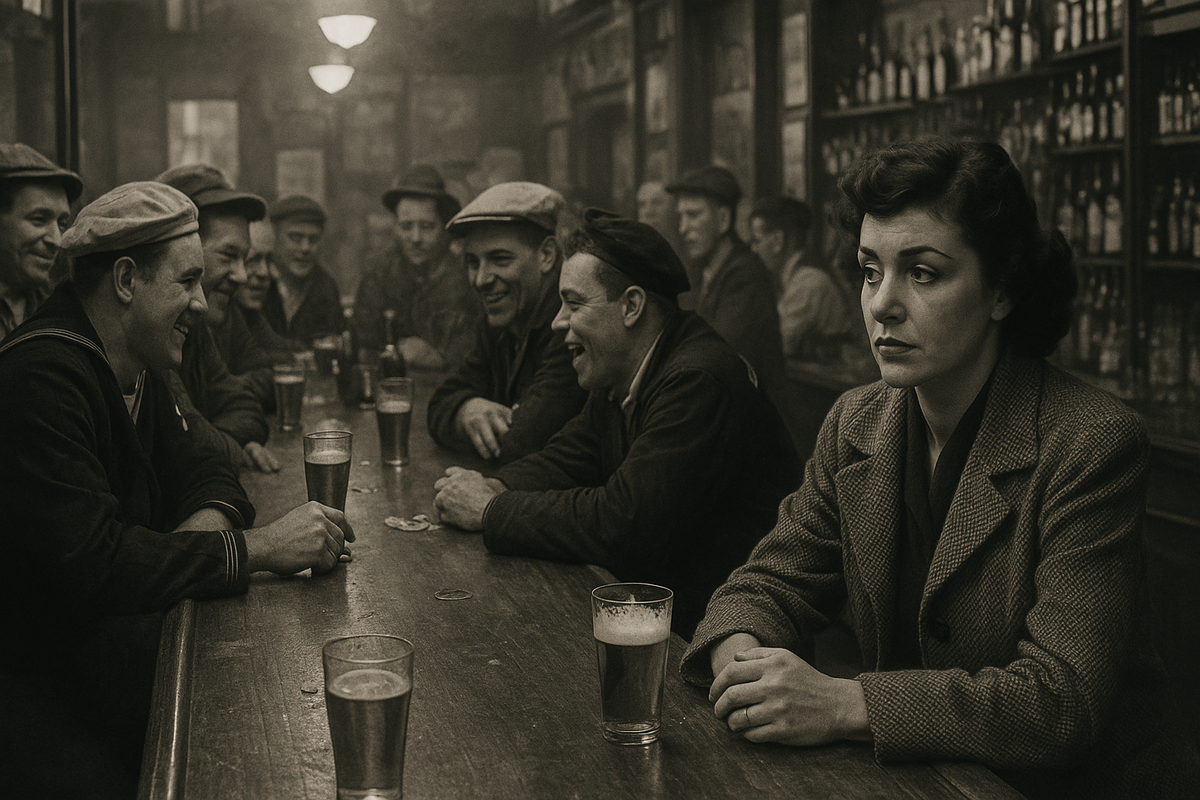
The magazine's visual treatment matched its ambition. A sketch of Duke's House—smoke, bodies, morning light through dirty windows—ran with the text. Esquire didn't merely describe Hoboken's saloons. It rendered them, creating immersion where other men's magazines offered instruction.
What Fry Captured
The essay's subtitle stated its thesis plainly: "Where the Lonely and the Taken drown their disbelief." Fry understood that Hoboken's bars served two populations the suburban dream had no use for—merchant seamen unmoored from domestic life, and married men seeking temporary escape from it.
His documentation was surgical:
The Ritual
Duke's House opens at six. Herbert John, the bartender, enforces codes that seem archaic even in 1955. Women may drink, but not at the bar. The back room awaits.
The Clientele
Jerry the sailor, crude and performative, deploying his limerick as social currency. The unnamed woman whose sharp correction reasserts civility in a space designed to suspend it.
The Arithmetic of Escape
One saloon per 220 residents. The statistic doubles as metaphor—Hoboken's bars weren't leisure destinations. They were infrastructure.
The Documentation
Fry wrote about drinking the way labor reporters wrote about factories. He cataloged the social mechanics of a working-class male culture that Eisenhower-era optimism preferred to ignore.
Cold War Margins
The context matters. March 1955 sits precisely between Senator McCarthy's censure (December 1954) and Rosa Parks's arrest (December 1955). The Korean War had ended. The nuclear standoff was calcifying into permanent condition. Americans were supposed to be building fallout shelters in their new suburban basements and teaching their children to duck and cover.
Hoboken's waterfront existed outside this script. The city's saloons predated the Cold War, predated Prohibition, predated the anxieties that postwar culture was frantically trying to contain through consumer goods and geographic dispersal. Fry's essay suggested that some forms of American masculinity—transient, undomesticated, literally liquid—couldn't be suburbanized.
Esquire published this not as nostalgia but as documentation of a present the magazine's aspirational content couldn't quite erase. The issue's reader would learn how to dress for success, then read about men drinking before breakfast. The tension was the point.
Why This Issue Endures
Collectors pursue the March 1955 Esquire for reasons beyond completism:
Cultural archaeology: Fry's essay preserves a microculture—waterfront saloon society, gender codes, working-class ritual—that didn't survive containerization and urban renewal. By the 1970s, Hoboken's bars were closing. The sailors were gone.
Literary provenance: Esquire in the 1950s operated as both magazine and literary institution. Issues from this era contain early work by writers who would define American letters. The editorial standards were uncompromising.
Design as document: The Old Crow ad facing Fry's text. The saloon sketch. The typography. Mid-century magazine design holds its own historical value, particularly in bourbon and cigarette advertising—categories that can no longer market themselves the same way.
Scarcity: Seven decades of attics, floods, moves, and recycling have winnowed the surviving copies. Issues in intact condition, with ads and illustrations preserved, command attention.
Owning this issue means possessing the moment Esquire chose to show its readers a bartender opening a door at dawn for people the American Century wanted to forget.
The Architecture of Mid-Century Masculinity
What makes "The Hoboken Blues" essential reading now is its refusal to moralize. Fry didn't romanticize the saloons or condemn them. He recorded. The lonely and the taken drank together not because Hoboken was fallen but because American masculinity in 1955 required escape valves the official culture wouldn't acknowledge.
The breadwinner ideal—stable job, mortgage, station wagon, wife at home—functioned for some men. For merchant seamen, it was impossible. For married men seeking the back room at Duke's House, it was insufficient. Fry documented the gap between prescription and practice.
Esquire understood its audience contained both groups. The magazine sold aspiration and reported reality, sometimes in the same issue, occasionally on facing pages. This editorial self-awareness is what separates lasting publications from their imitators.
For Collectors and Historians
The March 1955 issue represents Esquire at its most confident—willing to juxtapose bourbon ads with waterfront anthropology, fashion spreads with morning drunkenness, without apology or explanation. The magazine trusted its readers to hold contradictions.
Primary Documentation
Source material documenting urban working-class culture before suburbanization erased it—waterfront rituals, gender dynamics, and social codes preserved in Fry's precise observations.
Editorial Excellence
Integration of illustration and text that defined high-end magazine craft in the mid-century—a complete sensory experience of Hoboken's dawn saloons.
Advertising Archaeology
Old Crow bourbon ads and period marketing that inadvertently satirizes the editorial content it subsidizes—facing pages revealing cultural contradictions.
Literary Craft
Monroe Fry's prose—observational, specific, unsentimental—represents reportage elevated to art, capturing American masculinity at a pivotal cultural moment.
Build Your Archive
These issues aren't nostalgia objects. They're evidence—proof that American culture in the 1950s was more fractured, more interesting, and more honest about its contradictions than the decade's mythology suggests.
Browse Esquire Magazine CollectionClosing the Bar
When Herbert John locked Duke's House that night in early 1955, he couldn't have known Monroe Fry would turn his morning shift into literature. He couldn't have known Esquire would preserve the moment when Jerry recited his limerick, when the woman corrected him, when the lonely and the taken raised their glasses before most of America woke up.
But Fry knew. And Esquire knew. They understood that history lives in the specific—in the bartender's name, the saloon's address, the exact ratio of bars to residents. Nearly seventy years later, those details remain sharp on the page, a six a.m. door still opening, the sailors still waiting.