
The Quarrel That Launched the Cold War
Inside the March 4, 1950 Saturday Evening Post
On March 4, 1950, millions of Americans opened their mailboxes to find the latest issue of The Saturday Evening Post. The cover showed Fred W. Dayton, a Connecticut hobbyist, bent over his basement workbench, meticulously tying fishing flies. Artist Stevan Dohanos had captured the scene with Rockwellian warmth—a portrait of postwar American domesticity, quiet and unhurried.
Turn the page, and the tranquility shattered.
Inside was an article that would rewrite the public understanding of how the Cold War began. Its author was Fleet Admiral William D. Leahy, USN—Chief of Staff to President Franklin D. Roosevelt and the highest-ranking military officer in American history. The title: "The Quarrels After Yalta."
Leahy had been in the room. He had stood at Roosevelt's side during the final, agonizing weeks of the wartime alliance. Now, five years later, he was breaking his silence to reveal what Americans hadn't known: that the Cold War didn't begin with the Berlin Blockade or Soviet expansionism in 1948. It began in February 1945, in the days immediately following Yalta, when Stalin turned on Roosevelt with accusations of betrayal—and the President, mortally ill, struggled to hold the alliance together.
This wasn't diplomatic history. It was an autopsy of trust.
Editorial Archive
Historical Figure: Fleet Admiral William D. Leahy, USN
Issue Date: March 4, 1950
Archive Source: The Saturday Evening Post
Cover Artist: Stevan Dohanos
Yalta's Fragile Promise
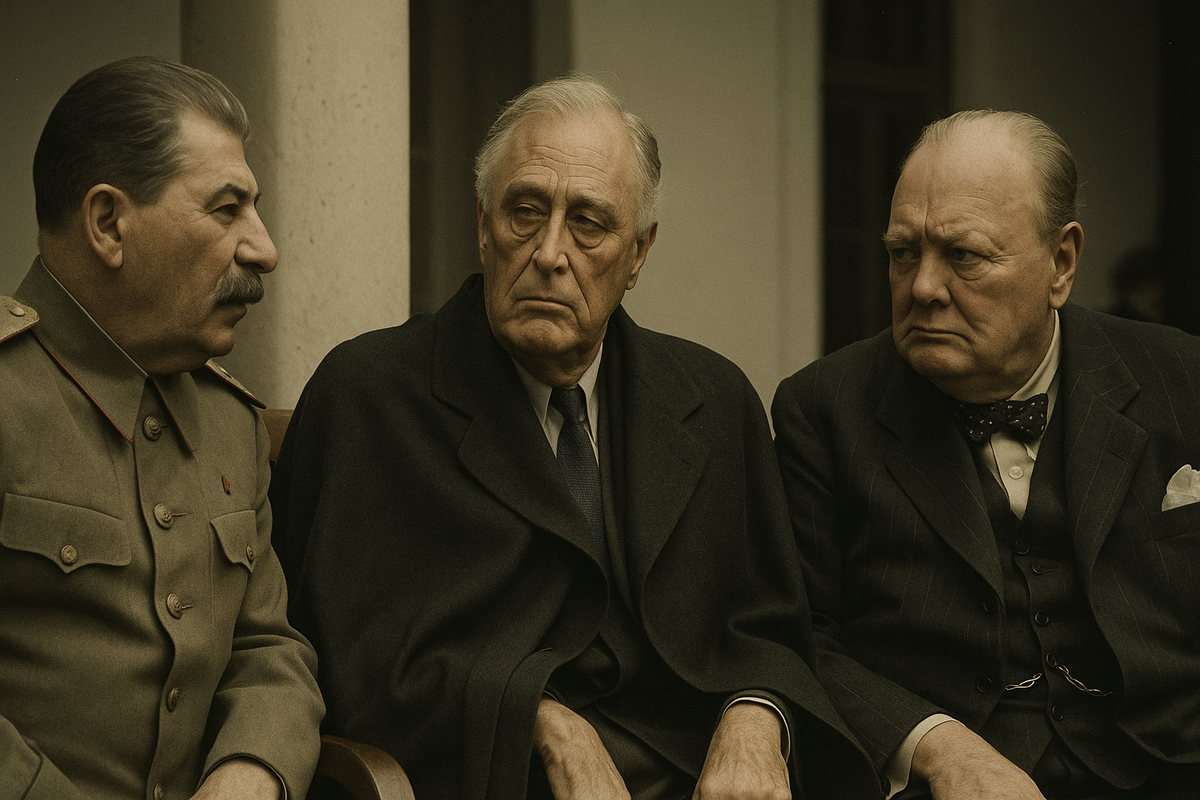
The Yalta Conference of February 1945 had been hailed as a triumph. Roosevelt, Churchill, and Stalin—the Big Three—gathered in Crimea to chart the postwar world. Germany would be divided. The United Nations would be born. The Soviets pledged free elections in Poland.
Photographers captured the leaders at banquets, glasses raised, unity on display. To the public, the alliance looked unshakeable.
Leahy knew better. Even at Yalta, he saw the cracks. The Soviets controlled Eastern Europe, their armies occupying territory from the Baltic to the Balkans. Stalin's promises about Poland were vague, conditional, laced with conditions the West couldn't enforce. Roosevelt, exhausted and visibly frail, pushed for compromise. But compromise, Leahy understood, required trust—and trust was already evaporating.
Within days of leaving Yalta, the quarrels began.
Stalin's Fury: The Bern Incident
The flashpoint was Switzerland.
In March 1945, agents of the Office of Strategic Services (OSS) made contact with SS General Karl Wolff in Bern. The objective was narrow: negotiate the surrender of German forces in northern Italy, potentially saving thousands of Allied lives and shortening the war. The talks were exploratory, tactical—nothing more.
Stalin saw treason.
Soviet intelligence reported the meetings to Moscow, and the Kremlin's interpretation was swift and venomous: the Americans and British were cutting side deals with the Nazis. Stalin accused Roosevelt of negotiating a separate peace, of planning to let Hitler's generals off the hook while Soviet soldiers bled on the Eastern Front. The charges were absurd, but Stalin wielded them like a weapon, launching a propaganda offensive that painted the West as faithless betrayers.
Roosevelt, shocked and weakened, scrambled to reassure the Soviet leader. He sent Harry Hopkins—his most trusted envoy—to Moscow on a desperate diplomatic mission. But the damage was done. The alliance, forged in the crucible of war, was fracturing under the weight of suspicion.
The Polish Tragedy
If Bern was the spark, Poland was the kindling.
At Yalta, Stalin had agreed to allow Poland to form a government representing "all democratic and anti-Nazi parties." The Soviets would permit free elections. It was a promise Roosevelt clung to, knowing that six million Polish-Americans were watching.
Stalin never intended to keep it.
In the weeks after Yalta, the Soviets installed a puppet regime in Warsaw and arrested Polish resistance leaders who had fought the Nazis. When Roosevelt and Churchill protested, Stalin's replies were curt, dismissive, and final. Poland, he made clear, was a Soviet sphere. No negotiation. No compromise.
Leahy recorded Roosevelt's anguish. The President understood what Stalin's intransigence meant: the dream of a cooperative postwar order, anchored by the United Nations and great power cooperation, was dying. In its place, something darker was taking shape—a world divided not by ideology alone, but by irreconcilable visions of power.
Roosevelt's Final Address
On March 1, 1945, Roosevelt appeared before a joint session of Congress to report on Yalta. For the first time in his presidency, he delivered the speech seated, too weak to stand. His voice, once commanding, was thin and strained. He spoke of agreements reached, of hopes for peace, of the United Nations as humanity's last, best chance.
He did not speak of Stalin's accusations. He did not mention Poland's betrayal or the bitter exchanges over Bern. To Congress and the American people, he presented Yalta as a success.
Leahy, watching from the wings, knew the truth. The President was dying, and so was the alliance. Six weeks later, on April 12, 1945, Roosevelt suffered a cerebral hemorrhage in Warm Springs, Georgia. He never woke up.
The quarrels he had tried so desperately to contain would outlive him by half a century.
A Magazine at the Crossroads of History
The March 4, 1950 Saturday Evening Post was a study in contrasts.
On the cover: Fred Dayton, fly-fishing enthusiast, embodying the quiet pleasures of American life.
Inside: Fleet Admiral Leahy, revealing the moment the postwar world split in two.
Between them, the magazine carried short stories by Arthur Mayse and C. S. Forester, Grace Amundson's novelette "A Pagan Affair," humor columns, editorials, and serialized adventures. This was the Post at its height—a cultural institution that reached millions, blending entertainment with serious journalism, Rockwell's Americana with hard-edged geopolitical analysis.
By 1950, the Cold War was no longer a revelation. The Berlin Blockade had ended. NATO had formed. The Soviet threat was real, immediate, and terrifying. But Leahy's article offered something readers craved: the origin story. How did we get here? When did it start? Who was to blame?
The answer, Leahy showed, was more complex than propaganda allowed. The Cold War began not with Soviet aggression alone, but with the collapse of trust between leaders who had once called each other allies. It began with Roosevelt's frailty, Stalin's paranoia, and the impossible burden of holding a fractured world together.
Historical Authority
Written by Fleet Admiral William D. Leahy, Roosevelt's Chief of Staff and the highest-ranking U.S. military officer of his era. This isn't analysis; it's testimony.
Cultural Timing
Published at the height of Cold War anxiety, when Americans were desperate to understand how their wartime allies became existential enemies.
Artistic Legacy
Stevan Dohanos' cover adds collectible value, situating this issue within the golden age of Post illustration.
The Contrast
The juxtaposition of Dayton's basement workshop and Leahy's diplomatic revelations captures the duality of postwar America—ordinary life continuing even as the world tilted toward confrontation.
Why This Issue Matters
Primary Source Document
For collectors and historians, the March 4, 1950 Saturday Evening Post is more than a magazine—it's a firsthand account from the man who stood at Roosevelt's side during the alliance's collapse.
Cultural Snapshot
The issue pairs heavy geopolitical history with lighthearted fiction and art—a complete portrait of American reading life at the dawn of the Cold War.
Enduring Relevance
The article remains vital reading for anyone seeking to understand not just the Cold War's beginning, but the fragility of international alliances under pressure.
Historical Artifact
To own this issue is to hold the moment Roosevelt's vision died and the Cold War was born—history as it was first reported, unfiltered by hindsight or revisionism.
Time Capsules, Not Trash
In an era of disposable digital news, vintage magazines remind us that history was once consumed slowly—read at kitchen tables, debated over coffee, saved in family attics. They are artifacts of how Americans understood their world in real time, unfiltered by hindsight or revisionism.
The March 4, 1950 Saturday Evening Post is one of those artifacts. It doesn't just report history; it is history.
Explore the Collection
Thousands of original Saturday Evening Post magazines—spanning the 19th century through the mid-20th—are available in our collection. From World War II photojournalism to Norman Rockwell covers, from Cold War politics to the rhythms of American family life, these magazines are living documents of their time.
Browse The Saturday Evening Post Magazine Collection