
When America Saw the Tide Turn
Life Magazine's Stalingrad Issue and the Moment Hitler's War Began to Crack
On January 4, 1943, Americans opened their mailboxes to find something unprecedented: photographic proof that the Third Reich could bleed.
The latest issue of Life Magazine didn't offer reassurances or propaganda. It delivered raw evidence. Under the banner "The Red Army Strikes Back," readers confronted images of Soviet troops advancing through snowfields, German divisions collapsing into captivity, and the smoldering skeleton of Stalingrad rising above the Volga. For a nation still reeling from Pearl Harbor and anxious about the war's trajectory, this issue represented more than journalism—it was the first tangible sign that Hitler's momentum had shattered.
Eighty years later, the January 4, 1943 issue remains one of the most consequential publications in wartime media history. Not because it simply reported events, but because it transformed the Eastern Front from distant abstraction into visceral reality for millions of Americans.
Historical Context
Publication: Life Magazine
Issue Date: January 4, 1943
Feature: "The Red Army Strikes Back"
Historical Moment: Battle of Stalingrad (climax phase)
Archive Source: Original wartime publication
The Battle That Broke the Wehrmacht
By winter 1942, the German Sixth Army had driven deep into Soviet territory, reaching the Volga and seizing much of Stalingrad. Hitler declared the city—named for Stalin himself—a symbolic objective whose capture would demoralize the Red Army and secure Germany's southern flank.
The Soviets had other plans.
In November 1942, they launched Operation Uranus, a massive counteroffensive that encircled more than 250,000 German troops inside the city. As temperatures plummeted and supply lines severed, the Wehrmacht found itself trapped in a frozen urban hellscape. Soviet forces tightened the noose while German soldiers—starving, frostbitten, and running out of ammunition—fought building by building through factory ruins and apartment blocks.
When Life went to press in early January, the battle's outcome was becoming inevitable. What remained uncertain was whether Americans fully grasped what this meant: the world's largest land battle was about to end in Germany's first catastrophic defeat.
How Life Made War Visible
Life Magazine had already established itself as America's premier visual chronicle. Founded in 1936, it pioneered photojournalism as both art form and weapon—a medium that could make distant conflicts immediate and undeniable. The January 4, 1943 issue deployed every tool in its arsenal.
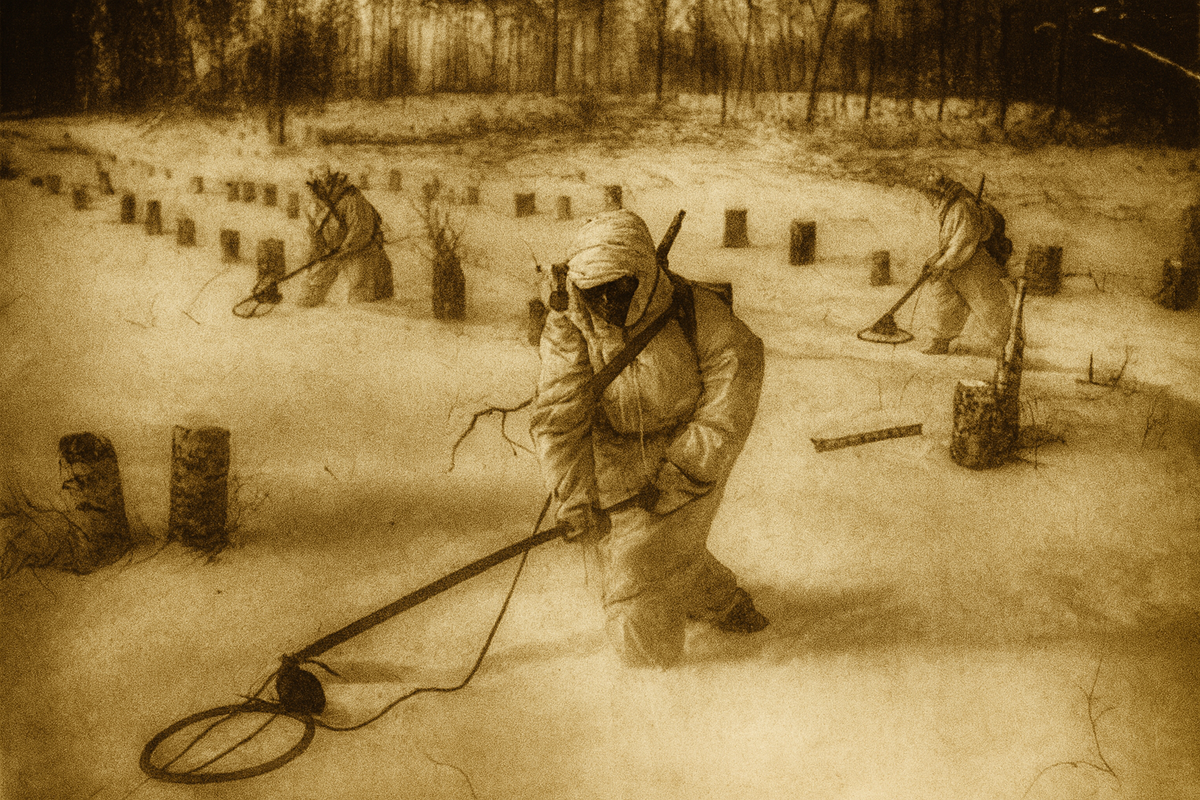
The Cover showed Soviet soldiers in white winter camouflage moving through snowy forests with mine detectors. The caption called it "the surest sign of winter and new Russian advances." No heroic posing, no dramatization—just soldiers doing deadly work in subzero conditions. The image communicated endurance as strategy.
Stalingrad's Skyline appeared in photographs taken across the Volga: smoke billowing from gutted factories, oil storage tanks reduced to twisted metal, industrial districts transformed into apocalyptic battlegrounds. Readers could see that modern war had turned a city of half a million into rubble where men fought room by room.
Soviet Infantry in Action filled multiple spreads—squads charging past barbed wire, machine gunners diving into shallow snow pits, troops advancing across landscapes stripped bare by artillery. These weren't staged victory shots. They captured combat's chaotic immediacy.
Women at War startled American audiences. One photograph showed a young Soviet radio operator standing knee-deep in snow, speaking into her "walky-talky" while coordinating troop movements. For many readers, this was their first encounter with women serving in direct combat roles—a reality that challenged assumptions about both warfare and gender.
Axis Prisoners marched in endless columns under Soviet guard. Captured Italians, faces hollow with exhaustion, illustrated not just German setbacks but the disintegration of Hitler's alliance system.
Battle Maps traced the campaign's geometry—German thrusts, Soviet counterattacks, the closing trap at Stalingrad. These graphics transformed Eastern Front complexity into comprehensible strategy, turning casual readers into informed observers of history's largest military theater.
Photography as Battlefield Intelligence
What separated Life from competitors wasn't just access or image quality—it was editorial philosophy. The magazine treated photographs as primary sources, not decorative elements. Each image carried evidentiary weight.
Unlike publications that relied on illustrated covers or patriotic artwork, Life chose stark realism. The snowy, grim cover of this issue signaled that readers were entering a serious accounting of war's reality, not consuming sanitized spectacle.
The magazine's photographers and editors understood something essential: Americans needed to see the Eastern Front to believe in it. Soviet resistance had been dismissed by some as temporary, doomed to collapse like France had in 1940. These photographs proved otherwise. They showed an enemy grinding down Hitler's army through industrial-scale combat that dwarfed anything happening in North Africa or the Pacific.
The Narrative Beneath the Images
Life's Stalingrad coverage crystallized several themes that would define how Americans understood the war's trajectory:
Winter as Weapon
Just as Napoleon had learned in 1812, the Russian winter proved a ruthless ally. Blizzards and temperatures far below zero immobilized German mechanized units while Soviet troops, equipped and trained for the conditions, pressed their advantage.
Encirclement as Annihilation
The maps made clear what text alone couldn't: Soviet generals had executed a pincer movement of devastating scale, trapping entire divisions in an urban pocket with no escape route.
Soviet Command Competence
Generals Chuikov, Vatutin, and Rokossovsky received credit by name, countering Western assumptions about Soviet military leadership. These weren't ideological commissars ordering suicidal charges—they were tacticians who had outmaneuvered the Wehrmacht.
Industrial Ruins as Fortresses
Factories and steel plants became vertical battlegrounds where fighting raged floor by floor. The images underscored both the scale of destruction and the ferocity of Soviet determination to hold ground.
Coalition Collapse
Italian prisoners and references to retreating Romanian and Hungarian units signaled that Hitler's European alliance was fracturing under military pressure.
Every photograph reinforced a single conclusion: the Red Army wasn't merely surviving. It was winning.
The Permanence of Print
Before 24-hour news cycles and smartphone alerts, Americans learned about the world through magazines like Life. These issues sat on coffee tables, passed between neighbors, and were saved in attics for decades. They were studied, discussed, clipped for scrapbooks.
Unlike digital media that vanishes into server archives, these magazines remain physical witnesses. The photographs aren't just illustrations—they're evidence, frozen at the moment of first publication. That tangibility explains why vintage Life issues continue to resonate. They offer something no screen can replicate: direct contact with how history was first reported to millions.
Why This Issue Matters to Collectors
Historical Timing
Published at the climax of Stalingrad, this issue captures history as it happened. Readers didn't yet know that German surrender would come on February 2nd, but they could see the outcome taking shape in real time.
Photographic Power
The images of snowbound Soviet advances, the smoldering cityscape, the columns of prisoners—these remain among the most striking combat photographs from any theater of World War II.
Cultural Artifact
This issue is a time capsule of American perception. It reveals what families on the home front knew, when they knew it, and how visual media shaped their understanding of a global conflict. To hold this magazine is to hold the same pages that reassured anxious readers in January 1943 that the war could be won.
Collector Demand
World War II issues of Life consistently attract serious interest from military historians, vintage media collectors, and families researching relatives who served. Issues tied to pivotal battles—Pearl Harbor, D-Day, Stalingrad, V-E Day—command particular attention.
This isn't just reading material. It's an original artifact from the winter that changed the war.
Explore the Archive
If the January 4, 1943 issue captures your interest, consider the broader collection of original Life magazines spanning the 1930s through the 1970s. From World War II and the Korean conflict to the Civil Rights Movement, the Space Race, and Vietnam, Life chronicled the 20th century with unmatched photographic authority.
Whether you're a military historian, a collector of vintage media, or someone honoring a family member who lived through these years, these magazines provide direct access to history exactly as it was first witnessed.
Browse Life Magazine CollectionA Magazine That Marked the Turning Point
The January 4, 1943 issue of Life Magazine stands as one of the most significant wartime publications ever printed. "The Red Army Strikes Back" brought the Battle of Stalingrad into American homes with photography that didn't flinch from war's brutality or complexity. It showed readers that Hitler's advance had not just stalled—it had reversed.
Eight decades later, this issue retains its power. It documents the moment when the outcome of World War II became imaginable, when the phrase "unconditional surrender" shifted from Allied aspiration to German nightmare.
For anyone who values primary sources, these vintage Life magazines aren't nostalgia—they're proof. Proof of how people first learned that the tide had turned, that sacrifice was yielding ground, and that the world's darkest chapter might eventually close.