
The Russian Bear Hugs Greece
When America's First Cold War Began in a Burned Village
The cover promised champagne and confetti. Inside were corpses and land mines.
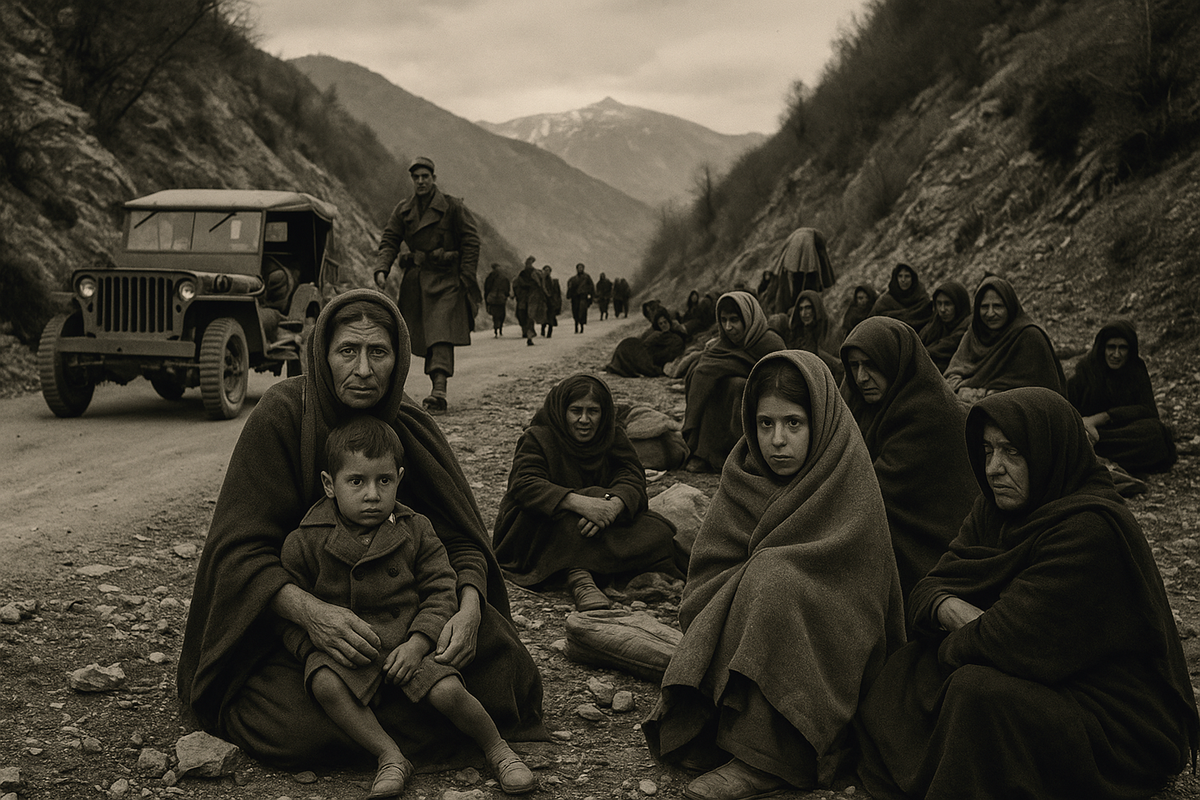
When Americans opened the January 3, 1948 issue of The Saturday Evening Post, they found John Falter's glowing illustration of a New York apartment building on New Year's Eve—sparklers in children's hands, couples toasting, an elderly man watching quietly from his window. Turn the page, and the festivity vanished. Demaree Bess's dispatch from Greece landed like a mortar round: refugee families crouched by roadsides, American Jeeps unloaded at Mediterranean ports, a captured guerrilla staring into the camera with exhausted defiance.
This wasn't foreign news. It was a transmission from the front lines of a war most Americans didn't yet know they were fighting.
Greece—birthplace of democracy, now its first Cold War proving ground—was burning. And for the first time in its history, the United States had formally pledged to put out the fire.
Historical Context
Publication: The Saturday Evening Post
Issue Date: January 3, 1948
Cover Artist: John Falter
Reporter: Demaree Bess
Article: "The Russian Bear Hugs Greece"
Archive Series: Cold War Origins Collection
The War That Wasn't Supposed to Happen
Three years after V-J Day, Europe should have been healing. Instead, it was fracturing. The Soviet Union had already swallowed Poland, Czechoslovakia, and Hungary. In Greece, the fracture ran through every village.
The Greek Civil War (1946–1949) wasn't a clash of uniformed armies. It was a guerrilla nightmare. Communist fighters calling themselves the "Democratic Army" ambushed government convoys, laid mines on mountain roads, and torched farmhouses to deny the Athens regime any foothold in the countryside. The Soviet Union sent no tanks, no divisions—it didn't need to. The chaos itself was the strategy.
For Greek peasants, ideology was irrelevant. What mattered was survival. Crops burned. Families fled with blankets and bread. Children went hungry while politicians in distant capitals debated the future of democracy.
Britain, bankrupt and exhausted from World War II, could no longer prop up the Greek government. In March 1947, President Harry S. Truman stood before Congress and announced what would become the Truman Doctrine: America would support free peoples resisting subjugation by armed minorities or outside pressures. Greece and Turkey were named explicitly.
By January 1948, that doctrine had a face. It had mud on its boots. And it had a body count.
What The Saturday Evening Post Understood
By mid-century, The Post had perfected a formula: make the distant personal. Its pages blended Norman Rockwell covers with war dispatches, humor columns with political analysis. It was the magazine on every coffee table, in every barbershop, passed from father to son.
Demaree Bess's "The Russian Bear Hugs Greece" exploited that intimacy. He didn't write about geopolitics in the abstract. He wrote about the mine that killed a Greek officer on a Macedonian road. The guerrilla fighter, filthy and defiant, being interrogated by government troops. The American aid convoy—steel, rubber, crates—being hauled off freighters in Piraeus.
For readers raised on the grand battles of World War II—Normandy, Iwo Jima, Berlin—this was disorienting. The Cold War, Bess revealed, would not be won with tanks. It would be won in villages. In propaganda battles. In the slow, grinding work of keeping fragile governments alive while their enemies bled them dry.
The photographs told the rest. A woman holding a child, sitting on bare ground with nothing. Wreckage from an ambush. American Jeeps lined up like a promise made tangible.
The juxtaposition was deliberate and devastating: while New Yorkers clinked glasses, Greek mothers clutched their children and ran.
The Anatomy of a Proxy War
Bess's reporting distilled the Greek conflict into a blueprint that would repeat across the Cold War for the next four decades. Ten patterns emerged, each one a warning of what was to come:
Mines, ambushes, and raids kept the countryside in perpetual chaos. Victory wasn't measured in territory held but in stability denied.
Peasants and farmers paid in blood and displacement. Families abandoned generational farms. Refugee camps swelled.
Moscow needed no soldiers in Greece. Proxy fighters and plausible deniability achieved the same goal: a government too weak to govern.
Rural insurgencies, communist ideology, foreign powers backing opposite sides. The template was global.
Millions in equipment—Jeeps, weapons, food—flowed into Greek ports. The Marshall Plan had a twin: military intervention dressed as humanitarian relief.
London could no longer police the Mediterranean. Washington had no choice but to step in.
If Greece fell, the Balkans would follow. Then Turkey. Then the Eastern Mediterranean. Stalin understood geography.
Both sides courted peasants, promising land, justice, stability. Legitimacy was a weapon.
Orphans, refugees, captured insurgents—each one a data point in the ideological calculus of the superpowers.
Not the last. Korea, Vietnam, Afghanistan, Nicaragua—they all began here, in the mountains outside Athens.
For American readers in 1948, this was revelation. For historians today, it's prophecy.
Why This Magazine Matters Now
Original issues of The Saturday Evening Post from the 1940s occupy a peculiar space in the collector's market. They're not rare in the way a Gutenberg Bible is rare. Millions were printed. But rarity isn't always about scarcity—it's about significance.
This January 3, 1948 issue documents the exact moment America's postwar identity crystallized. The cover art—Falter's warm, glowing New Year's scene—captures the optimism. The interior reporting captures the cost of maintaining it.
The Power of Permanence
The Saturday Evening Post mattered because it moved slowly. In an era before 24-hour news cycles, before the internet dissolved information into vapor, these magazines were saved. Passed down. Reread.
Families kept them in basements and attics. They marked moments: a child's birth, a father's deployment, a president's speech. The January 3, 1948 issue wasn't just read—it was held, folded, annotated, remembered.
That physicality is what makes vintage magazines powerful for collectors today. Headlines vanish. Tweets evaporate. But this issue—printed on paper, illustrated by hand, reported from the ground—endures.
It reminds us that history was once consumed deliberately. That Americans once sat at kitchen tables and absorbed news that would shape their children's futures. That permanence was the point.
Collector Significance
The Truman Doctrine in action, photographed and analyzed in real time.
Falter's New Year's Eve illustration is pure Americana, a visual counterweight to the war inside.
Refugee camps, ambush sites, aid convoys—primary source imagery that cannot be recreated.
From isolationism to global leadership, visible in a single magazine.
Issues tied to historic turning points—World War II, the Cold War, Rockwell or Falter covers—command sustained interest.
These pages contain the blueprint of the next fifty years of American foreign policy.
Own the Moment
If you want to hold the artifact of America's first Cold War commitment—when Greece became the testing ground for Truman's promise and the Post showed Americans what that promise looked like on the ground—you can.
Browse The Saturday Evening Post Magazine CollectionFrom the 1930s through the 1970s, our collection traces American culture, politics, and art as they unfolded in real time. Whether you're a collector, a historian, or someone preserving family memory, these magazines offer something irreplaceable: history exactly as it was reported, exactly as it was felt.
The First Battlefield
The January 3, 1948 issue of The Saturday Evening Post is more than journalism. It's a historical marker. The moment when a civil war in the Greek mountains became the first test of American resolve in the Cold War. The moment when guerrilla tactics, proxy wars, and ideological struggle replaced the clarity of conventional combat.
John Falter's cover promised celebration. Demaree Bess's reporting delivered reckoning.
To hold this issue is to hold the origin point—not in the Kremlin, not in the White House, but in the burned villages where history actually happens. Vintage magazines aren't reading material. They're primary sources. Voices from the past, still speaking, still urgent, still true.