
The Night America Believed in Martians
Inside the 1940 Profile That Captured Orson Welles at His Most Dangerous
On February 3, 1940, Americans opened their mailboxes to find something unsettling tucked between advertisements for Listerine and Lucky Strike cigarettes.
The Saturday Evening Post—the nation's most trusted weekly—had placed a 24-year-old theatrical upstart on trial. The headline read: "How to Raise a Child: The Disturbing Life—To Date—of Orson Welles." Not "remarkable." Not "brilliant." Disturbing.
Sixteen months earlier, Welles had committed what many considered an act of media terrorism. His Mercury Theatre broadcast of The War of the Worlds convinced thousands of listeners that Martians had landed in New Jersey, sending families fleeing into the streets, clogging police switchboards, and sparking sermons about the devil's new voice on the radio. Now, as Europe burned and America teetered on the edge of global war, The Post asked a question that felt both urgent and prophetic: What do we do with a genius who can weaponize imagination?
This wasn't a puff piece. It was an autopsy of American credulity—and a warning shot about the future of mass persuasion.
Archive Details
Historical Figure: Orson Welles
Issue Date: February 3, 1940
Archive Source: The Saturday Evening Post
Article Title: "How to Raise a Child: The Disturbing Life—To Date—of Orson Welles"
Authors: Alva Johnston and Fred Smith
When the Barbarians Came to Grover's Mill
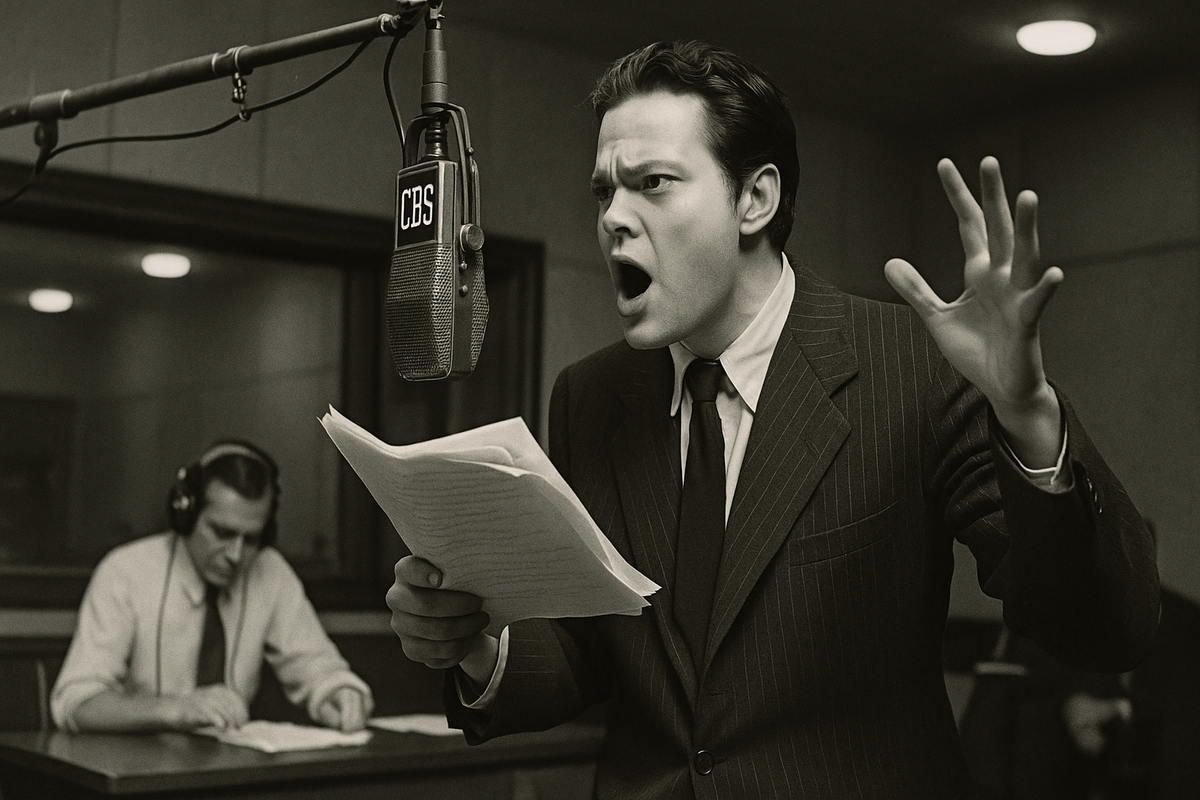
October 30, 1938. Halloween Eve. While children carved pumpkins and planned their costumes, Orson Welles walked into a CBS studio and shattered the boundary between theater and reality.
His adaptation of H.G. Wells' The War of the Worlds unfolded as a string of "breaking news" bulletins: a meteorite in New Jersey. Strange creatures emerging. Heat rays vaporizing soldiers. The catastrophe escalated in real time, interrupted only by the crackle of a reporter's microphone going dead mid-scream.
Listeners who tuned in late—or who simply forgot they were listening to fiction—believed every word. Newspaper offices were mobbed. Churches filled with the faithful praying for deliverance. In Newark, families wrapped wet towels around their faces to protect against Martian poison gas that existed only in a script.
The Post article, penned by Alva Johnston and Fred Smith, dissected this event not as entertainment gone wrong, but as a case study in collective vulnerability. If one actor with a microphone could trigger nationwide panic, what could a totalitarian state achieve with coordinated propaganda? Hitler and Mussolini were already proving the answer overseas.
The timing of the Post profile was no accident. America in February 1940 was a nation holding its breath—still neutral, still isolationist, but watching Europe collapse under mechanized warfare and information control. Welles had demonstrated, accidentally or not, that the American mind could be hacked.
The Post as Cultural Sentry
By 1940, The Saturday Evening Post reached more American homes than any publication in the country. It was the visual and narrative heartbeat of middle-class life—Norman Rockwell covers, serialized fiction, and investigative profiles that combined literary craft with cultural interrogation.
The magazine's approach to Welles embodied this mission. While the February 3 cover by John Phillips depicted a scene of wholesome domesticity—a visual lullaby—the interior delivered something far more confrontational: a portrait of a child prodigy who had skipped innocence entirely, performing Shakespeare at ten, staging avant-garde theater at twenty, and wielding radio like a psychological weapon at twenty-three.
Photographs accompanying the article captured Welles mid-gesture in the studio, his face contorted with dramatic intensity, hands conducting invisible forces. For readers who had never seen him perform, these images were revelatory—and unnerving. Here was a young man who seemed to exist entirely inside imagination, with little regard for the havoc he left in the real world.
Johnston and Smith's prose walked a tightrope between admiration and alarm. They chronicled his rebellious education, his theatrical innovations with the Mercury Theatre, and his uncanny ability to manipulate audiences. But they also posed a darker question: Was Orson Welles a visionary artist or a dangerous illusionist?
The article never quite answered. And that ambiguity was the point.
Five Threads That Define the Profile
1. The Boy Who Refused Childhood
Welles painted sets, debated Nietzsche, and performed King Lear while his peers struggled with multiplication tables. The Post framed this not as charming precociousness but as something almost pathological—a refusal to be ordinary that bordered on compulsion.
2. The Broadcast as Media Rupture
The "War of the Worlds" incident receives forensic attention. The article explains how the Mercury Theatre exploited radio's intimacy and authority, crafting fake news bulletins with such precision that listeners abandoned critical thinking. It was radio's first demonstration of its power to override reason.
3. The Collapse of Trust
Why did people believe? The Post suggests that Americans in 1938—exhausted by economic depression, anxious about European fascism—were primed to accept catastrophe as plausible. Welles didn't create the fear; he triggered it.
4. The Showman as Manipulator
The profile depicts Welles as both magnetic and reckless. He understood theatricality better than anyone alive, but seemed indifferent to consequences. Was he an artist or a con man? The Post leaves readers unsettled.
5. The Omen of Things to Come
Implicit throughout the article is a warning: If one broadcast could cause such disruption, what awaited America in an era of global propaganda wars? The piece reads less like celebrity journalism and more like strategic intelligence.
The Post as American Mirror
The Saturday Evening Post functioned as more than a magazine—it was a national mirror, reflecting how ordinary citizens understood themselves, their country, and the forces reshaping their world.
The Welles profile exemplifies this role. It doesn't merely entertain; it provokes. It forces readers to confront uncomfortable truths about their own susceptibility to manipulation, their trust in authority, and the fragility of consensus reality.
In an era when propaganda was already a tool of war, The Post offered Americans a stark preview: truth was negotiable, and the line between fact and fiction was thinner than anyone wanted to admit.
For historians, cultural scholars, and collectors seeking to understand 20th-century America, these vintage Saturday Evening Post issues provide irreplaceable insight. They are time capsules of anxiety, hope, and transformation—printed evidence of how a nation saw itself at critical junctures.
Why This Issue Matters to Collectors
Timing as Destiny
Published just months before Welles began filming Citizen Kane, the issue captures him at a pivot point—already infamous, not yet immortal. It documents the young iconoclast before Hollywood tried to tame him.
Primary Source Literature
This is one of the first major national profiles of Welles, written when the "War of the Worlds" panic was still raw, still unprocessed. It predates decades of revisionist scholarship and remains unfiltered by hindsight.
Design and Craft
The layout reflects The Post's signature blend of illustration, photography, and narrative design. Original issues in good condition showcase the magazine's editorial artistry at its peak.
Artifact of Media Awakening
Beyond Welles, this issue documents the moment Americans realized that mass media wasn't neutral. It could persuade, deceive, and transform society overnight. That realization—prescient in 1940—feels almost clairvoyant today.
Collectors prize this issue not just as memorabilia, but as a document of cultural inflection. It captures the instant when entertainment became something far more dangerous.
The February 3, 1940 issue of The Saturday Evening Post—featuring "How to Raise a Child: The Disturbing Life—To Date—of Orson Welles"—stands as one of the most compelling cultural documents of its era.
It captured a young genius who thrilled and terrified in equal measure. It reflected a nation grappling with its own vulnerability on the eve of global conflict. And it demonstrated that mass media had crossed a threshold from which there was no return.
To hold this issue today is to hold the story of a broadcast that shook a generation, a personality who redefined performance, and a magazine that chronicled it all with clarity and nerve.
For anyone who values the evolution of media, the intersection of art and power, or the fragile architecture of public trust, this isn't simply a collectible magazine. It's a living artifact of American imagination and fear—preserved in print, waiting to teach us what we've always been capable of believing.
Explore More Saturday Evening Post History
Discover our curated collection of original Saturday Evening Post magazines spanning decades—stories, art, and cultural commentary that form a mosaic of American identity.
Browse The Saturday Evening Post Magazine Collection