
When America Went to War Without Declaring It
The Life Magazine Issue That Captured a Nation on the Brink
Eleven months before Pearl Harbor, Americans were already fighting World War II. They just weren't using bullets.
The January 6, 1941 issue of Life Magazine froze a singular moment in American history: a nation technically neutral, publicly conflicted, yet privately mobilized. While President Roosevelt maneuvered the Lend-Lease Act through Congress and isolationists protested in the streets, ordinary citizens had already chosen sides. They threw coins into giant American flags. They gambled at makeshift casinos to buy Spitfire planes. A burlesque queen stripped down to paper stars and sold them for ten dollars apiece—all for Britain.
This wasn't charity. It was a dress rehearsal for total war, conducted in ballrooms and parade routes instead of battlefields.
For collectors, this issue represents more than photojournalism. It's the last snapshot of peacetime America, captured at the exact moment the country stopped pretending it could stay out of Europe's fight.
Issue Details
Publication: Life Magazine
Issue Date: January 6, 1941
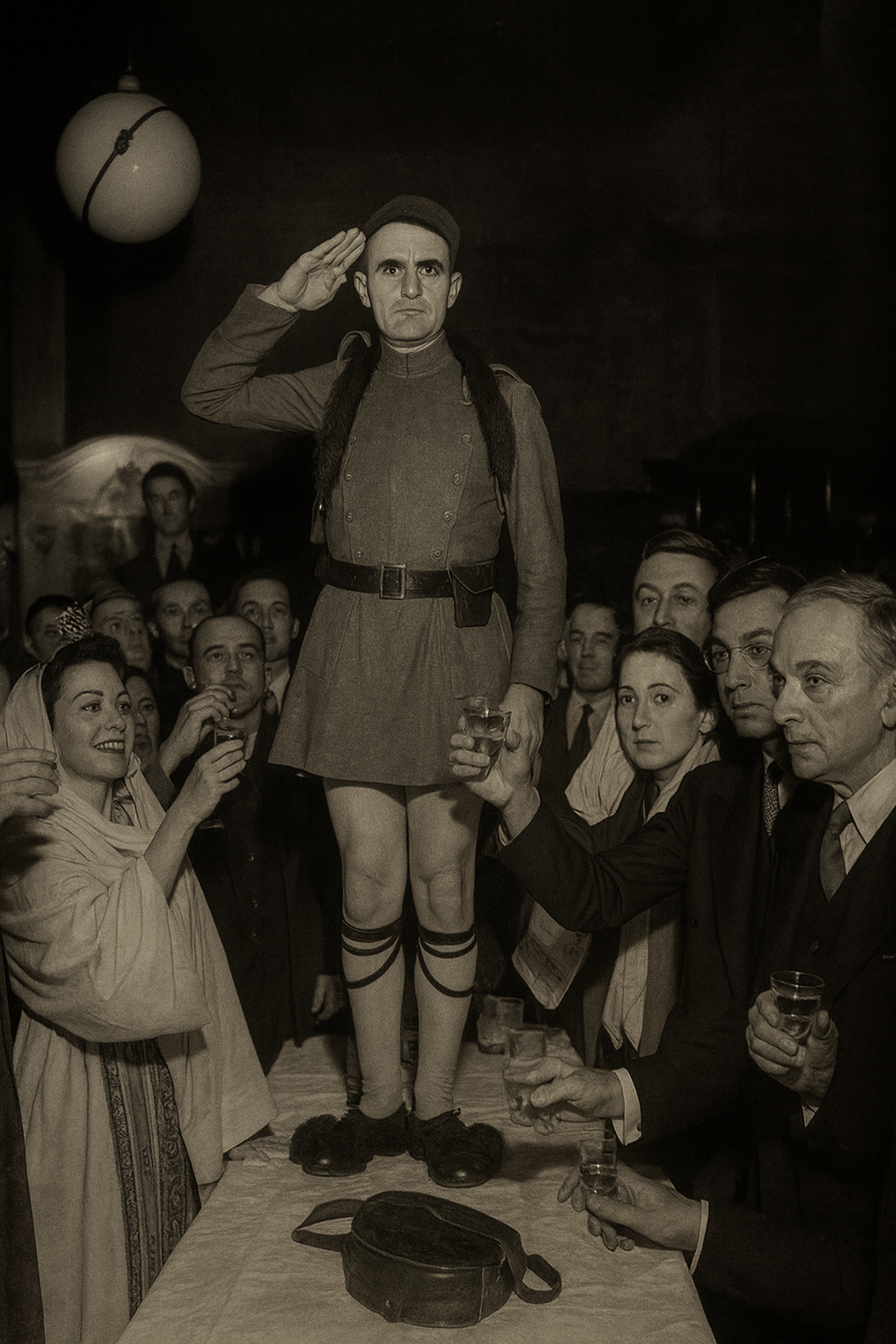
Cover Subject: Greek-American veteran in Evzone uniform, Chicago's "March of Freedom"
Historical Context: Eleven months before Pearl Harbor
Archive Significance: Final portrait of pre-war American mobilization
The Historical Pressure Point
By January 1941, the illusion of neutrality had become impossible to maintain. Germany controlled most of Europe. Britain was surviving the Blitz on borrowed time. In the Mediterranean, Greece had stunned the world by stopping Mussolini's Italian invasion—a David-and-Goliath moment that electrified American public opinion.
Charles de Gaulle's Free French movement was rallying expatriates in New York. Polish refugees were organizing in Chicago. The question wasn't whether America would enter the war, but when—and how prepared the country would be when it did.
Life Magazine understood its assignment. The relief drives profiled in this issue weren't just feel-good human interest stories. They were political barometers, showing which way the wind was blowing in immigrant communities, high society, and Middle America. The magazine's editors knew they were documenting something larger than charity: the visible cracks in America's isolationist facade.
Life's Editorial Weapon: The Marriage of Image and Urgency
By 1941, Life had perfected a form of visual storytelling that magazines like The Saturday Evening Post, with their illustrated covers and text-heavy layouts, couldn't match. The magazine's philosophy was simple: one powerful photograph communicated more urgency than a thousand words of wire service copy.
The cover announced its thesis immediately. A Greek-American veteran in full Evzone uniform—white kilt, pompom shoes, rifle at attention—saluted during Chicago's "March of Freedom." His badge read "Give Today." Behind him, fellow Greek immigrants marched in solidarity. For readers flipping through newsstands, the image demanded a question: If immigrants were this committed to defending their ancestral homelands, how long could native-born Americans remain spectators?
The interior pages delivered a relentless montage of contradictions: serious purpose wrapped in social spectacle, immigrant patriotism mixed with high-society glamour, genuine sacrifice staged as entertainment. Life didn't editorialize. It simply showed readers what their country looked like from the inside—a nation mobilizing through the only channels available to civilians in peacetime.
The Spectacle Catalogue: How America Fundraised Before It Fought
Chicago's Greek-American community built a papier-mâché Parthenon on a parade float and marched it through downtown streets. Spectators threw $1,500 in loose change into a giant American flag held aloft by volunteers—a moment of civic theater that turned pocket money into a political statement.
At the Ritz-Carlton in New York, socialite Mrs. Harrison Williams—regularly named one of the best-dressed women in the world—dined beside Archbishop Athenagoras, head of the Greek Orthodox Church in America. The gala raised funds for Greek War Relief, but it also signaled something else: establishment approval. When Fifth Avenue showed up in evening gowns, neutrality was effectively over.
Carnegie Hall hosted the first "France Forever" rally for de Gaulle's Free French movement. The venue sold 3,700 tickets. Another 5,000 people were turned away at the doors. Inside, eighteen-year-old Robert Redgate of New York posed for Life's cameras as the youngest volunteer for the Free French ambulance corps—a boy barely old enough to vote, already committed to driving into combat zones.
In Seattle, society women turned fundraising into gambling nights, running bingo and roulette tables to buy Spitfire fighters for the Royal Air Force. In Richmond, Virginia's "First Families"—the self-appointed aristocracy of the Old Dominion—danced under a British naval ensign at an English relief ball, proving that Anglophilia ran deeper than Revolutionary War grudges.
Broadway royalty joined the effort. Alfred Lunt and Lynn Fontanne, the most celebrated acting couple in American theater, packed "Bundles for Britain" in a Manhattan warehouse, photographed surrounded by crates of supplies. The image carried symbolic weight: if stage legends were willing to do manual labor for the cause, what excuse did anyone else have?
And then there was Gypsy Rose Lee.
The most famous burlesque performer in America turned her striptease into fundraising performance art. She sold paper stars pinned to her costume for ten dollars each—a fortune in 1941—and donors lined up to buy them. It was patriotism as spectacle, charity as seduction, and exactly the kind of cultural moment that made Life's editors understand they were documenting something unprecedented.
Why This Issue Became Visual Doctrine
Life's layout strategy made the relief drives feel both vast and intimate. Full-page photographs of Chicago's parade floats appeared opposite tight shots of individual volunteers. Captions were spare but sharp, letting images carry the emotional weight.
The magazine refused to sentimentalize. Greek-Americans weren't just helping their homeland—they were asserting their American identity through foreign loyalty, a paradox the magazine let readers navigate themselves. High-society galas weren't mocked for their theatricality; they were presented as legitimate expressions of commitment, even if the commitment came with champagne.
What made the issue powerful was its refusal to reconcile contradictions. Ambulance volunteers preparing for combat appeared pages away from debutantes collecting coins at hockey games. Gambling nights funded fighter planes. A burlesque star became a patriotic icon. Life showed America exactly as it was: messy, inconsistent, already at war in every way except officially.
Key Moments in Relief Mobilization
The Greek Parade
Chicago's "March of Freedom" featured papier-mâché Parthenons and Evzone soldiers, with spectators throwing $1,500 into a giant American flag.
France Forever Rally
Carnegie Hall sold 3,700 tickets for de Gaulle's Free French movement while 5,000 more were turned away.
Seattle Gambling Nights
Society fundraisers ran bingo and roulette tables to purchase Spitfire fighters for the Royal Air Force.
Gypsy Rose Lee's Patriotic Striptease
The burlesque star sold paper stars from her costume for $10 each, turning performance into fundraising spectacle.
Bundles for Britain
Broadway legends Alfred Lunt and Lynn Fontanne packed supply boxes in Manhattan warehouses for British relief.
Ambulance Volunteers
Eighteen-year-old Robert Redgate became the youngest recruit for Free France's ambulance corps.
The Permanence of Print in an Ephemeral Age
Wartime Life issues endure because they were designed to. These weren't disposable newspapers meant to wrap fish the next day. They were premium products, printed on quality stock, intended to be saved. Families collected them. Libraries archived them. Veterans kept copies as personal records of the years they lived through.
That permanence matters now more than ever. Digital news evaporates. Social media posts disappear. But an original Life Magazine from 1941 exists as a physical object, unchanged, preserving not just facts but the texture of how those facts were presented to the public. The typography, the paper quality, the advertisement layouts—everything contributes to understanding how Americans experienced their own history in real time.
For historians, these magazines are primary sources. For collectors, they're tangible connections to grandparents and great-grandparents who read the same pages, absorbed the same images, and made their own decisions about what America's role in the world should be.
The Collector's Case: Why This Issue Commands Attention
For serious collectors of 20th-century Americana, the January 6, 1941 Life occupies rarified territory. Several factors converge to make it essential:
Historical Timing
Published eleven months before Pearl Harbor, it captures the exact inflection point when American neutrality became untenable. Earlier issues miss the mobilization; later issues are wartime propaganda. This one exists in the liminal space between peace and total war.
Visual Iconography
The Greek Evzone cover is instantly recognizable and photographically striking—a collector's piece that displays well and carries immediate historical weight.
Cultural Convergence
The issue documents immigrant patriotism, celebrity activism, high society's political signaling, and grassroots fundraising simultaneously. It's a cross-section of an entire society in transition.
Scarcity and Condition
Original copies from 1941 are increasingly difficult to find in good condition. Wartime paper drives encouraged recycling, and decades of handling have reduced the surviving population. Clean copies with intact covers and unfoxed pages command premiums.
Entertainment Crossover
Featuring Gypsy Rose Lee, Alfred Lunt, and Lynn Fontanne gives the issue appeal beyond political history—it crosses into theater history, celebrity culture, and the evolution of American performance.
Primary Source Value
Owning this issue means possessing a primary source document from one of the most consequential years in American history. It's not just reading material. It's evidence—proof that ordinary people understood what was coming before the government officially acknowledged it.
Explore the Full Archive
If the January 6, 1941 issue captures your imagination—with its fusion of war relief, social spectacle, and historical urgency—the archive runs deeper. From the Great Depression through the Space Age, Life Magazine chronicled every major cultural and political moment of mid-century America.
Whether you're building a serious collection, researching family history, or preserving the memory of relatives who lived through these decades, owning original issues creates a direct physical link to the past.
Browse Life Magazine CollectionThe Last Peacetime Picture
The January 6, 1941 Life Magazine stands as America's final portrait before total war. Its pages show a country already mobilized, already committed, already fighting—just not yet officially. From papier-mâché temples to burlesque fundraisers, from Carnegie Hall to Chicago's parade routes, the magazine documented a society that understood what was coming and refused to wait for permission to act.
As both historical record and collectible artifact, this issue preserves something irreplaceable: the moment when Americans stopped debating whether to fight fascism and started preparing to win.