
Whimsy and Worry: The Magazine that Captured a Nation in Transition
Inside the February 15, 1958 New Yorker—When America's Space Race Began on a Florida Beach
The Soviet Union had already won.
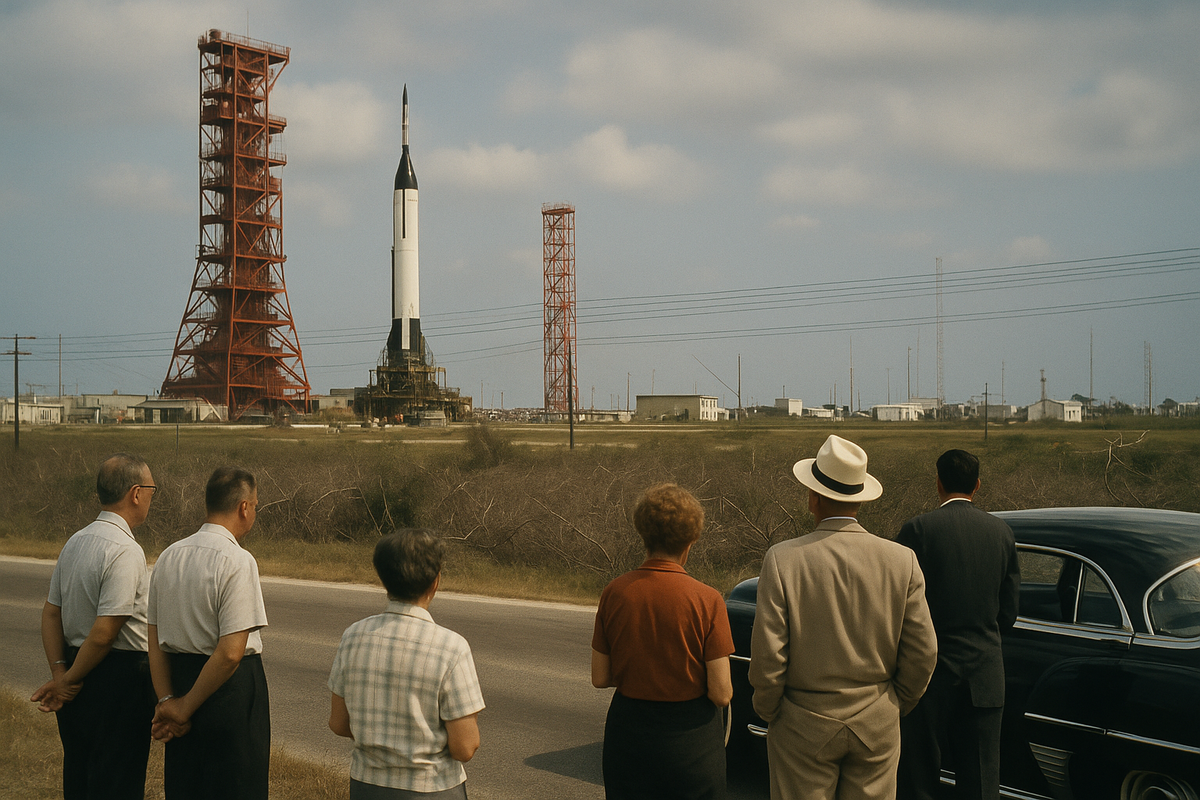
By the time Americans opened the February 15, 1958 issue of The New Yorker, Sputnik had been orbiting overhead for four months—a metal sphere the size of a beach ball, humiliating the most powerful nation on Earth every 96 minutes. The magazine's lead feature didn't offer platitudes. It offered Cape Canaveral: a windswept Florida coastline where America's rockets exploded as often as they flew, where engineers worked under impossible pressure, and where a sleepy beach town had become ground zero for Cold War redemption.
This wasn't typical New Yorker territory. The magazine built its reputation on urbane wit, literary fiction, and Talk of the Town gossip—not military installations and missile telemetry. But in February 1958, the space race wasn't a story. It was the story. And The New Yorker covered it the only way it knew how: not with breathless patriotism, but with atmosphere, irony, and the kind of ground-level reporting that revealed how national destiny looked when filtered through motel bars and real estate speculation.
For collectors and historians today, this issue represents something rarer than documentation. It captures the precise moment America realized the future would be decided in the sky—and that it was already behind.
Issue Archive Details
Publication: The New Yorker
Issue Date: February 15, 1958
Historical Context: Four months after Sputnik 1 launch, five months before NASA's creation
Archive Significance: Early cultural examination of America's space program origins
The Shock That Changed Everything
October 4, 1957. The Soviet Union launched Sputnik 1 into orbit, and the American public absorbed the news like a gut punch. The Cold War, previously fought through proxy conflicts and ideological posturing, had suddenly acquired a new dimension. Whoever controlled space controlled the high ground—militarily, scientifically, symbolically.
The national panic was immediate. President Eisenhower scrambled to create the Advanced Research Projects Agency (ARPA) in February 1958. Congress began drafting legislation for what would become NASA by July. Meanwhile, American rockets—Vanguard, Redstone, Jupiter—kept failing. Launch pads erupted in fireballs. Test flights nose-dived into the Atlantic. The press, savage and relentless, called one particularly spectacular failure "Kaputnik."
Into this chaos, The New Yorker sent a reporter south.
Why The New Yorker Mattered in 1958
By mid-century, The New Yorker occupied a singular position in American media. It wasn't mass-market like Life or Look. It wasn't partisan like the newspapers. It was the magazine intellectuals read, the publication that treated long-form journalism as literature. Its "Reporter at Large" pieces gave readers not just facts, but texture—the details that revealed how history actually felt to the people living through it.
The Cape Canaveral feature exemplified this approach. Rather than fixate on rocket specifications or Cold War strategy, the article examined the transformation underway in Florida. Cocoa Beach, once a fishing village with more pelicans than people, had become a boomtown practically overnight. Engineers from California and contractors from across the country flooded in, buying up land, building houses, filling bars. Federal money poured into the local economy. Car dealers couldn't keep inventory. Motels operated at capacity. The entire region had reorganized itself around a single question: Could America catch up?
The article captured both the technical drama—launches that succeeded or, more often, exploded—and the strange cultural dislocation of living at the edge of history. Scientists ate at diners next to fishermen. Generals discussed classified projects in restaurants where anyone could overhear. The future and the past collided on a daily basis, and The New Yorker documented the friction.
For 1958 readers, this wasn't entertainment. It was reassurance that someone was paying attention to the human dimension of the space race, the way grand ambitions translated into ordinary lives.
The Cover: A Quiet Subversion
The New Yorker covers operated as subtle counterpoints to the news they contained. While Life and Time plastered rockets and astronauts across their mastheads, the February 15, 1958 issue featured something decidedly different: a ceremonial procession, attendants in formal dress carrying a sedan chair, rendered with the magazine's characteristic elegance and wit.
The image worked as visual irony. Here was a publication reporting on supersonic missiles and orbital mechanics, yet the cover depicted an older, slower form of conveyance—human-powered, ritualistic, dignified. The juxtaposition suggested that progress, for all its technological velocity, still required deliberation and human judgment. Or perhaps it was simpler: The New Yorker reminding readers that sophistication meant not taking everything at face value, even—or especially—during a crisis.
For collectors, these covers represent miniature works of mid-century art. They didn't shout. They insinuated. And in doing so, they captured the magazine's essential character: intelligent, skeptical, never quite willing to surrender to the hysteria of the moment.
Inside the Feature: What Readers Discovered
The Cape Canaveral piece worked across multiple registers simultaneously:
The Boomtown Economics
Land speculation transformed the region. Housing developments sprouted where orange groves had been. Contractors arrived with families in tow, creating instant suburbs. Local businesses couldn't expand fast enough to meet demand. The article captured how Cold War policy translated into mortgage applications and zoning disputes.
The Launch Spectacles
Rockets were temperamental, dangerous, and expensive. Test launches drew crowds who came to witness either triumph or disaster—often the latter. The article conveyed the visceral drama: the countdown tension, the roar that rattled windows miles away, the split-second uncertainty before a rocket either climbed or exploded.
The Cultural Weight
These weren't just machines. They were symbols of American capability, tools of geopolitical messaging. Every successful launch reassured allies. Every failure emboldened adversaries. Engineers and scientists worked under the kind of pressure normally reserved for combat, knowing their work would be scrutinized by both the Kremlin and Capitol Hill.
The Ground-Level Reality
Amid the grand strategy and technological risk, ordinary life continued. The article detailed the bars where engineers unwound after failed launches, the gossip networks that spread rumors faster than official announcements, the way small-town Florida absorbed and adapted to its sudden role in history.
Together, these elements created a portrait of America at an inflection point—ambitious, anxious, and figuring it out in real time.
The Echo Across Decades
The New Yorker's 1958 coverage of Cape Canaveral now reads as prescient. The anxieties it documented—technological competition, national prestige, the intersection of government funding and private enterprise—mirror contemporary concerns as SpaceX, Blue Origin, and other private companies redefine space access.
The difference: in 1958, the outcome was uncertain. America didn't know if it could catch up, didn't know if its rockets would work, didn't know if the space race would be won or lost. That uncertainty saturates the magazine's reporting, giving it an edge that retrospective accounts can never quite capture.
Historians and collectors return to issues like this because they preserve that uncertainty—the moment before the ending was written, when the future remained genuinely open.
Why Collectors Value This Issue
Historical Proximity
Published just four months after Sputnik, during the most intense phase of American space race anxiety, before NASA even existed.
Cultural Documentation
One of the earliest literary examinations of Cape Canaveral and the emerging rocket program, capturing the moment before space exploration became normalized.
Editorial Prestige
The New Yorker's "Reporter at Large" pieces represent the gold standard of mid-century journalism. This particular article stands as primary source material for historians studying Cold War culture.
Condition Rarity
Well-preserved copies from 1958 are increasingly scarce. Newsprint degrades, binding weakens, covers fade. Clean copies with intact spines represent genuine finds.
Cross-Market Appeal
This issue interests multiple collector categories: space history enthusiasts, Cold War scholars, vintage magazine completists, and literary journalism archivists.
Unlike ephemeral newspaper coverage, which prioritized immediacy over permanence, The New Yorker was designed to be kept. Readers saved issues. Libraries archived them. As a result, they survived as artifacts—tangible connections to how Americans understood their world in 1958.
Conclusion
The February 15, 1958 New Yorker stands as a landmark in cultural journalism. Its Cape Canaveral feature transformed a military story into a human one, a technology story into a cultural one. The magazine's willingness to slow down, to look closely, to capture the texture of the moment rather than just its headlines—that approach created something that survives long after the news cycle moved on.
Holding this issue means holding the ambiguity of February 1958: the rockets that might work, the competition that might be lost, the future that hadn't yet been decided. That's why it matters. That's why collectors seek it out. And that's why, sixty-seven years later, it still reads like news.
For Collectors and Enthusiasts
The February 15, 1958 issue of The New Yorker represents more than archival curiosity. It's a document from the first chapter of the space age, produced when America was still learning to think of itself as a spacefaring nation.
Whether you collect for historical research, cultural preservation, or the simple pleasure of holding an artifact from another era, this issue delivers. It's not nostalgia. It's evidence.
Browse The New Yorker Magazine Collection