📖 About this Collection
Veruschka: The Countess Who Became a Canvas
The Legend & The Legacy
Before the algorithm, before the digital mood board, before the supermodel was even a word, there was Vera Lehndorff — the six-foot Baltic aristocrat the world came to know simply as Veruschka. Born into Prussian nobility and scarred by the tragedies of the Second World War, she transformed herself into one of the most hypnotic visual presences of the twentieth century, reigning over the pages of the world's most prestigious publications throughout the 1960s and into the 1970s. At a time when the fashion industry favored petite, conventional femininity, she arrived as something altogether different — towering, otherworldly, and fiercely self-authored. The public encountered her not through a screen, but through the deliberate turning of glossy pages, each spread a small revelation. She was not merely a model; she was a collaborator, a conceptual artist, a living sculpture. And for an entire generation, those magazines were the only portal through which her mythology could be entered.
Inside the Archive
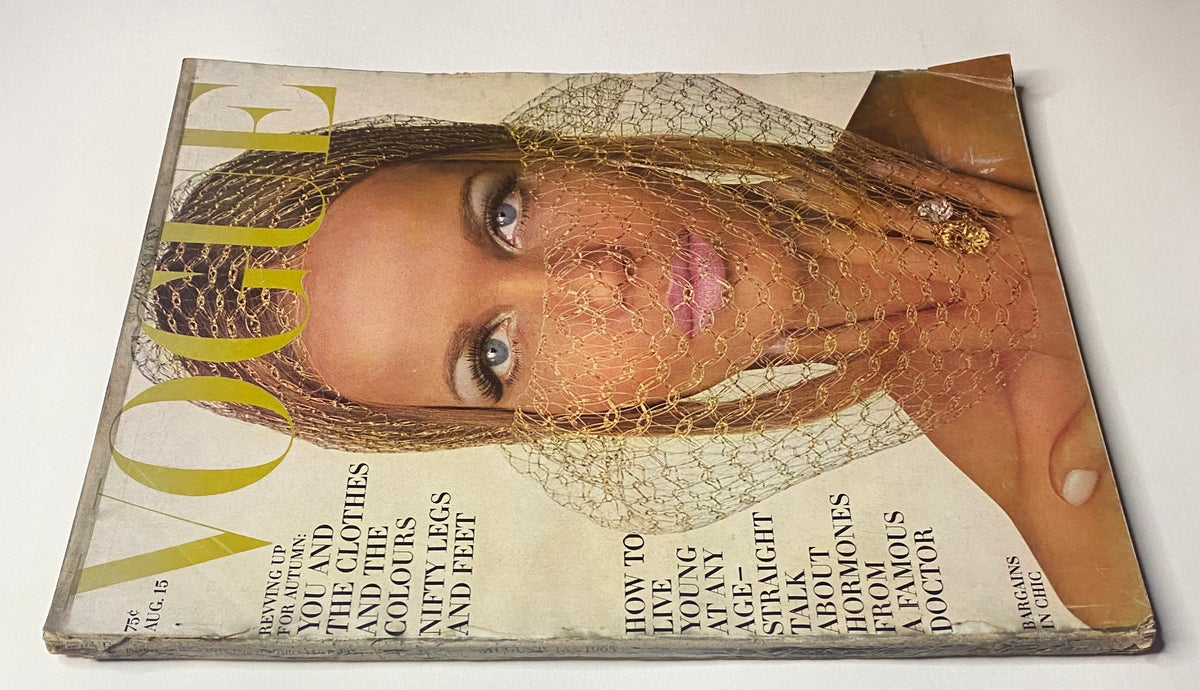
Vintage coverage of Veruschka is, without exception, visually extraordinary. The photographers drawn to her — most famously Franco Rubartelli, her longtime creative partner — understood that her face and body were instruments of total transformation, and the editorial spreads of the era reflect that ambition at every turn. Vogue — both the American and Italian editions — published some of the most iconic imagery of her career, including the legendary 1967 sequences in which she was painted directly into landscapes, her body dissolving into stone, wood, and earth in ways that seemed to defy the very laws of photography. Life magazine, then the preeminent chronicle of culture and spectacle in the United States, brought her otherworldly presence to the broadest possible readership, cementing her status as a figure of genuine cultural gravity. Stern, the influential German illustrated weekly, documented her with particular intimacy and frequency, reflecting her deep roots in European culture and the continental fascination with her aristocratic origins and avant-garde reinvention. Across all of these publications, the editorial tone oscillates between reverence and wonderment — writers and editors alike reaching for language adequate to someone who seemed, quite simply, to exist outside the ordinary categories of beauty.
Curator's Checklist: Highlights Often Include
- Landmark body-paint spreads from the mid-to-late 1960s, in which she was photographed as pure environmental camouflage — among the most reproduced and discussed fashion images of the entire twentieth century
- Early career portraiture from the transitional period when she was establishing herself in New York and European fashion circles, offering a fascinating contrast to her later, more conceptual work
- Film and celebrity coverage tied to her appearance in Michelangelo Antonioni's Blow-Up (1966), one of the defining art films of the decade, in which she played a fictionalized version of herself
- Retrospective and profile features from the 1970s and 1980s reassessing her influence as fashion photography evolved beyond the studio and into fine art territory
- International fashion issues — particularly Italian, French, and German editions — capturing the distinctly European sensibility that surrounded and celebrated her throughout her peak era
The Collector's Value
To hold one of these magazines is to hold something no digital archive can replicate. The paper stock of a 1960s Vogue has a particular weight and warmth to it — slightly ivory, faintly fragrant with the ghost of ink and decades past — and the full-bleed spreads of her body-paint work, printed at scale across a double-page layout, carry an immediacy and grandeur that no screen rendering can approximate. The surrounding advertisements — for perfumes now discontinued, airlines that no longer fly, cosmetics in their original mid-century packaging — create an immersive time capsule that transforms each issue into a complete artifact of its moment. For collectors of high fashion history, mid-century fine art photography, or the cultural history of 1960s Europe, these publications offer a primary source of irreplaceable depth — a direct, tactile connection to an era of unparalleled creative daring. Explore the current available inventory below and claim your piece of that history.