




Description
Collector's Note – Why This Issue Matters
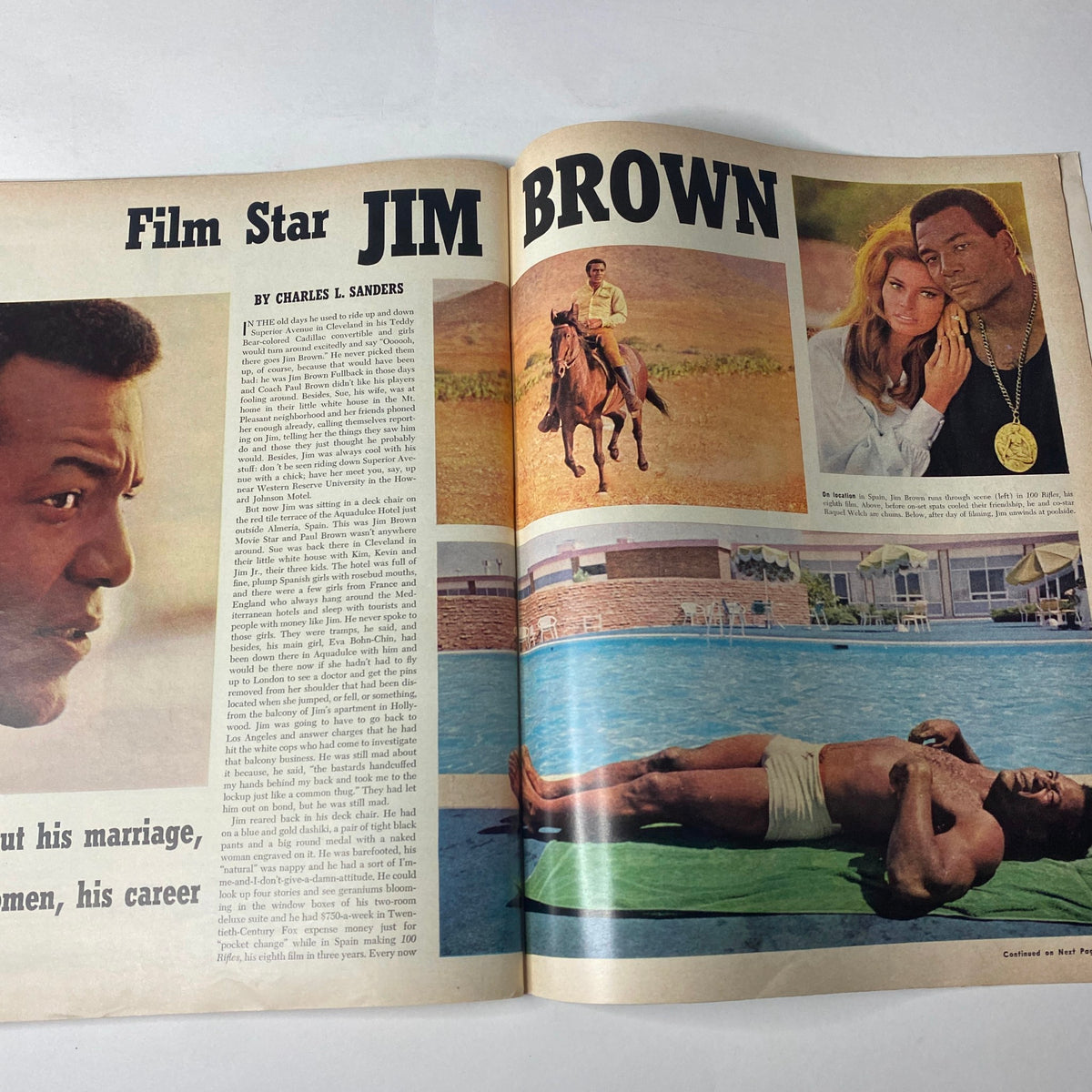
The December 1968 issue of Ebony magazine — Volume XXIV, Number 2 — featuring Jim Brown on the cover is a primary document of one of the most significant career transitions in American sports and entertainment history, captured at a specific and historically well-defined moment. By December 1968, Brown had retired from professional football in July 1966 — abruptly and controversially, while filming The Dirty Dozen in England — and was in the active phase of establishing himself as a Hollywood actor, having completed several major films including Ice Station Zebra and 100 Rifles. The confirmed Charles L. Sanders interview — "a revealing interview on marriage, women, Hollywood, and identity" — is primary source journalism from one of Ebony's most experienced interviewers, engaging Brown on the specific dimensions of his post-football identity at a moment when that identity was still being actively constructed. Brown's transition from the most dominant running back in NFL history to a Hollywood leading man was genuinely unprecedented — no Black athlete of his stature had attempted the transition to mainstream film stardom at that level — and a December 1968 Ebony cover story with an in-depth Sanders interview is primary documentation of how he was navigating that transition, in his own words, at a specific biographical moment. For collectors building archives of Jim Brown magazine covers and features, this Ebony appearance is among the most substantive and personally revealing primary documents of his post-football public identity.
The broader confirmed content of this December 1968 issue provides an extraordinary cross-section of Black American life at one of the most politically and culturally turbulent moments of the twentieth century. The confirmed Shirley Verrett Metropolitan Opera feature documents the contralto and soprano's rise to major operatic prominence at a specific career moment — Verrett had been performing at the Met since 1968 and was in the early phase of the career that would make her one of the most celebrated opera singers of her generation. The confirmed Lerone Bennett Jr. excerpt — "Passion: A Certain Dark Joy" from The Negro Mood — provides a primary document of one of the most significant Black American historians and cultural critics at the height of his engagement with the Black consciousness movement. The confirmed O.J. Simpson and Leroy Keyes Heisman Trophy feature documents the 1968 Heisman race — the year Simpson won the award — at its specific conclusion, providing a primary record of Simpson before his 1969 NFL debut. The confirmed "Photo-Editorial: The Olympics in Retrospect" situates this December issue two months after the October 1968 Mexico City Olympics and the Black Power salute by Tommie Smith and John Carlos — one of the most discussed sports protest moments in American history — making this retrospective a primary document of how Ebony engaged that event in its immediate aftermath. Collectors of vintage Ebony magazine issues will find this issue among the most historically dense in the publication's 1968 run. The broader 1968 magazine collection provides context within one of the most consequential years in American history.
The confirmed "The Colonel Is a Lady" feature — on the first Black woman colonel in the U.S. military — and the "Why I Quit the Convent" piece by Saundra Willingham document the specific intersections of race, gender, and institutional authority that were being actively renegotiated in 1968. The Alex Poinsett feature on Kiswahili and Afro-American identity — published in December 1968 — is a primary document of the specific moment when the cultural and linguistic dimensions of Black identity were being most actively and publicly debated, connecting to the broader Black Power and Black Arts movements that were reshaping American culture throughout the year.
About the Publication
Ebony magazine, founded by John H. Johnson of Johnson Publishing Company in Chicago in 1945, was by December 1968 the most widely read and culturally authoritative Black American general-interest magazine in the United States, with a circulation in the millions. Modeled on the picture-magazine format of Life but directed specifically at Black American readers, its editorial formula combined celebrity profiles, cultural journalism, sports coverage, political commentary, and the practical lifestyle content that addressed a readership whose experiences and aspirations were systematically ignored by white-owned mainstream publications. By December 1968 it had been publishing for twenty-three years and had established an editorial authority that made a cover feature in Ebony the most significant single mainstream press recognition available to a Black American public figure.
Key Highlights Inside
- "Jim Brown" — interview by Charles L. Sanders (page 192) — A confirmed in-depth interview with the former Cleveland Browns star on marriage, women, Hollywood, and identity, published at the specific moment of his post-football career establishment — primary source journalism from one of Ebony's most experienced interviewers.
- "Metropolitan Opera's New Star" — Shirley Verrett (page 54) — A confirmed feature on the contralto and soprano's rise to major operatic prominence, documenting her early-career establishment at the Met.
- "Two Superstars Vie for Heisman Trophy" — O.J. Simpson and Leroy Keyes (page 170) — A confirmed feature on the 1968 Heisman race, the year Simpson won the award — primary documentation of him before his NFL debut.
- "Photo-Editorial: The Olympics in Retrospect" (page 161) — A confirmed retrospective on the 1968 Mexico City Olympics, published two months after the Tommie Smith and John Carlos Black Power salute — primary documentation of how Ebony engaged that historic protest moment in its immediate aftermath.
- "Passion: A Certain Dark Joy" — Lerone Bennett Jr. (page 52) — A confirmed excerpt by one of the most significant Black American historians and cultural critics, published at the height of his engagement with the Black consciousness movement.
- "The Colonel Is a Lady" — first Black woman colonel in the U.S. military (page 100) — A confirmed feature on a trailblazing military psychiatrist, documenting a specific first in American military racial and gender history.
Condition & Rarity
Very good condition with minor edge wear and plastic protective covering represents a strong collector-grade example of a fifty-seven-year-old monthly general-interest magazine. Ebony was printed on coated paper stock of good commercial quality, and issues from 1968 that survive in very good condition have typically benefited from deliberate preservation. The confirmed very good condition with only minor edge wear indicates above-average survival for a publication of this age and original circulation pattern. The plastic protective covering confirms deliberate preservation. For an issue with the confirmed editorial depth of this December 1968 number — the Jim Brown Sanders interview, the Olympics retrospective, the Bennett excerpt — interior page completeness and legibility are the primary research value factors alongside the cover surface condition.
Looking for More Issues Like This?
Jim Brown Ebony covers from the immediate post-football Hollywood transition period are a specific and historically grounded collecting category, and a December 1968 issue with the confirmed Sanders interview and the Olympics retrospective alongside the O.J. Simpson Heisman feature makes this one of the most content-rich numbers in the publication's 1968 run. The dedicated Jim Brown magazine collection at OriginalMagazines.com is the most direct place to search for other documented cover appearances. The broader Ebony magazine archive and the complete 1968 collection are both worth exploring for other issues that document the extraordinary political and cultural intensity of one of the most consequential years in American history.