



Description
Collector's Note – Why This Issue Matters
The July 20, 1998 issue of Fortune Magazine, with Bill Gates and Warren Buffett on the cover under the title "The Bill & Warren Show," documents one of the most genuinely extraordinary friendships in the history of American business at a specific and consequential moment for both men. By July 1998, Gates was at the zenith of his dominance over the technology industry — Microsoft's market capitalization had made it the most valuable company in the world, and the Windows operating system and Office suite were ubiquitous across global computing. Buffett, as chairman of Berkshire Hathaway, had built the most successful long-term investment record in American financial history. The two had become close friends in the early 1990s, and their relationship was unusual precisely because their approaches to business — Gates's technology-driven, first-principles innovation and Buffett's value-investing patience and brand-franchise focus — were so philosophically distinct. A Fortune cover story presenting them in dialogue about motivation, risk, and philanthropy captures a conversation that was genuinely unusual: two of the world's most influential businessmen with the intellectual honesty and personal security to engage each other's different frameworks without defensiveness. For collectors building an archive of Bill Gates magazine covers and technology business history, this July 1998 Fortune is a primary document of his peak public prominence before the Microsoft antitrust case would reshape his public image.
The July 1998 date places this issue at a historically charged moment in the technology industry. The Department of Justice antitrust case against Microsoft was gathering momentum — the formal complaint had been filed in May 1998, just two months before this issue — and the question of whether Microsoft's dominance constituted an illegal monopoly was becoming the central business and technology policy debate in America. Gates's appearance on a Fortune cover discussing success philosophy and philanthropy in July 1998 captures him at the precise moment when his company's legal challenges were intensifying but before they had fully overshadowed his public identity as a business visionary. The confirmed "Microsoft's Big Bet on Small Machines" article adds a forward-looking technology dimension — the late 1990s Microsoft's push beyond traditional PCs toward mobile and handheld computing was a strategic initiative that would prove prescient in its direction if not in its execution. Warren Buffett magazine coverage from this period documents the investor at the peak of his long-term track record before the late-1990s technology bubble would temporarily make his value investing approach appear outdated. Fortune Magazine issues from the late 1990s capture American business at its most exuberant and consequential moment. Publications from 1998 document the peak of the dot-com era's optimism.
About the Publication
Fortune Magazine, founded by Henry Luce in 1930, was by July 1998 one of the most authoritative business publications in the United States, with a readership of senior executives, investors, and business professionals who relied on its long-form analysis of major commercial figures and corporate trends. Its biweekly publication schedule allowed for the kind of in-depth feature reporting that weekly publications could not sustain, and a cover story pairing Gates and Buffett reflected both the magazine's access to the most powerful figures in American business and its editorial ambition to engage them in substantive dialogue rather than hagiographic profiles.
Key Highlights Inside
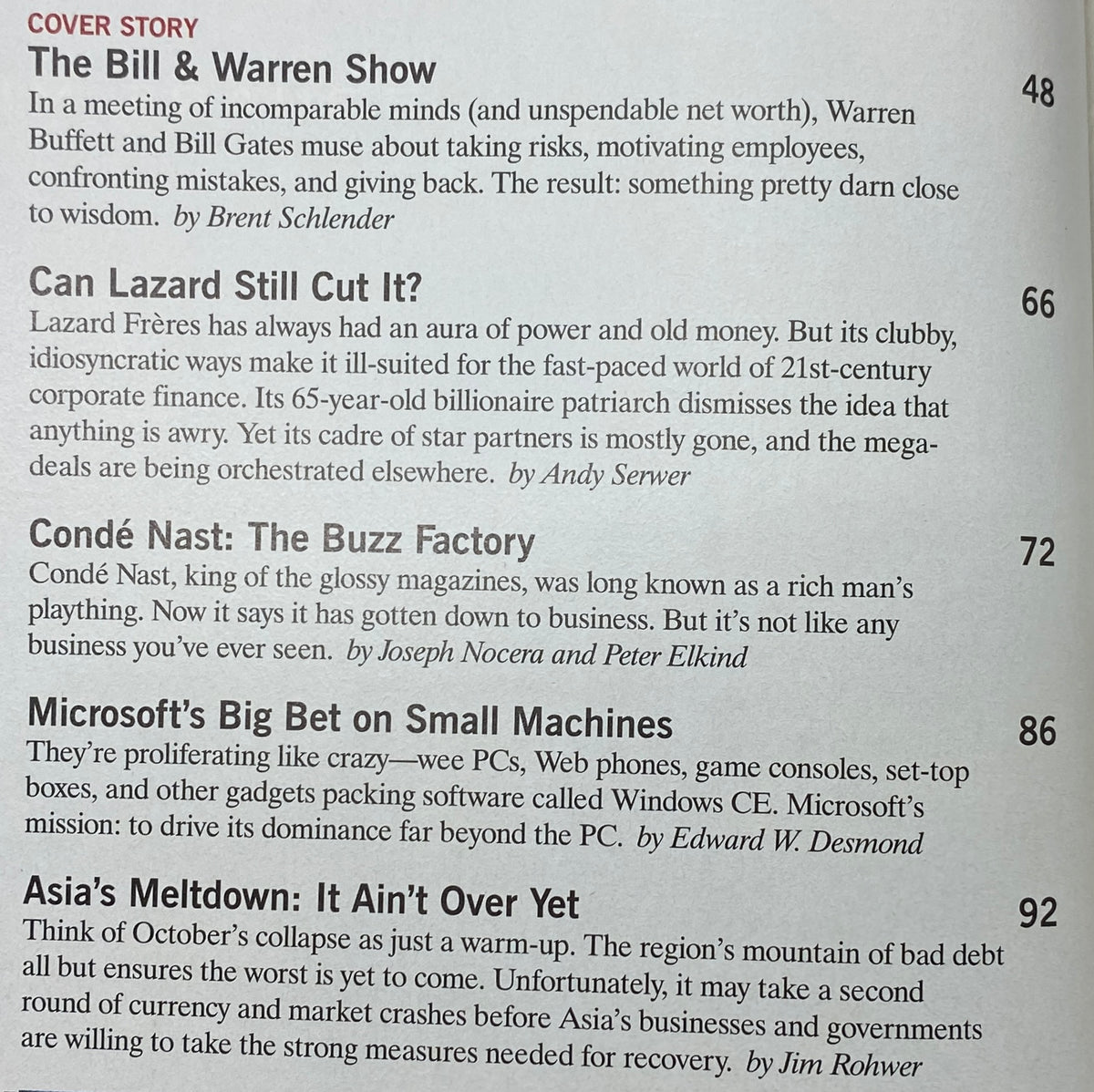
- "The Bill & Warren Show" cover story — a confirmed dialogue between Bill Gates and Warren Buffett covering employee motivation, risk-taking philosophy, and philanthropy, published July 1998 at the peak of Gates's technological dominance and just months after the DOJ filed its antitrust complaint against Microsoft.
- "Microsoft's Big Bet on Small Machines" — a forward-looking technology article documenting Microsoft's late-1990s push into mobile and handheld computing, capturing the company's strategic ambitions at a moment before the antitrust case had fully constrained its expansion plans.
- "Can Lazard Still Cut It?" — a feature on one of Wall Street's most storied investment banks navigating the modern corporate landscape, reflecting Fortune's consistent coverage of institutional finance alongside technology.
- Publication date of July 20, 1998 — placing this issue two months after the DOJ filed its antitrust complaint against Microsoft in May 1998, capturing Gates at the precise moment his company's legal challenges were intensifying.
Condition & Rarity
Excellent condition with light age-consistent wear is a strong rating for a business magazine now over twenty-five years old. The plastic protective covering indicates deliberate preservation storage, consistent with treating this as a collectible at or near the time of publication. The listing does not specify whether a mailing label is present; collectors evaluating any surviving copy of this issue should assess label status as a primary display consideration, since labeled subscriber copies are the norm for Fortune from this period and label-free examples are preferred for cover presentation. For a glossy-stock biweekly of this vintage, the primary condition factors are cover surface brightness and image clarity — the Gates and Buffett cover photograph is the primary visual and collectible attribute — and spine integrity.
Looking for More Issues Like This?
A July 1998 Fortune with Bill Gates and Warren Buffett sharing the cover — at the peak of Gates's dominance and just months into the antitrust era — is a historically specific configuration that serious collectors of technology and business history recognize as significant. If this issue has already been claimed, the archives of Bill Gates magazine covers and Warren Buffett magazine coverage are both worth exploring for other significant appearances by these figures. The full Fortune Magazine collection and the 1998 magazine archive offer additional context for this pivotal year in American business history.