
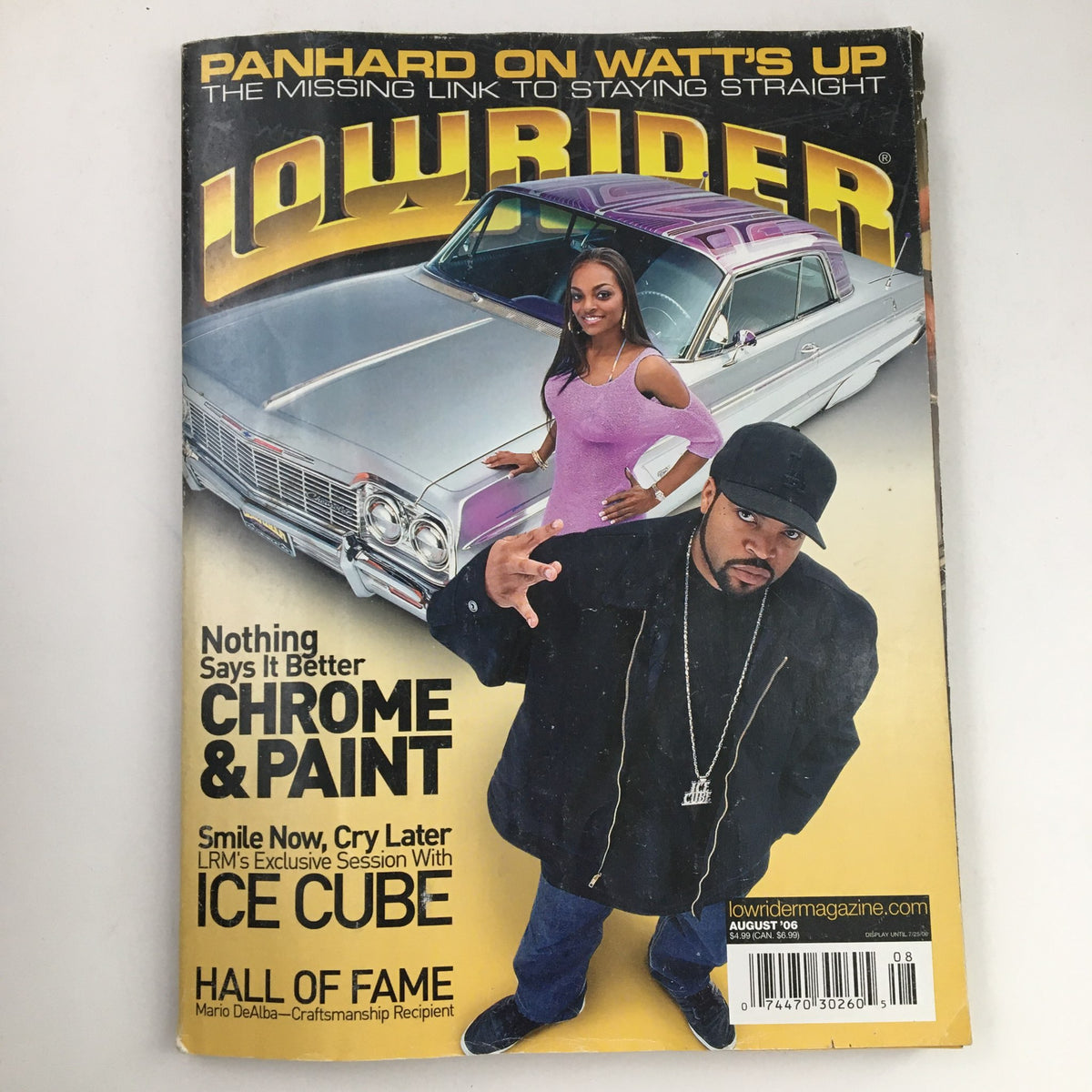

Description
Collector's Note – Why This Issue Matters
August 2006 is a historically specific and culturally interesting date for a LowRider Magazine issue featuring an exclusive session with Ice Cube, and the combination of these two cultural institutions at this precise moment rewards careful appreciation. By the mid-2000s Ice Cube had completed one of the more remarkable career trajectories in American entertainment — from his foundational role in N.W.A and the invention of gangsta rap at the close of the eighties, through a solo career that produced some of the most critically significant hip-hop records of the early nineties, to a successful transition into film acting and production that had made him one of the most commercially versatile figures to emerge from the West Coast rap tradition. His appearance in LowRider Magazine in August 2006 was not incidental — it reflected the deep and historically grounded connection between Los Angeles hip-hop culture and the lowrider tradition that had been central to the cultural geography of South and East Los Angeles since the decades before hip-hop existed as a genre. Ice Cube's entire artistic identity was rooted in the specific streets, neighborhoods, and cultural practices of that geography, and his relationship with lowrider culture was one of biographical and aesthetic authenticity rather than celebrity endorsement. A LowRider Magazine exclusive session with Ice Cube is therefore a document of two of Los Angeles's most significant and most historically consequential cultural traditions in genuine conversation, produced at a moment when both were being recognized as matters of serious cultural and historical importance. For collectors researching Ice Cube's documented presence in print media across his remarkable career, the Ice Cube magazine collection is the most concentrated resource for tracing his coverage across the full arc of his influence.
The specific framing of "LRM's Exclusive Session" gives this August 2006 issue a specific editorial identity within the LowRider Magazine publishing history that distinguishes it from routine celebrity features. The exclusive designation signals a deliberate editorial investment — a feature produced with the full engagement of the magazine's staff and the subject's genuine participation, rather than a repurposed press interview or a brief celebrity appearance. LowRider Magazine's credibility within the lowrider community was built on exactly this kind of authentic engagement, and an exclusive Ice Cube session in 2006 reflected both the magazine's continuing authority within that community and Ice Cube's own willingness to engage with the publication on its own terms and within its own cultural context. The August 2006 date also places this issue within a specific moment in the broader cultural history of lowrider culture's relationship with mainstream recognition — the mid-2000s were a period of increasing academic, curatorial, and media interest in lowriding as a significant American art form and cultural practice, and LowRider Magazine's ongoing documentation of the community and its figures was being recognized as a historical record of genuine importance. The LowRider Magazine archive is the most comprehensive resource for collectors researching the publication's full run and its documentation of the lowrider tradition across its most historically significant decades.
The broader cultural significance of the lowrider-hip-hop connection that this August 2006 issue documents deserves appreciation from collectors who approach it as a document of American cultural history rather than purely as a celebrity magazine feature. The relationship between lowrider culture and West Coast hip-hop was not accidental or superficial — it was rooted in the shared geography, shared community, and shared aesthetic sensibilities of the same Los Angeles neighborhoods that had produced both traditions. Ice Cube's music had referenced and celebrated lowrider culture throughout his career, and his appearance in the magazine that had been documenting that culture since 1977 was a meeting of two of the most significant cultural expressions that those neighborhoods had produced. The complete 2006 magazine archive provides essential context for understanding how this issue fits within the broader publishing and cultural landscape of a year when the long-term historical significance of both West Coast hip-hop and lowrider culture was increasingly being recognized and documented.
About the Publication
LowRider Magazine was founded in 1977 and established itself across nearly three decades as the primary and most authoritative publication dedicated to lowrider car culture in the United States — a title that documented the vehicles, the community, and the broader cultural traditions of the lowrider world with a consistency and depth that gave it genuine historical significance as the primary archive of a major American art form and cultural practice. Its editorial formula combined car photography and technical content with the music, fashion, and lifestyle coverage that reflected the full cultural context within which lowrider culture existed — coverage that made it both a specialized automotive publication and a significant document of Los Angeles's Mexican-American and African-American communities and their cultural expressions. By August 2006 the magazine had been publishing for nearly thirty years and had built the institutional authority and community credibility that made an exclusive Ice Cube session a meaningful cultural event rather than a routine celebrity feature.
Key Highlights Inside
- An exclusive session with Ice Cube — a confirmed, dedicated feature with one of the most significant figures in the history of West Coast hip-hop, whose artistic identity was rooted in the same Los Angeles cultural geography that produced lowrider culture, documented by the publication with the longest and most authoritative record of that culture in American magazine publishing.
- Content reflecting the intersection of lowrider culture and West Coast hip-hop — the specific cultural conversation between two of Los Angeles's most historically significant creative traditions, documented at a moment in 2006 when both were being recognized as matters of serious cultural and historical importance by mainstream media, academic institutions, and curatorial organizations.
- Vehicle photography and lowrider community content consistent with LowRider Magazine's August 2006 format — the publication's characteristic combination of automotive documentation and cultural coverage that had made it the authoritative archive of the lowrider tradition across nearly three decades of continuous publication.
- A label-free newsstand copy preserving the cover design fully intact in its original printed state — without subscription marking interrupting the cover imagery and typography, the issue can be appreciated as its art director intended.
- Note: Beyond the confirmed Ice Cube exclusive session and the general lowrider culture content verifiable from the publication's documented format, specific article titles, additional featured vehicles or personalities, and full interior content details have not been independently confirmed for this issue. The highlights above reflect what is verifiable from the named feature subject, newsstand designation, date, and the publication's well-documented editorial approach for the period.
Condition & Rarity
Surviving copies of this issue present with the physical characteristics consistent with newsstand copies of a monthly specialty publication that have passed through private ownership over nearly two decades. The absence of a mailing label confirms newsstand rather than subscription origin — a positive attribute that preserves the cover design fully intact in its original printed state, without subscription marking interrupting the cover imagery. Minor wear consistent with the magazine's age and Good condition grade is the expected surface characteristic of a well-handled newsstand copy from this period — fully readable, completely displayable as a cultural and historical artifact, and collectible with the honest patina that distinguishes an authentic survivor from an artificially preserved example. The inclusion of a protective plastic sleeve indicates conscious collectible treatment at some point in the magazine's ownership history, a circumstance that reliably correlates with better interior page condition and cover integrity than copies stored without protection. Mid-2000s LowRider Magazine issues featuring exclusive sessions with significant West Coast hip-hop figures in newsstand condition represent a specific and culturally well-defined category within the vintage specialty magazine collector market — issues that document the authentic intersection of two of Los Angeles's most historically consequential cultural traditions, produced by a publication whose thirty-year archive of the lowrider world gives each issue genuine historical weight.
Looking for More Issues Like This?
Mid-2000s LowRider Magazine exclusive features with West Coast hip-hop figures of Ice Cube's historical significance are among the more culturally specific and authentically grounded items in the vintage specialty magazine collector market — documents of the genuine and historically rooted relationship between Los Angeles hip-hop and the lowrider tradition, covered by the publication that has been the authoritative archive of that tradition for nearly half a century. If this particular August 2006 issue has already been claimed, the Ice Cube magazine collection at OriginalMagazines.com is the most comprehensive resource for finding other issues that document his extensive print presence across his remarkable career. The full LowRider Magazine archive is equally worth exploring for collectors researching the publication's complete documentation of the lowrider tradition, and the complete 2006 magazine archive rounds out the picture for anyone researching the mid-2000s cultural landscape in which both lowrider culture and West Coast hip-hop were receiving their most sustained and most serious mainstream historical recognition.