

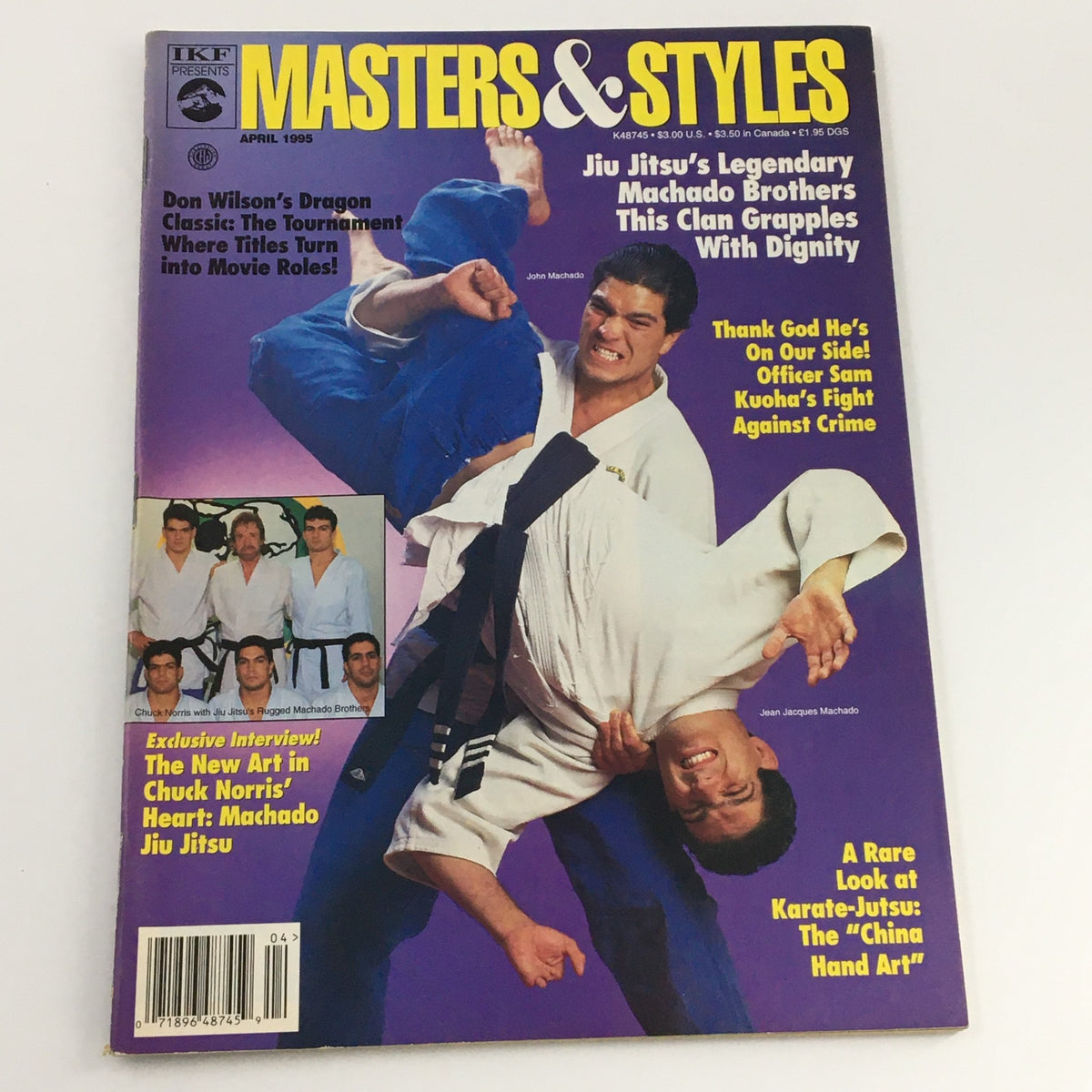


Description
Collector's Note – Why This Issue Matters
The April 1995 issue of Masters & Styles belongs to a revealing moment in American martial arts culture, when Brazilian Jiu-Jitsu was moving from specialist circles into broader visibility. A feature on John Machado and Jean-Jacques Machado places the issue directly inside that shift. By the mid-1990s, the Machado family had already become important ambassadors of Brazilian Jiu-Jitsu in the United States, with Jean-Jacques having established a major competitive and teaching presence after arriving in America in 1992.
The date matters because 1995 sits near the beginning of the decade when grappling-based systems were becoming more widely discussed in American martial arts media. Jean-Jacques Machado’s competitive record in Brazil through 1992 and his championship results in the mid-1990s made him one of the most visible technical figures in that transition, while the broader Machado family was helping establish a distinct identity for Machado Jiu-Jitsu in the United States. For collectors of 1995 magazines, this issue captures the period when Brazilian Jiu-Jitsu was still being introduced to many readers through profiles, personality features, and technique-centered martial arts journalism rather than through later mainstream saturation.
This issue also matters because a Machado brothers feature is historically rich even without claiming any unverified interior details beyond the listing. John Machado and Jean-Jacques Machado were part of a family lineage closely tied to the Gracie orbit and to the spread of Brazilian Jiu-Jitsu outside Brazil, which gives this issue importance beyond simple cover appeal. In that sense, the magazine stands as a period document of how American martial arts publishing was beginning to frame grappling, lineage, and technical credibility in the mid-1990s. It reflects a moment when Brazilian Jiu-Jitsu was becoming not just a style, but a subject of serious curiosity within the wider martial arts community.
About the Publication
Masters & Styles appears to have been a monthly martial arts magazine or special-issue publication circulating in 1995, covering a wide mix of fighting systems and personalities. Surviving issue records describe it as featuring topics across karate, aikido, judo, tai chi, kung fu, and tae kwon do, which suggests a broad readership of martial arts enthusiasts rather than followers of a single discipline. In editorial terms, it fits the long-running martial arts magazine tradition of the era: personality-driven features, style comparison, visual presentation, and accessible coverage meant to appeal to practitioners, collectors, and general fans of martial arts culture.
Key Highlights Inside
- Features John Machado and Jean-Jacques Machado, as stated directly in the listing.
- Centers on two members of the Machado family, a major Brazilian Jiu-Jitsu lineage connected to the Gracie family and to the growth of BJJ in the United States.
- Represents a mid-1990s martial arts publishing moment when grappling and Brazilian Jiu-Jitsu were attracting growing attention in American print culture.
- The listing describes the feature as covering their training, techniques, and contributions to Brazilian Jiu-Jitsu.
- Serves as a useful period reference for collectors interested in early American media coverage of the Machado brothers and the spread of Brazilian Jiu-Jitsu.
- No additional specific interior article titles or departments are confirmed in the provided listing beyond the Machado feature, so further contents should be treated as unverified unless documented from the issue itself.
Condition & Rarity
The listing describes a very good surviving example, preserved bagged and boarded, with “like new” presentation and no wear noted. In collector terms, protective boarding is a meaningful preservation detail because it helps maintain cover flatness, reduces corner wear, and limits handling damage over time. For a mid-1990s martial arts magazine, collectors would typically look at cover gloss, spine stability, page completeness, corner sharpness, staple condition, and the absence of bends, marks, or moisture exposure. Because publications of this kind were often read repeatedly rather than archived carefully from the start, strong visual presentation can matter almost as much as content. For a title tied to an important transitional moment in Brazilian Jiu-Jitsu’s American visibility, condition affects not just display value but long-term usefulness as a historical print artifact.
Looking for More Issues Like This?
Readers interested in this issue are often following the larger story of martial arts publishing in the mid-1990s, when grappling culture was gaining new momentum in magazines as well as in training circles. The broader 1995 magazine collection is a useful place to continue, especially for anyone interested in how original periodicals documented changing ideas about technique, lineage, and martial arts identity.
Seen in that wider frame, this April 1995 issue becomes more than a single feature on two well-known martial artists. It becomes part of a larger archive of how Brazilian Jiu-Jitsu and cross-style martial arts culture were being introduced to readers in real time.