
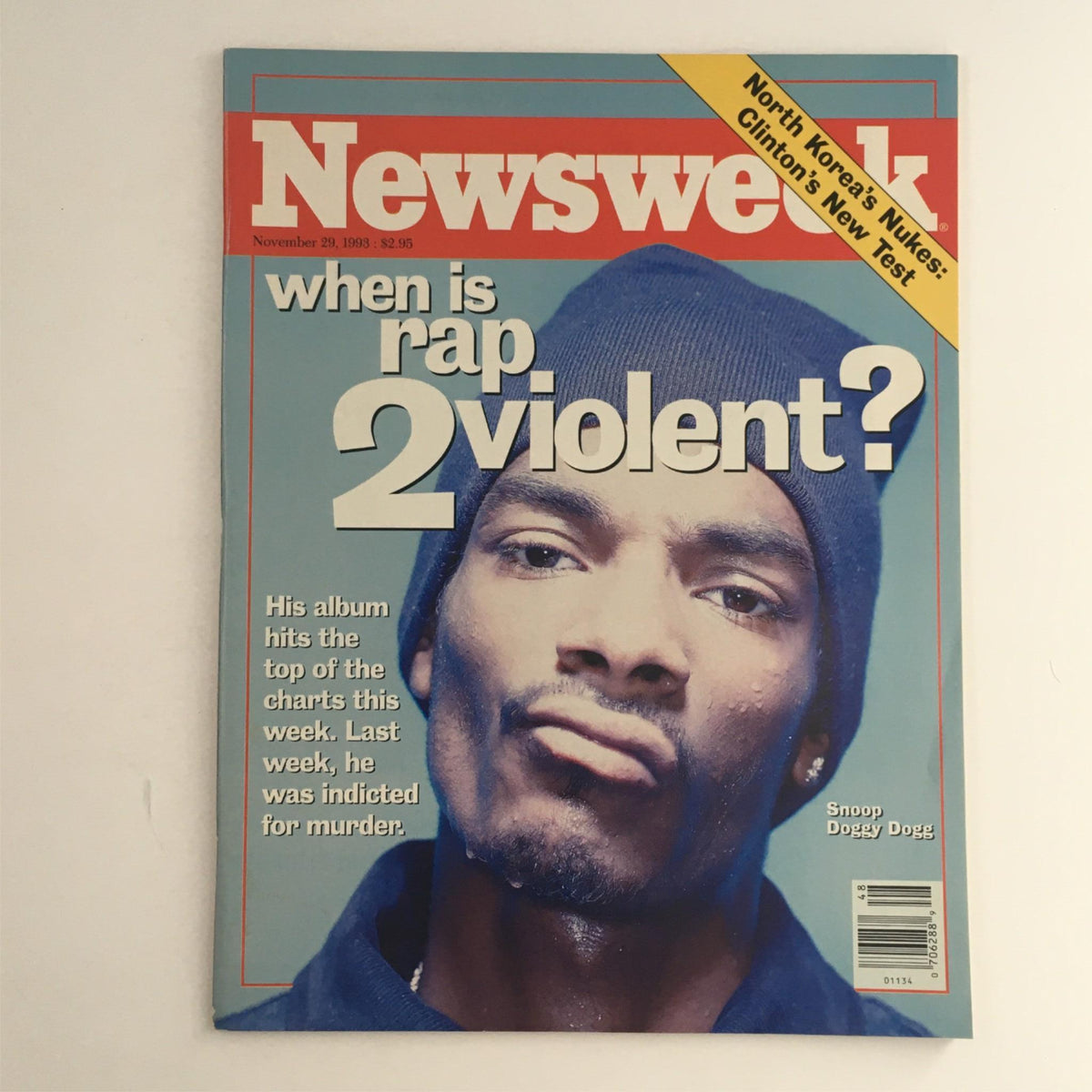

Description
Collector's Note – Why This Issue Matters
The November 29, 1993 issue of Newsweek featuring Snoop Doggy Dogg on its cover is one of the most significant mainstream media documents of hip-hop's first genuine mainstream cultural breakthrough, and understanding its full historical weight requires understanding precisely what was happening in American music and American culture in the final weeks of 1993. Doggystyle, Snoop's debut album produced by Dr. Dre, had been released on November 23, 1993 — just six days before this issue's publication date — and had entered the Billboard 200 at number one, selling 800,000 copies in its first week. That figure was not merely commercially extraordinary — it was, at the time, the fastest-selling debut album in history, a record that announced with unmistakable clarity that West Coast gangsta rap had achieved a level of mainstream commercial penetration that the music industry, the mainstream press, and American cultural institutions were going to have to reckon with whether they wanted to or not. A Newsweek cover in the same week as that album's release was the mainstream media's acknowledgment that something of genuine cultural significance was happening, produced by a publication whose primary readership — educated, broadly centrist, politically engaged adults — was precisely the demographic that the music's critics were warning about its influence over. For collectors building a serious archive of Snoop Dogg magazine covers from the peak of his early career, a Newsweek cover in the same week as Doggystyle's record-breaking debut is the single most historically significant mainstream press document of his cultural emergence.
The context of November 1993 in hip-hop history is essential to understanding why this cover carries the weight it does. The early nineties had seen West Coast gangsta rap — pioneered by N.W.A, Ice Cube, and Dr. Dre's foundational 1992 album The Chronic — move from underground phenomenon to genuine commercial force while simultaneously becoming the center of one of the most heated cultural debates in American public life. Congressional hearings, parental advisory labels, editorials from politicians and educators, and a sustained campaign from multiple directions to restrict or delegitimize the music had only increased its cultural visibility and its appeal to the young audiences who saw that opposition as confirmation of the music's authenticity and relevance. Snoop Doggy Dogg had appeared on The Chronic as a featured artist and had established himself through that album as one of the most distinctive new voices in hip-hop — a rapper whose laconic delivery, melodic flow, and narrative specificity set him apart from virtually everyone working in the genre. His debut album was therefore one of the most anticipated releases in hip-hop history before it even arrived, and its first-week sales figures validated every expectation. The Newsweek cover that appeared in the same week was not simply a celebrity profile — it was a cultural reckoning, a mainstream publication taking the measure of a figure and a movement that had become impossible to ignore.
The broader significance of this issue extends well beyond hip-hop collecting into the wider history of American popular music, race, media, and the ongoing culture wars of the early nineties. The early nineties were a period of genuine and sometimes bitter public debate about the role of explicit and politically charged popular music in American life, and hip-hop was consistently at the center of those debates in ways that made mainstream magazine coverage of its leading figures simultaneously important journalistic documents and cultural artifacts in their own right. A Newsweek cover devoted to Snoop Doggy Dogg in November 1993 represents one of the clearest possible signals that hip-hop had achieved a cultural centrality that the mainstream press could no longer cover from a distance — that it had to engage with the music and its artists directly, on the same terms it would apply to any other dominant force in American cultural life. Those assembling a comprehensive archive of vintage Newsweek magazine issues from the nineties, or building broader collections of 1993 magazines as primary documents of a pivotal year in American music and culture, will find this issue one of the most historically significant and editorially consequential pieces in either collection.
About the Publication
Newsweek magazine, founded in 1933, had established itself over the following six decades as one of the two dominant American weekly newsmagazines alongside Time, reaching a broad national readership of educated, politically engaged adults who wanted more analytical depth and breadth than daily newspapers provided. Its editorial format combined concise reporting on the week's major domestic and international news events with longer analytical features, cultural coverage, and regular columns from prominent journalists and public intellectuals, and its covers — chosen weekly to embody the single most important or compelling story of the moment — were among the most closely watched editorial decisions in American journalism. By 1993 Newsweek was operating at the height of its late-period influence, covering the Clinton administration's first year, the post-Cold War realignment of global politics, and the rapidly evolving American cultural landscape with the authority of a publication that had spent six decades building credibility with its readership. The decision to devote a cover to Snoop Doggy Dogg in the same week as Doggystyle's record-breaking debut release reflected the magazine's editorial recognition that hip-hop's cultural and commercial breakthrough was a story of genuine significance to its broad, mainstream readership — not a niche music story but a moment in American cultural history that warranted the same serious engagement it would give to any other major development in national life.
Key Highlights Inside
- The cover features Snoop Doggy Dogg in the same week as the release of Doggystyle — the debut album that sold 800,000 copies in its first week to become the fastest-selling debut album in history at the time of its release — making this Newsweek cover one of the most precisely timed and historically significant mainstream press documents of hip-hop's first major commercial breakthrough into the American mainstream.
- The November 29, 1993 publication date places this issue at the precise cultural hinge point when West Coast gangsta rap completed its transition from controversial underground phenomenon to undeniable mainstream commercial force — a transition that had been building since The Chronic in 1992 and that Doggystyle's first-week sales figures made impossible for mainstream media or cultural institutions to continue treating as marginal or temporary.
- A Newsweek cover devoted to Snoop Doggy Dogg in November 1993 represents one of the clearest and most historically documented moments of the mainstream American press engaging directly and substantively with hip-hop as a cultural force deserving of the same serious attention the publication gave to political figures, business leaders, and other dominant forces in American life — a framing that itself constituted a significant cultural acknowledgment of the music's centrality.
- The confirmed newsstand origin of this issue, evidenced by the absence of a subscriber address label, means the cover — featuring one of the most recognizable and culturally significant debut artists in the history of American popular music at the moment of his commercial arrival — is presented in its complete and uninterrupted form, exactly as it appeared on newsstands in the final week of November 1993.
- As a late-November 1993 issue, the magazine would have carried Newsweek's comprehensive coverage of the full range of domestic and international stories of that week — including the first year of the Clinton administration, the aftermath of the NAFTA debate, and the broader American cultural landscape of a year that also produced Nirvana's In Utero, Janet Jackson's janet., and a remarkable concentration of culturally significant music releases — making it a rich documentary cross-section of a genuinely important year in American popular culture.
- Note: Specific article titles, interior features, and secondary editorial content beyond the confirmed cover subject have not been independently verified for this issue. The above reflects what is documented from the cover, publication date, and the well-established historical record surrounding Snoop Doggy Dogg's career, the release of Doggystyle, and hip-hop's cultural position in November 1993.
Condition & Rarity
Surviving copies of the November 29, 1993 Newsweek in Very Good to Excellent condition represent the better end of the survivability range for a thirty-plus-year-old weekly newsmagazine, and the condition profile described in this listing reflects what careful storage over three decades can preserve in a publication of this type. Newsweek of the early nineties was printed on a combination of coated stock for photographic and cover pages and lighter text-weight paper for its news and editorial sections — more durable than the newsprint-adjacent stocks of earlier decades but not engineered for archival longevity, and susceptible over time to the tanning, spine softening, and surface wear that affect all paper-based periodicals in long-term storage. A copy grading in the Very Good to Excellent range will display minimal handling wear — perhaps slight softening at the spine, minimal tanning, and no significant surface damage to the cover stock — while retaining full structural integrity, complete page counts, and entirely legible content throughout, representing one of the better surviving examples of this issue in the current collector market. The confirmed absence of an address label is the single most significant positive condition attribute for this issue, confirming newsstand origin and preserving the Snoop Doggy Dogg cover portrait — one of the most culturally significant hip-hop covers in the history of American newsmagazine publishing — in its complete and uninterrupted form without the adhesive residue or paper damage that subscriber labels would otherwise have left on the coated cover stock. Protective plastic sleeve storage is the appropriate preservation standard for coated-stock newsmagazines of this type and age, and its application helps prevent the continued light exposure and humidity-driven deterioration that would otherwise affect unprotected copies in long-term storage.
Looking for More Issues Like This?
The November 29, 1993 Newsweek Snoop Doggy Dogg cover is one of the most historically significant hip-hop magazine covers ever produced by a mainstream American newsmagazine — a primary document of the moment West Coast gangsta rap completed its cultural breakthrough, timed to coincide with Doggystyle's record-breaking debut week — and copies combining Very Good condition with confirmed newsstand provenance are among the more compelling individual issues available to serious collectors of nineties music culture ephemera. The Snoop Dogg magazine collection at OriginalMagazines.com brings together a carefully assembled range of his most significant print appearances across multiple publications and years, making it the essential resource for collectors building a comprehensive documentary archive of one of hip-hop's defining careers. The vintage Newsweek collection spans a wide and historically rich selection of issues from across the publication's long run, and the 1993 magazine collection offers a broad cross-section of an extraordinary year in American popular culture across multiple titles and subjects — an invaluable resource for anyone serious about the documentary history of the decade that reshaped American music most fundamentally since the sixties.