



Description
Collector's Note – Why This Issue Matters
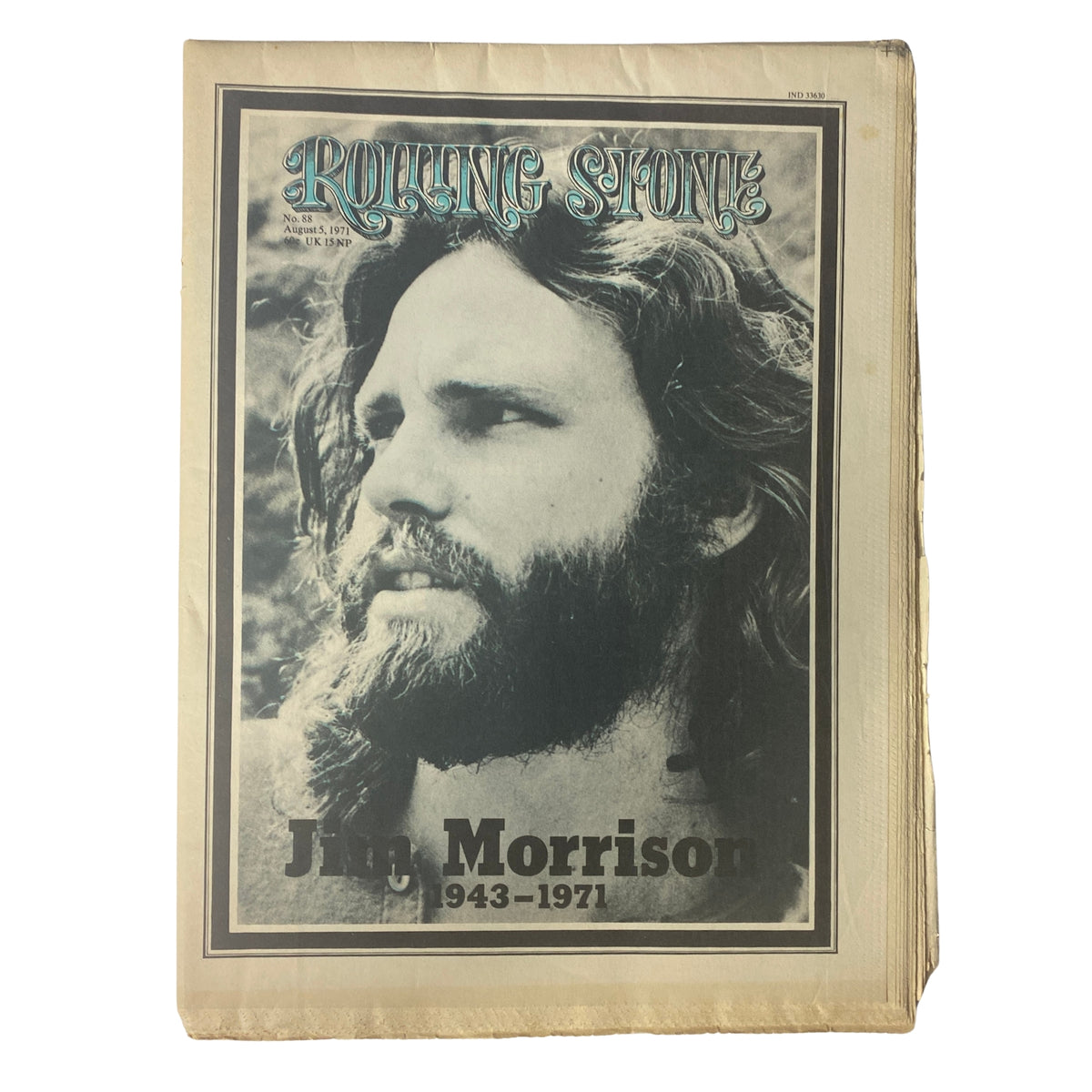
Jim Morrison died in Paris on July 3, 1971. He was 27 years old. Rolling Stone No. 88, dated August 5, 1971, is the publication's formal reckoning with that loss — a memorial issue that arrived on newsstands while the shock was still raw and the circumstances of his death remained stubbornly unclear. Ben Fong-Torres, one of the magazine's most trusted voices, authored the central piece: a detailed account of Morrison's final days in the French capital, his quiet burial at Père Lachaise Cemetery, and the deliberate privacy his wife Pamela and close friends sought to maintain around his passing. That restraint was itself a statement, a conscious contrast to the very public grief that had surrounded Janis Joplin and Jimi Hendrix in the months prior. Collectors serious about Jim Morrison's documented legacy in the press recognize this issue as the definitive contemporary account — written in real time, before mythology fully displaced fact.
The issue also carries a second significant tribute: Ralph Gleason's appreciation of Louis Armstrong, who had died just days earlier on July 6, 1971. The convergence is remarkable. Within a single summer, two of the most towering figures in twentieth-century American music were gone, and Rolling Stone No. 88 serves as an elegy for both. That dual weight gives this issue a historical density that few single editions of any publication can claim. For collectors building a serious archive of Rolling Stone's most consequential issues, this is among the essential entries — not a curiosity, but a primary document.
Morrison's cover designation — "1943–1971" — is spare and deliberate. No headlines. No sensationalism. Just the dates, framing him as a figure who now belonged to history. That editorial choice reflects where Rolling Stone stood in 1971: still young enough to feel the losses personally, already authoritative enough to shape how a generation would understand them. The summer of 1971 was, in many ways, the quiet close of the 1960s counterculture, and the magazines of 1971 document that transition with an honesty that retrospective accounts rarely match.
About the Publication
Rolling Stone was founded in San Francisco in 1967 by Jann Wenner, initially as a biweekly broadsheet aimed at an audience that took rock and roll seriously as both music and culture. By issue No. 88 in mid-1971, it had established itself as the authoritative journal of record for the rock era — not a fan magazine, but a publication with genuine journalistic ambition, capable of long-form reporting, criticism, and cultural analysis. Its writers in this period included some of the most significant music journalists of the century, and its coverage of deaths, movements, and milestones carried a weight that mainstream outlets rarely achieved on these subjects.
Key Highlights Inside
- James Douglas Morrison, Poet: Dead at 27 — Ben Fong-Torres's central feature reconstructs Morrison's last weeks in Paris, the circumstances of his death, and the private burial at Père Lachaise. The piece engages seriously with Morrison's identity as a poet and performer, and reflects on how his inner circle navigated grief outside the public eye.
- Louis Armstrong: The King of Perdido — A special appreciation by Ralph Gleason, Rolling Stone's founding critic and one of the most respected jazz writers of his generation, honoring Armstrong as the most influential trumpet player in jazz history. Armstrong had died on July 6, 1971, just weeks before this issue went to press.
- Cover tribute — The cover presents Morrison's name and lifespan — "1943–1971" — without embellishment, a deliberate editorial choice that frames him as a historical figure from the moment of publication.
- Dual elegies in a single issue — The convergence of Morrison and Armstrong tributes makes this issue an unusually concentrated document of American musical loss, capturing a singular moment when two entirely different generations of popular music confronted mortality simultaneously.
Condition & Rarity
Surviving copies of Rolling Stone No. 88 must be evaluated with the understanding that newsstand periodicals from 1971 were printed on acidic paper stock not designed for longevity. Issues that have been stored without labels — meaning they were never mailed to subscribers and avoided the moisture, adhesive damage, and address imprints that subscription copies often bear — represent a meaningfully cleaner category of survivor. The absence of a mailing label preserves the full integrity of the cover image, which matters considerably for an issue whose cover design is itself part of its historical statement. A plastic protective covering, when present on a stored copy, indicates some level of deliberate preservation effort and typically correlates with reduced exposure to humidity and light damage. For any surviving copy of this issue, collectors should examine spine integrity, page tanning, and the condition of the cover image closely, as these are the primary factors that distinguish a display-quality example from one suitable only for reading reference.
Looking for More Issues Like This?
A memorial issue of this significance is genuinely difficult to find in collector-grade condition, and examples tend to move quickly when they surface. If this particular issue is unavailable, the broader Jim Morrison magazine collection is the natural next stop — it gathers the press coverage that defined and redefined his legacy across multiple publications and years. The Rolling Stone archive at OriginalMagazines.com is also worth exploring for other landmark issues from the early era of the magazine, and the full 1971 magazine collection documents the cultural moment this issue belongs to with unusual depth and range.