
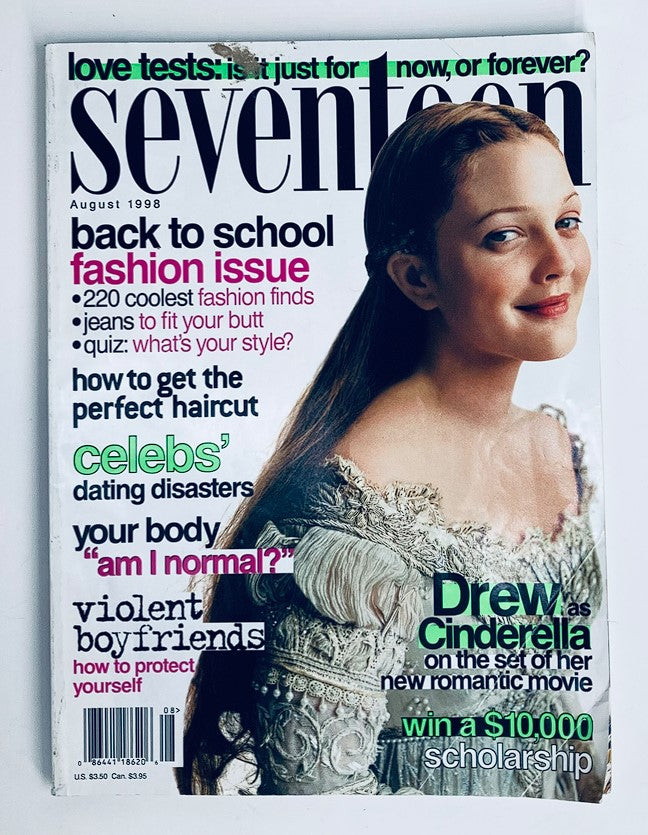


Description
Collector's Note – Why This Issue Matters
The August 1998 issue of Seventeen Magazine featuring Drew Barrymore as Cinderella is a specific and culturally precise artifact of a moment in Barrymore's career and in the broader landscape of late-1990s teen media that makes it considerably more interesting than a typical celebrity cover. By August 1998, Barrymore had completed one of the most remarkable career rehabilitations in Hollywood history — having navigated a very public childhood marked by substance abuse issues in the early 1990s into a renewed adult career that had produced the commercial breakthrough of The Wedding Singer earlier that year. She was in the early stages of establishing the romantic comedy persona that would define her mainstream commercial career through the early 2000s, and her public image was in active reconstruction as an accessible, warm, and slightly eccentric but fundamentally wholesome young woman. A Cinderella framing on a Seventeen cover in this specific context is therefore not an arbitrary fairy-tale conceit — it resonates directly with the comeback narrative that was central to how Barrymore's career was being understood and presented to the public in 1998. Collectors building a focused archive of Drew Barrymore's documented presence in magazines across the arc of her career will find the Drew Barrymore magazine collection a valuable resource for tracking how her public image was constructed and reconstructed across different publication types and career phases.
The specific editorial decision to present Barrymore as Cinderella also connects to a broader moment in late-1990s popular culture that was actively reworking fairy-tale narratives for contemporary female audiences. Ever After — the Drew Barrymore-starring Cinderella reimagining — was released in July 1998, just weeks before this August Seventeen issue would have gone on sale, and the Cinderella framing of the cover was almost certainly a direct editorial response to the film's release. This makes the cover a document not just of Barrymore's general celebrity but of her specific promotional presence in the summer of 1998, when Ever After was establishing itself as one of the summer's significant releases and when the Cinderella imagery was actively circulating in the public consciousness. A Seventeen cover produced in this specific context is a primary document of how teen media engaged with and amplified a major Hollywood release through editorial choices that met their young female readership's interests at the intersection of celebrity, fairy tale, and the romantic-comedy sensibility that defined so much of the era's popular entertainment. Collectors focused on this specific cultural moment will find that Seventeen magazine issues from the late 1990s provide unusually direct access to how teen girl culture engaged with celebrity and entertainment in this specific period.
The broader context of Seventeen's position in the teen magazine landscape of 1998 also gives this issue a specific documentary value. The publication had been a primary voice for American teenage girls since its 1944 founding, and by 1998 it was navigating the specific challenges of a media landscape that was beginning to fragment with the growth of the internet and the diversification of teen media options. Its August issues were traditionally among the most editorially significant of the year — back-to-school content, fall fashion previews, and the specific celebrity coverage that its readership was most engaged with converged in the summer issues. A Drew Barrymore Cinderella cover in August 1998 represents Seventeen deploying one of the era's most bankable young female celebrities at the publication's most commercially important editorial moment, and the resulting artifact is a document of that intersection. Collectors building a comprehensive picture of 1998 across teen media and popular culture will find that 1998 magazine issues capture a specific cultural moment at the threshold of the digital transformation that would reshape how teens consumed media in the following decade.
About the Publication
Seventeen Magazine was founded in 1944 and established itself across the following decades as the most widely read and institutionally authoritative magazine for American teenage girls, combining fashion and beauty content calibrated to its readers' age and budget with celebrity coverage, relationship advice, fiction, and the practical content that gave it utility as a regular companion through the school year. By 1998, under the ownership and editorial direction that had maintained its position as the dominant teen girl publication through multiple decades of changing youth culture, Seventeen was navigating the specific late-nineties landscape of expanding teen media options, rising celebrity culture, and the beginning of internet influence on how teenagers consumed information and entertainment. Its editorial format in this period combined the traditional fashion and beauty content with increasingly celebrity-forward cover choices that reflected the broader transformation of teen media toward entertainment journalism as its primary draw, and its covers were among the most commercially significant in the teen magazine publishing calendar.
Key Highlights Inside
- Drew Barrymore as Cinderella cover — a primary document of Barrymore's summer 1998 public presence, produced in direct editorial response to the July 1998 release of Ever After and capturing her at the specific moment of her career transition from comeback story to established romantic comedy lead.
- August 1998 publication date — the back-to-school season issue of one of the most commercially significant teen magazines in the American publishing calendar, when Seventeen traditionally deployed its most attractive celebrity cover subjects and its most comprehensive fashion and beauty editorial content of the year.
- Cinderella framing reflecting a broader late-1990s cultural moment of fairy-tale narrative reclamation for female audiences — a specific editorial choice that positioned the cover as simultaneously a celebrity profile, a film promotion, and a statement about the romantic-comedy sensibility that was defining mainstream entertainment for young women in this period.
- Style tips, beauty content, and celebrity coverage consistent with Seventeen's late-1990s editorial format — providing a complete picture of how the publication was addressing its teen girl readership at this specific cultural moment.
- Note: Specific interior article titles, additional featured celebrities, fashion editorial content, and other details beyond what is indicated by the cover and listing description are unconfirmed for this issue. The above reflects what is verifiable from the cover subject, framing, date, and the thoroughly documented cultural context of Drew Barrymore's career and the Ever After release in summer 1998.
Condition & Rarity
Excellent condition with light wear typical for age and a bright, glossy cover finish is a strong and meaningful grade for a Seventeen Magazine from August 1998 now nearly thirty years old. Excellent condition indicates a copy showing essentially no meaningful handling wear — light surface aging consistent with careful storage rather than active reading use, with overall presentation quality that reflects deliberate preservation. Teen magazines from this era were typically read actively and enthusiastically by their young audience — passed between friends, clipped for bedroom walls, and used as practical beauty and fashion guides — making well-preserved examples in genuine excellent condition a meaningful minority of surviving issues. The maintained glossy finish noted in the listing is a specific and positive condition attribute for a late-1990s Seventeen cover, as the high-gloss printing of celebrity covers from this era is particularly susceptible to surface degradation from handling and environmental exposure. The absence of a mailing label confirms newsstand origin, preserving the full surface integrity of the Barrymore cover image without adhesive damage. A protective plastic covering applied to a copy in this condition indicates ongoing preservation intent consistent with the excellent overall grade.
Looking for More Issues Like This?
Excellent-condition newsstand copies of Seventeen from August 1998 with the specific Barrymore Cinderella cover are among the more precisely sought issues in the publication's late-1990s run for collectors working at the intersection of Drew Barrymore's career documentation and the teen media culture of the era. For those tracking Barrymore's presence across publications throughout her career, the Drew Barrymore magazine collection is the most focused starting point for finding other significant issues featuring her across different publication types and career phases. The broader Seventeen magazine archive offers a wide range of issues from across the publication's history for collectors building a comprehensive picture of teen girl media, and those focused on the late nineties specifically will find the complete 1998 magazine collection a valuable resource for contextualizing this issue within the larger cultural landscape of the year it documents.