



Description
Collector's Note – Why This Issue Matters
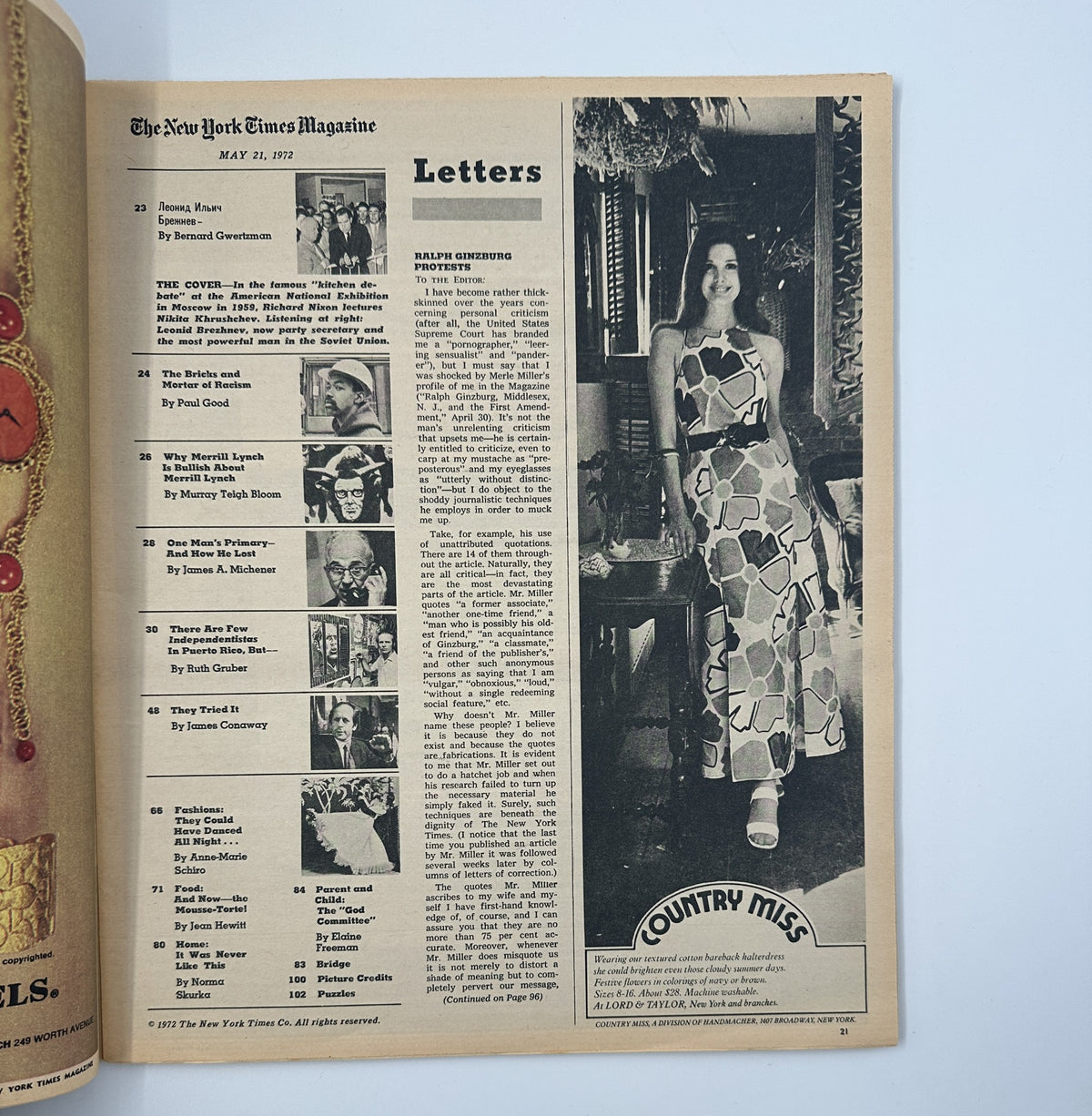
The May 21, 1972 issue of The New York Times Magazine carries one of the most historically layered cover images in the publication's long history. The photograph depicts the famous "Kitchen Debate" of July 1959 — the impromptu argument between Vice President Richard Nixon and Soviet Premier Nikita Khrushchev at the American National Exhibition in Moscow, in which the two men sparred over the relative merits of capitalism and communism while standing in a model American kitchen. The image was iconic long before this cover appeared. What makes the May 1972 usage extraordinary is the figure identified at the right of the frame: Leonid Brezhnev, present at the Kitchen Debate as a relatively junior Soviet official, now identified in the cover caption as "party secretary and the most powerful man in the Soviet Union." The cover was published just days before Nixon's historic summit with Brezhnev in Moscow — the first visit by an American president to the Soviet Union since World War II — transforming a famous Cold War photograph into a before-and-after document of thirteen years of history compressed into a single frame.
The timing could not be more deliberate or more resonant. Nixon had visited China in February 1972 in another landmark diplomatic opening, and the Moscow summit of May 1972 — during which SALT I and the Anti-Ballistic Missile Treaty would be signed — represented the culmination of his détente strategy, a fundamental restructuring of American foreign policy that sought to manage Cold War tensions through engagement rather than pure confrontation. The cover photograph of Nixon and Khrushchev in 1959, with Brezhnev listening at the edge of the frame, captures the full arc of that transformation: Nixon as a Cold War combatant in 1959, Nixon as a diplomatic architect in 1972, and Brezhnev's remarkable ascent from background witness to the Soviet Union's paramount leader. The Bernard Gwertzman profile of Brezhnev listed in the table of contents almost certainly provided Times Magazine readers with essential context for understanding the man Nixon was about to meet. Collectors interested in Nixon's extraordinary magazine presence across his political career will find related material in the Richard Nixon magazine collection at OriginalMagazines.com, while those focused on Soviet leadership will find Khrushchev's and Brezhnev's documentary footprints in the Nikita Khrushchev and Leonid Brezhnev collections respectively.
The table of contents preserved for this issue adds a second layer of documentary value that elevates it well above a typical political cover piece. James A. Michener's contribution — One Man's Primary — And How He Lost — places this issue squarely within the 1972 Democratic presidential primary season, one of the most consequential and chaotic in modern American political history, which would ultimately produce George McGovern's nomination and Nixon's landslide reelection. Paul Good's The Bricks and Mortar of Racism engages with civil rights and housing discrimination at a moment when those issues were reshaping American cities and politics. The "God Committee" piece on medical ethics and the Puerto Rico independence feature round out a table of contents that reflects the full breadth of American domestic and social debate in the spring of 1972 — making this issue a remarkably complete document of its moment, not merely its cover story. The full New York Times Magazine archive at OriginalMagazines.com and the complete 1972 magazine collection both provide essential surrounding context for collectors serious about this period.
About the Publication
The New York Times Magazine is the weekly supplement published with the Sunday edition of The New York Times, with a continuous publishing history stretching back to 1896. By 1972 it had long established itself as one of the most intellectually serious general-interest magazine platforms in the United States, reaching an educated, culturally engaged readership that included policymakers, academics, journalists, and informed general readers who expected substantive long-form journalism alongside the newspaper's daily coverage. Its cover features were carefully chosen to reflect and shape national conversations — foreign policy, domestic politics, civil rights, culture, and social change all received the kind of extended treatment that the Sunday magazine format uniquely permitted. The magazine's willingness to combine serious political journalism with cultural coverage, lifestyle features, and arts criticism in a single issue gave it an editorial range that distinguished it from both pure news publications and pure cultural magazines, making each issue a genuine cross-section of the concerns of educated American life at a given moment.
Key Highlights Inside
- Cover photograph of the 1959 "Kitchen Debate" between Richard Nixon and Nikita Khrushchev, with Leonid Brezhnev visible at right — published days before Nixon's 1972 Moscow summit with Brezhnev, transforming an iconic Cold War image into a before-and-after document of thirteen years of American-Soviet history and one of the most visually resonant covers in the magazine's publishing history.
- Леонид Ильич Брежнев by Bernard Gwertzman — a profile of the Soviet party secretary providing essential context for Nixon's upcoming Moscow summit and for understanding Brezhnev's rise from Kitchen Debate bystander to the most powerful figure in the Soviet Union.
- One Man's Primary — And How He Lost by James A. Michener — a contribution from one of America's most prominent writers situating this issue within the turbulent 1972 Democratic primary season that would ultimately produce McGovern's nomination and one of the most consequential presidential elections of the postwar era.
- The Bricks and Mortar of Racism by Paul Good — an engagement with housing discrimination and structural racism at a moment when these issues were actively reshaping American cities, politics, and the terms of the ongoing civil rights conversation.
- There Are Few Independentistas in Puerto Rico, But— by R. W. Gruber and Parent and Child: The "God Committee" by Eloise Freeman — feature pieces reflecting the magazine's characteristically wide-ranging engagement with American social and ethical questions beyond the dominant political headlines of the moment.
- Additional editorial content including Murray Teigh Bloom on Merrill Lynch, lifestyle and fashion features by Anne-Marie Schiro and Jean Hewitt, and home coverage by Norma Skurka — the full cross-section of American upper-middle-class cultural life that the Times Magazine documented alongside its more serious journalism in every issue of this era.
Condition & Rarity
Surviving copies of this issue are described as complete and in good condition, with moderate signs of age including corner creases and light surface wear — honest and appropriate attrition for a publication now more than fifty years old. The good condition designation, combined with the explicit confirmation of completeness, indicates that the full table of contents documented above remains intact, which matters considerably for an issue whose interior features — the Gwertzman Brezhnev profile, the Michener primary piece, the Good racism essay — carry as much historical significance as the cover photograph. This is not an issue whose value is purely visual; it is a document whose complete interior is part of what makes it worth preserving. Each surviving copy ships in a protective plastic sleeve, providing basic archival protection against further deterioration. When evaluating any surviving copy of this issue, collectors should prioritize the completeness of all interior pages against the documented table of contents, the legibility and surface integrity of the Kitchen Debate cover photograph, the condition of the spine and binding, and the overall level of toning — the combination of factors that determines whether a given copy fully delivers on the extraordinary documentary value this issue contains.
Looking for More Issues Like This?
A complete copy of this specific issue — with its extraordinary Kitchen Debate cover, its Brezhnev profile, its Michener primary piece, and its full table of contents intact — is a genuinely layered and difficult find, and if this one has already moved on, the search across all three of its major cover subjects is worth pursuing simultaneously. The Richard Nixon magazine collection, the Nikita Khrushchev collection, and the Leonid Brezhnev collection at OriginalMagazines.com all offer related material worth exploring. The New York Times Magazine archive and the 1972 magazines collection round out the search for anyone serious about this pivotal year in American political and diplomatic history.