



Description
Collector's Note – Why This Issue Matters
February 5, 1927 places this issue of The New Yorker in its second year of publication — and crucially, just one week after the magazine's second anniversary. Harold Ross had launched The New Yorker on February 21, 1925, and by early 1927 the publication had navigated its uncertain infancy and was consolidating the editorial and visual identity that would define it for the rest of the century. Issues from this narrow founding window are among the rarest in the magazine's entire run, not because they were produced in small numbers, but because they were read, handled, and discarded by readers who had no reason to anticipate that they were holding future collector's items. A February 1927 issue that has survived in good condition nearly a century later represents meaningful attrition from an already distant print run. Collectors assembling a serious archive through The New Yorker's original issues treat the 1926–1928 period as a categorically distinct founding tier, and second-year issues like this one sit near the top of that hierarchy.
The cover for this issue was created by Hans O. Hofmann, one of the rotating stable of illustrators who contributed to The New Yorker's early visual program under the art direction of Rea Irvin. The magazine's cover artists in this period were tasked with projecting a specific and carefully calibrated tone — urbane, witty, observational, and light without being trivial — that distinguished The New Yorker's exterior identity from every other American periodical of the 1920s. Hofmann's whimsical and lighthearted style, as described, places his work squarely within that register: the Roaring Twenties sensibility of a New York that was prosperous, socially energetic, and self-consciously stylish. A February issue in 1927 would have addressed the social rhythms of a New York winter, and the cover art of this period consistently translated the magazine's seasonal and cultural context into elegant, playful imagery that has aged remarkably well as a record of the decade's visual confidence. For researchers tracing the early development of American magazine illustration through original magazines from 1927, this issue offers a representative example of the visual language The New Yorker was developing in real time.
The broader significance of a February 1927 New Yorker extends beyond illustration history. The magazine in this period was actively attracting the writers — E.B. White had joined the previous year, James Thurber would arrive in 1927 — who would define its literary voice for the following decades. Each issue from this founding generation is therefore a document of that larger creative project at one of its most generative early stages, with a cover program that was simultaneously establishing a visual standard and a readership expectation that would carry the magazine through the rest of the twentieth century and beyond.
About the Publication
The New Yorker was founded by Harold Ross and first published on February 21, 1925, with financial backing from Raoul Fleischmann. From its earliest issues it cultivated a sophisticated urban readership — self-consciously cosmopolitan, literate, and attuned to the cultural life of New York and the broader American intelligentsia. By February 1927 it had established its core editorial identity: a blend of humor, fiction, criticism, and long-form journalism wrapped in cover art that treated illustration as a serious visual form rather than mere decoration. The magazine's early cover program, overseen by founding art editor Rea Irvin, helped establish visual standards that made The New Yorker's covers among the most recognized and collected in American periodical history.
Key Highlights Inside
- Hans O. Hofmann Cover Illustration: The cover art reflects the whimsical, socially observational illustrative tradition that The New Yorker's early art direction cultivated — lighthearted in tone, precise in execution, and representative of the visual language the magazine was developing during its founding years under Rea Irvin's oversight.
- Second Year of Publication: This issue appears in The New Yorker's second full year of existence, placing it within the founding generation of a publication that would shape American literary journalism for the following century. Very few issues from this early in the magazine's run survive in collectible condition.
- Post-Anniversary Issue: Published just two weeks after the magazine's second anniversary, this February 1927 issue captures The New Yorker at a moment of early consolidation — past the survival uncertainty of its first year, actively building toward the editorial confidence of its mature voice.
- Roaring Twenties New York Context: The February 1927 editorial environment reflects mid-decade Jazz Age New York at the height of its cultural and economic confidence, more than two years before the crash that would transform both the city and the magazine's tone.
- Complete Issue: The listing confirms this as a complete magazine — a meaningful attribute for a nearly hundred-year-old publication, where partial copies occasionally circulate and completeness should not be assumed.
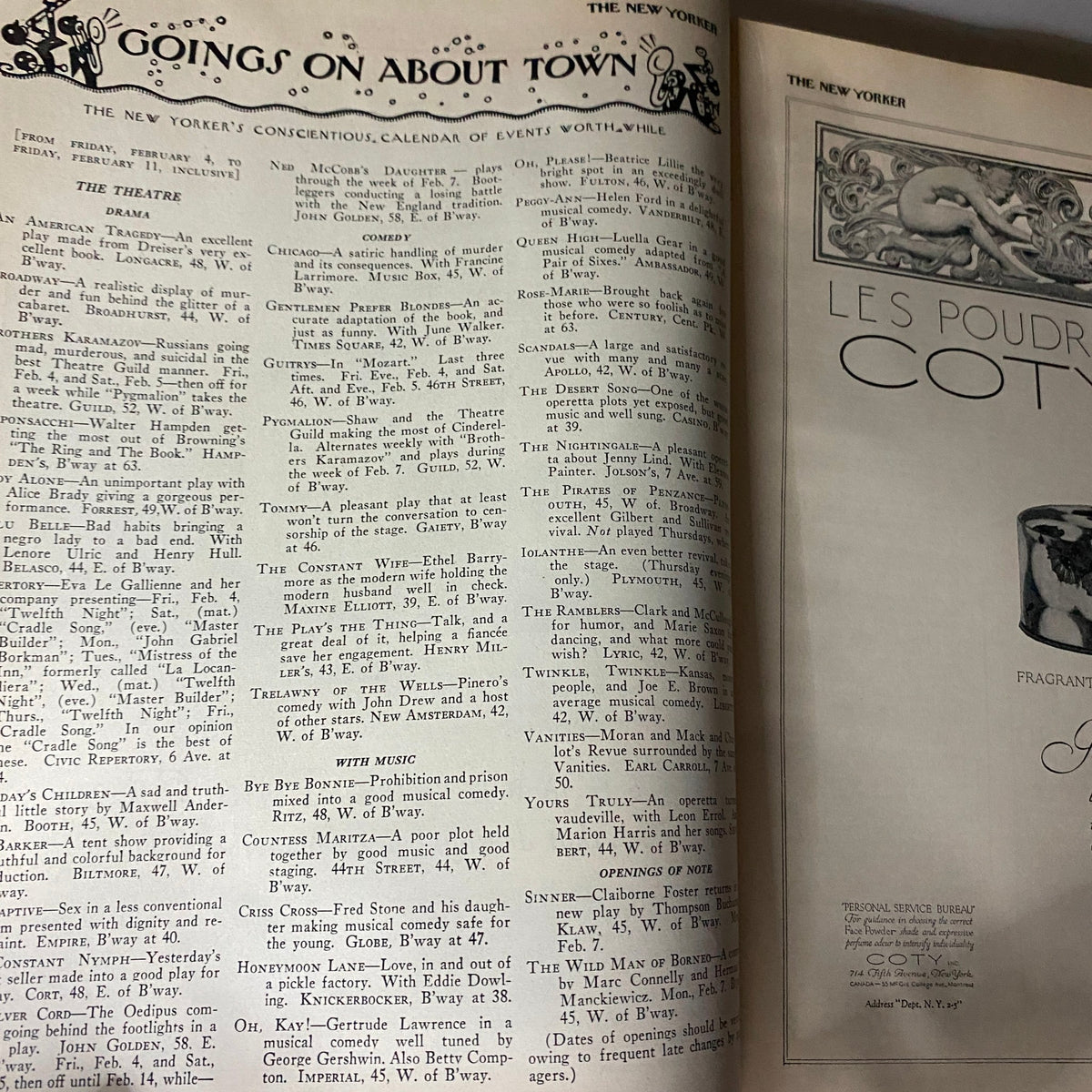
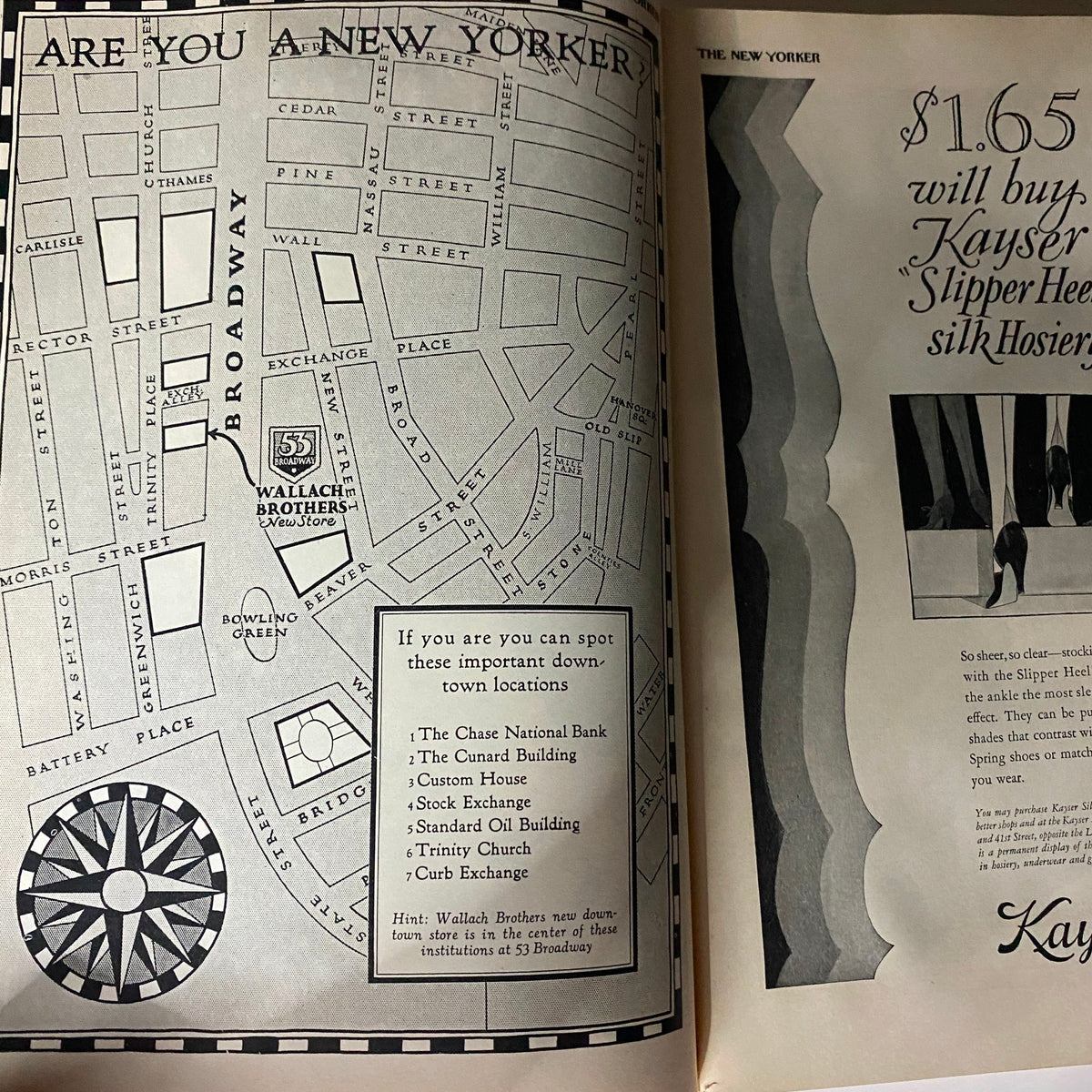
- Interior Content: Specific articles, fiction, and additional features within this issue are not confirmed from available listing information. Collectors seeking a full table of contents are encouraged to cross-reference with New Yorker digital archives or periodical databases indexing the magazine's 1927 run.
Condition & Rarity
Good condition on a magazine from February 1927 represents exceptional survivorship for paper stock now approaching a century in age. The New Yorker of the late 1920s was printed on quality coated stock appropriate to a premium periodical of the era — meaningfully better than newsprint, but not remotely archival by modern standards — and the compound effects of nearly a hundred years of environmental exposure, light, humidity, and handling present significant attrition challenges for any surviving copy. The listing does not specify label presence or absence, so cover surface condition should be assessed directly from available photographs, with particular attention to the Hofmann cover illustration, which serves as both the primary aesthetic value and the main visual identification marker for this specific issue. Spine integrity and interior page cohesion are equally important evaluation points at this age, as binding degradation is among the most common condition failures in pre-Depression magazine survivorship. When assessing any surviving copy of the February 5, 1927 New Yorker, collectors should approach honest age-related wear as inherent to the vintage rather than a condition deficiency, and prioritize cover image clarity, structural completeness, and interior page integrity as the primary grading criteria.
Looking for More Issues Like This?
Second-year New Yorker issues from 1927 are among the most deliberately pursued items in American periodical collecting, and complete copies in good condition appear infrequently enough that serious collectors move quickly when they surface. If this issue is currently unavailable, the New Yorker collection at OriginalMagazines.com is the most comprehensive place to explore original issues from across the magazine's extraordinary run. Collectors drawn to the visual culture and literary energy of the Jazz Age will also find the 1927 magazine collection a rich source of primary documents from one of the most creatively charged years of the decade.