


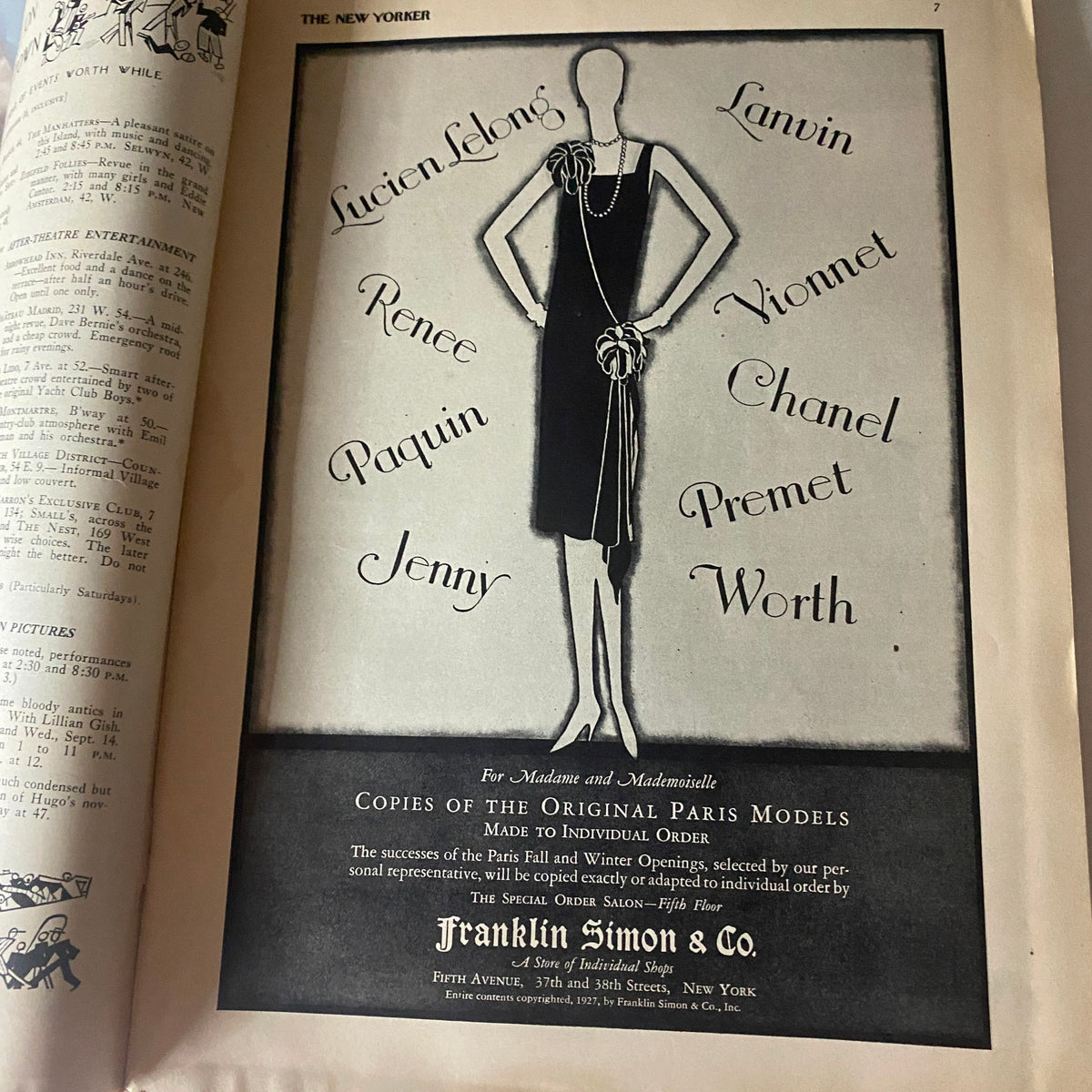


Description
Collector's Note – Why This Issue Matters
The September 10, 1927 issue of The New Yorker arrives from one of the most electrically charged years in American cultural history. Nineteen twenty-seven was the year Charles Lindbergh crossed the Atlantic, the year Babe Ruth hit sixty home runs, the year the Jazz Age reached what many historians regard as its creative and social peak. The New Yorker itself was only two and a half years old — Harold Ross had founded it in February 1925 — and the magazine was still in the process of defining its voice and establishing the editorial identity that would eventually make it the most influential literary magazine in the English language. Issues from this founding period are primary documents in that story, and collectors who specialize in early New Yorker material understand that the magazine of 1927 is a genuinely different object, editorially and visually, from the institution it would later become. The New Yorker magazine archive at OriginalMagazines.com spans the full run of the publication, but issues from this earliest stratum are among the most historically significant in the entire collection.
The cover is the work of Theodore Haupt, one of the rotating stable of artists who defined The New Yorker's visual identity in its first decade. Haupt contributed covers to the magazine during the late 1920s and is associated with the modernist sensibility that Ross and art editor Rea Irvin were cultivating — an American adaptation of European Art Deco and modernist graphic design that was sophisticated without being academic, witty without being cheap. The bold geometric composition and vibrant color palette described for this cover are consistent with the visual language The New Yorker was developing as its signature: crisp, cosmopolitan, and distinctly urban. For collectors of 1920s American graphic art and illustration, the magazine's covers from this period are serious objects. Those interested in exploring the broader cultural output of this remarkable year will find the 1927 magazine archive at OriginalMagazines.com an invaluable resource across multiple publications and genres.
It is also worth situating this issue within The New Yorker's own institutional timeline. By September 1927, the magazine had survived its shaky first year and was finding its financial footing, but it had not yet achieved the cultural dominance it would reach by the 1930s. The contributors appearing in its pages during this period included figures who were then emerging and are now canonical — writers and cartoonists whose early work in these issues represents their formative published output. A surviving complete issue from September 1927 is therefore not simply a period artifact; it is an archival document from the magazine's foundational era, before the mythology had fully solidified.
About the Publication
The New Yorker was founded in New York City in 1925 by editor Harold Ross, with backing from Raoul Fleischmann, and was conceived from the outset as a sophisticated weekly for urban, educated readers — Ross famously and somewhat misleadingly declared it was "not edited for the old lady in Dubuque." In its early years the magazine mixed humor, criticism, fiction, poetry, and what would later be called long-form journalism, and it distinguished itself visually through a consistent investment in original cover art and interior illustration. By 1927 it was publishing a rotating roster of writers and artists who were actively shaping American literary and visual culture, and its weekly covers — each a standalone commissioned artwork — had already become one of its most recognized features. The magazine was published weekly and sold primarily on newsstands and through subscription in the northeastern United States, though its cultural reach extended considerably further.
Key Highlights Inside
- Cover art by Theodore Haupt, featuring bold geometric shapes and a vibrant color palette consistent with the modernist and Art Deco visual language The New Yorker was developing in its early years.
- Editorial content representative of The New Yorker's 1927 format, which typically included humor pieces, cultural criticism, short fiction, poetry, and the "Talk of the Town" section that was already a signature feature of the magazine.
- Period advertising pages reflecting the commercial culture of late-1920s New York — themselves a primary-source document of the consumer landscape of the Jazz Age at its height.
- Interior illustrations by the broader stable of artists contributing to The New Yorker in this period, whose work collectively defined the magazine's visual identity during its founding era.
- Note: Specific article titles, bylines, and interior features for this exact issue are not confirmed in available listing details. The above reflects what is verifiable from the cover, publication history, and documented editorial format of the period.
Condition & Rarity
Early New Yorker issues from the magazine's first decade present unique preservation challenges. The paper stock used in the late 1920s is heavier and more durable than the newsprint of mass-market contemporaries, but nearly a century of potential exposure to light, humidity, and handling takes an inevitable toll. Minor wear consistent with age — the condition noted for this issue — is an honest and expected descriptor for any surviving copy from 1927, and in collector grading terms it places the issue in a range that acknowledges its antiquity without suggesting significant damage. Key evaluation points for issues of this vintage include the integrity of the cover art (color retention, absence of tears or significant creasing), the completeness of the interior page block, and the stability of the spine binding. Complete, unrestored issues from The New Yorker's 1925–1930 founding period are genuinely uncommon in any condition; the print runs of the era were modest by later standards, institutional archiving of periodicals was inconsistent, and nearly a hundred years of attrition have thinned the surviving population considerably.
Looking for More Issues Like This?
Finding a complete, well-preserved New Yorker from 1927 is a slow hunt under any circumstances — these early issues don't surface often, and when they do, condition varies widely. The New Yorker collection at OriginalMagazines.com is one of the deepest available sources for the magazine across its full publishing history, and it's worth browsing regularly for issues from this founding era. For collectors drawn specifically to the cultural richness of the late 1920s across multiple publications, the 1927 magazine archive offers a broader view of what American print culture looked like in that extraordinary year.