
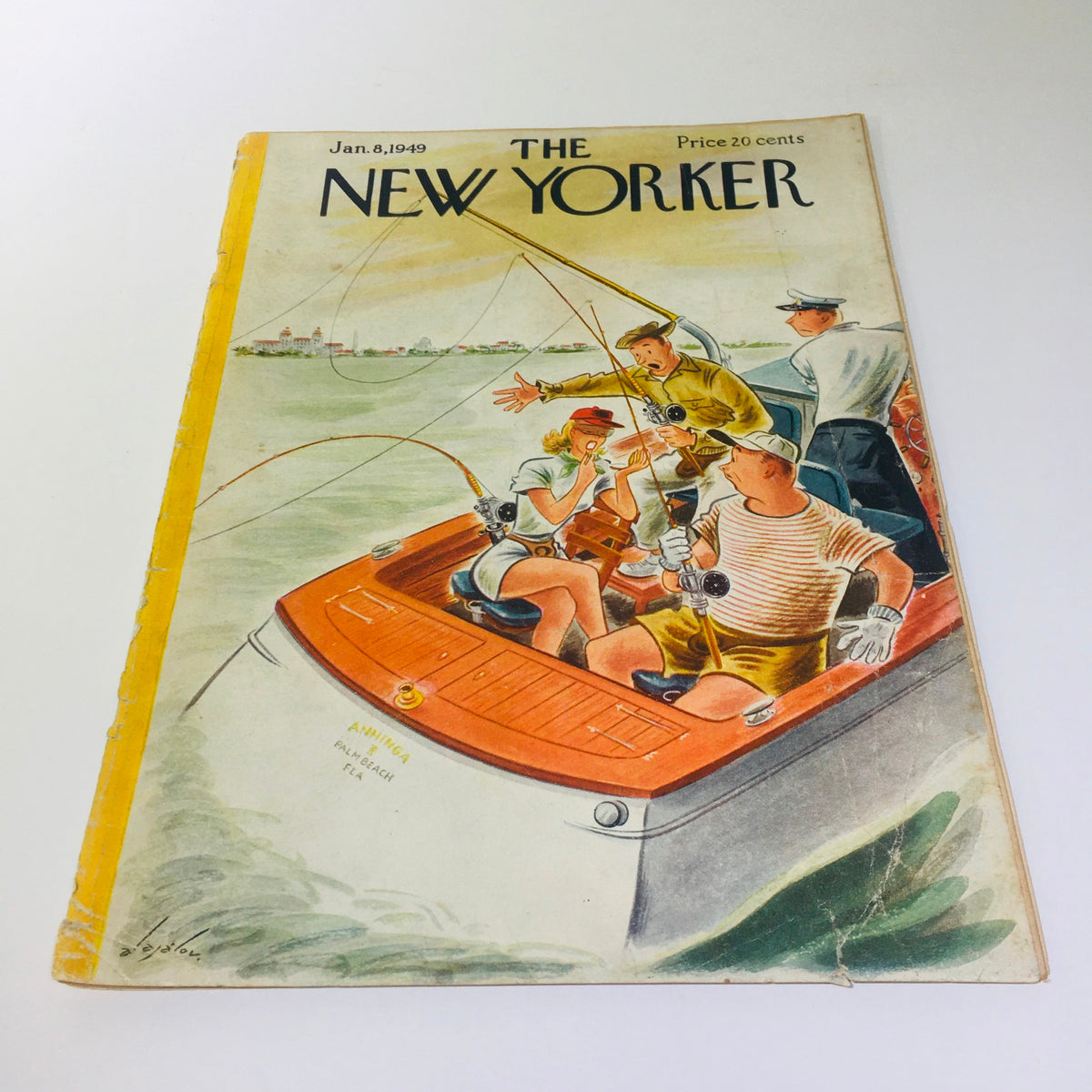

Description
Collector's Note – Why This Issue Matters
The January 8, 1949 issue of The New Yorker with a cover by Constantin Alajalov arrives at a specific and historically interesting moment in both the magazine's history and in postwar American cultural life. January 1949 marks the opening of a year that would prove consequential: NATO was being negotiated into existence, the Berlin Blockade was still in effect, and the first full year of the Cold War as a settled geopolitical condition was underway. The New Yorker's first issue of 1949 — with a cover by one of its most consistently employed illustrators of the mid-twentieth century — represents the magazine resuming its peacetime editorial rhythm after years of wartime adjustment, with the particular confidence of a publication that had emerged from the 1940s with its literary and cultural authority considerably enhanced. Alajalov's covers for the magazine during this period were typically social comedies — gently satirical observations of New York and American bourgeois life rendered with warmth and visual elegance — and a January cover in his style would have set the tone for a new year with the kind of knowing, affectionate wit that defined the magazine's relationship with its readership. Collectors who pursue vintage New Yorker issues from the late 1940s will find that the postwar years represent the magazine in one of its most creatively distinguished periods, publishing writers and illustrators at the peak of their powers in a cultural moment that valued exactly the qualities The New Yorker had always cultivated.
Constantin Alajalov deserves specific attention as a cover artist. Born in Russia in 1900 and arriving in the United States in the early 1920s, he became one of The New Yorker's most prolific cover contributors from the late 1920s through the 1960s, producing more than 100 covers for the magazine over that span. His style — elegant figure work, sophisticated color, and a gift for social observation that translated complex social dynamics into a single image — was perfectly suited to the magazine's editorial identity, and his covers from the late 1940s are considered among the finest in his body of work. A January 1949 Alajalov cover represents a specific moment in his mature period, when his technique was fully developed and his understanding of the magazine's visual language was at its most sophisticated. For collectors and researchers interested in mid-century American illustration and magazine art, his New Yorker covers are primary documents of the form, and the 1949 magazine archive places this issue within the broader postwar cultural landscape that shaped his subject matter.
The first issue of any year in The New Yorker's run carries a particular collector's interest as a temporal document — the magazine's choice of cover artist and cover subject for its first publication of a new year reflects its editorial sense of what the moment called for. January 8, 1949 is the magazine's opening statement for a year that would see the establishment of NATO, the Communist victory in China, and the Soviet Union's first nuclear test. Whatever Alajalov's cover depicted — the listing does not specify the image's subject matter — it was the visual note on which The New Yorker chose to begin 1949, and that editorial judgment is itself a document of the magazine's relationship with its cultural moment.
About the Publication
The New Yorker, founded by Harold Ross in 1925, had by 1949 established itself as the preeminent American literary and cultural magazine, publishing fiction, poetry, criticism, reportage, and humor alongside its celebrated cover art and internal cartoons. The late 1940s were one of the most distinguished periods in the magazine's history: Ross's editorial vision had been refined over two decades, the roster of writers and illustrators was extraordinary, and the magazine's wartime journalism — including John Hersey's "Hiroshima," published in 1946 — had demonstrated that it could operate at the highest levels of literary journalism as well as cultural commentary. Its readership was educated, urban, and culturally engaged, and its weekly covers — produced by a rotating group of commissioned illustrators — had become one of the most recognized visual series in American publishing. Alajalov was one of the central figures in that cover tradition throughout the mid-twentieth century.
Key Highlights Inside
- Cover art by Constantin Alajalov — A contribution from one of The New Yorker's most prolific and accomplished cover artists of the mid-twentieth century, working in his mature period during one of the magazine's most distinguished editorial eras.
- First issue of 1949 — The magazine's opening publication of a year that would prove consequential in postwar American and global history, representing the editorial judgment about tone and subject with which The New Yorker chose to begin that year.
- Late 1940s literary and cultural content — A late-Ross-era issue of the magazine at one of its most creatively distinguished periods, with the full range of fiction, criticism, humor, and reporting that defined the publication's identity in the immediate postwar years.
Note: Specific interior article, fiction, and feature details beyond the cover attribution are not confirmed in the available listing information. The photographs accompanying the original listing are the most reliable reference for full content details.
Condition & Rarity
Surviving copies of this issue graded Good with a loose binding and minor wear across pages represent an honest collector grade for a seventy-five-year-old weekly magazine that has passed through active readership and storage. The New Yorker in 1949 was printed on standard newsprint and coated stock combination typical of weekly general-interest publications of the era, and copies of this age will show the expected characteristics of that paper stock — light to moderate toning at page edges, possible brittleness at page margins, and surface aging on the coated cover. A loose binding indicates stress or partial failure at the saddle-stitch staple points, which is a common condition attribute for weekly magazines of this vintage that were frequently consulted or stored without support. The listing notes this issue does not come with a plastic protective sleeve, which means current storage conditions should be assessed carefully by any collector taking possession. For any surviving copy of this issue, the condition of the Alajalov cover art — its color fidelity, surface clarity, and freedom from moisture damage or significant abrasion — is the primary collector evaluation variable, given the cover's status as the defining visual and documentary asset of this particular number.
Looking for More Issues Like This?
Late 1940s New Yorker issues with covers by major mid-century illustrators like Alajalov are among the most visually and historically distinguished entries in the magazine's postwar run, and copies in Good or better condition from this period take real patience to find at seventy-five years of age. The full New Yorker archive at OriginalMagazines.com is the most comprehensive place to browse what's currently available across the publication's history, including other notable cover art issues from the Alajalov era. For collectors building a broader picture of American cultural and political life in the first full postwar year, the 1949 magazine archive brings together issues from multiple titles that together document this transitional and consequential moment in American history.